Australia
December 28, 2005
Santa Fe, New Mexico: We are enjoying our last few weeks in our Sangre de Cristos mountain retreat before returning to Australia at the end of January, 2006. Our
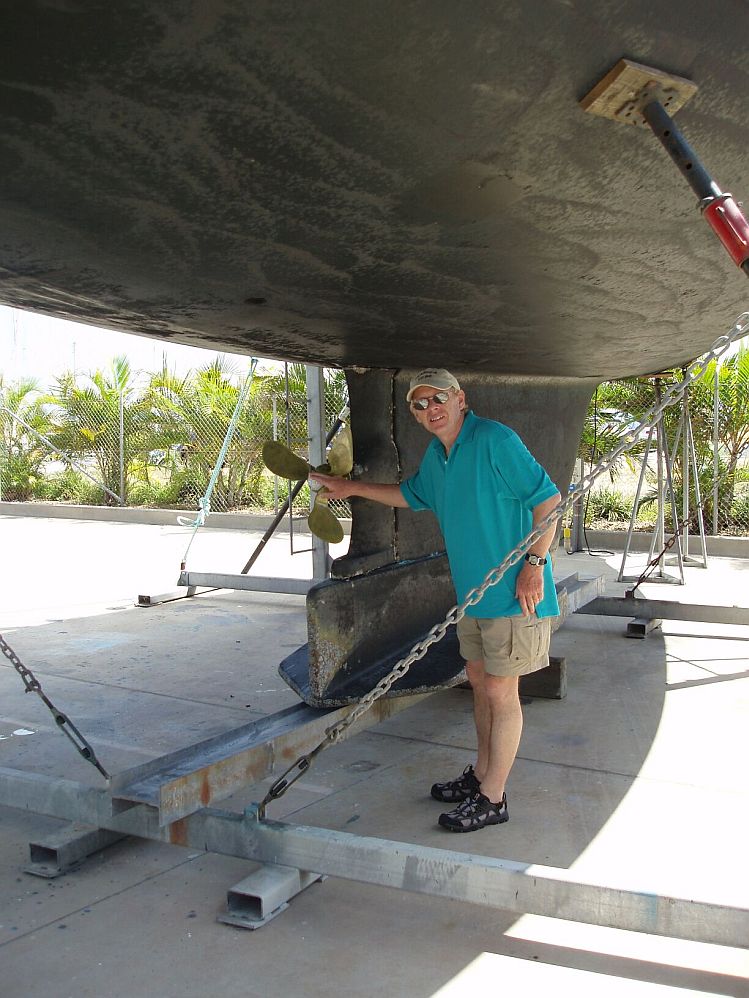
plan is to go "walkabout" in Eastern Australia for a month or so and then re-launch DoodleBug by mid-March.
Several friends have commented that our 2005 cruise was fairly tame compared with our 2004 experiences. It is true that we had no broken bones in 2005, no groundings
and no night entrances through unknown reef passages. Those are adventures that we are quite willing to forego.....
We wish everyone a Happy New Year.
February 5, 2006
Sunday morning Bundaberg: We arrived safely in Brisbane on Friday morning. The flight was mostly uneventful.
Of course Annette had a problem at Albuquerque security, where they discovered her knife in her purse. Fortunately we knew the drill, since this is not the
first time she has done this. (One memorable occasion in San Diego involved a machete in her hand luggage). She returned to Southwest Airlines check-in and
they slipped the offending article into one of our a suitcases. The next alarm was transferring terminals in Los Angeles. We had to take a shuttle bus and
after I had loaded four of fifty pound suitcases, the driver closed the bus doors. I looked around and Annette was nowhere to be seen. She was dutifully returning the baggage trolley to one of
the prescribed return locations, instead of just leaving it on the sidewalk as most folks do. I began yelling at the driver to stop and Annette was pounding on
the door but the driver must have been a recent Katrina evacuee, as she ignored both of us. Fortunately the L.A. traffic intervened and forced the bus to halt.
I retrieved my wife and we all set off again.
Our Brisbane arrival was early morning and after picking up a rental car we headed for the Brisbane City Marina, to see if we could locate SV Freewind. Both
Freewind and crew were at the dock and were able to visit and enjoy

 a late breakfast together at a nearby cafe. We bade farewell to Freewind and headed north up the coastal highway as far as Gympie. Here the effects of jet lag began
to be felt, so we checked ourselves into the "Muster Inn", where we found showers, air-conditioning, and beer in the fridge.
a late breakfast together at a nearby cafe. We bade farewell to Freewind and headed north up the coastal highway as far as Gympie. Here the effects of jet lag began
to be felt, so we checked ourselves into the "Muster Inn", where we found showers, air-conditioning, and beer in the fridge.
Refreshed by an 11 hour sleep we made an early start for Bundaberg. This is possible since we were in bed by 4:00 p.m. the previous day. The drive north was very pleasant
with clear skies and light traffic. We spotted a large kangaroo, on the opposite side of the freeway and stopped to take a photograph. He hopped away but the
experience brought home to us, we are REALLY BACK IN AUSTRALIA!!
Doodlebug was sitting just where we left her and all seems well on board. We have unloaded our luggage,


 repacked for a month or so "walk-about" and will sort out our financial obligations with the marina people when they open for business on
Monday. Today we will head over to the railway station and find out about trains to Melbourne. This sounds like more fun than flying but we believe the trip may
be 30 hours or so from Brisbane.
repacked for a month or so "walk-about" and will sort out our financial obligations with the marina people when they open for business on
Monday. Today we will head over to the railway station and find out about trains to Melbourne. This sounds like more fun than flying but we believe the trip may
be 30 hours or so from Brisbane.
February 6, 2006
Today was a busy day as it was the first "work" day (Monday) since we have been back in Australia. The marina offices were open and we have arranged
for DoodleBug to be relaunched on March 13th. We ran the engine and generator to make sure they started and we also checked the fluid level in the
batteries. We have nine of these and they were installed "new" about ten months ago in New Zealand. Unlike the batteries they replaced, these are not
"sealed for life" and require the now old fashioned practice of adding distilled water occasionally. When we checked them, the fluid level was
dangerously low and the eight batteries that have been "trickle charged" since we left, required a liter each of distilled water added. By
the time we had finished this task, we were hot, sweaty, dirty and badly needed a beer. How easily we are transformed from tourists to sailors!
We had carried many of the hard to get spare parts with us from the USA and took this opportunity to stock up on the remainder of our needed spares from the
marina chandlery. We needed to resupply our stock of Racor diesel fuel filters and expected to find them in stock at the marina. We were mildly
surprised that they have had to be ordered from outside of Australia and we were particularly gratified that we had ordered these so far in advance of our
departure. As it is, it may be touch and go as to whether we receive them in time.
February 7, 2006
This morning we checked out of our motel and drove over to the marina to close up DoodleBug until we return in March. It was just light as we drove
along the quiet lane behind the motel. We noticed "things" moving on the road and were amazed to see that the road surface was covered in cane
toads. They were all sizes from tiny, up to about eight inches long. Their defense mechanism seems to be that they "freeze" so that you can't see
them. Not a really smart evolutionary response to an automobile. We zigzagged through this maze of amphibian targets as best we could and were hopeful that we
were unobserved by law enforcement personnel, lest they thought we were driving drunk.
The next close encounter was with a pair of rabbits. They were the biggest rabbits I have ever seen and looked like small deer. Annette thought you could feed a
family off just one, if you hunted them. No, they weren't kangaroos! No long tail.
Bundaberg is a sugar cane growing area and we have been noticing some similarities and some differences with the other sugar cane growing countries we have
visited - such as Fiji. Both Fiji and Australia use a small gauge railway, in order to transport the cut cane to the processing mill. The rails criss-cross
the fields and highways in a network. The most striking difference is that Fiji was covered in haze from burning the cane stubble after harvest and this is
reported as a year around phenomenon - the cane harvest is not seasonal there. We saw sprinklers irrigating the cane and surmised that the clean, clear
atmosphere in Australia, meant that here, the cane stubble is not burnt. As we drove on, we saw our theory confirmed, by observing tractors plowing
or disking the stubble and leaving the rich, reddish and almost chocolate brown earth exposed.
We drove south to Brisbane this morning - a very pleasant drive through lightly populated farmland with the occasional small town and little
traffic on the two lane coastal highway, that encircles Australia. We did find a
 freshly killed kangaroo that occupied most of the width of the lane we were in and reminded us of one of the several hazards of Australian driving -
both for the driver and the kangaroo, apparently. It was even bigger than the rabbits. We stopped for breakfast in Maryborough. A sign outside the town
hall proudly announced that Maryborough was the birthplace of author P.L. Travers. He wrote "Mary Poppins" in 1899. We had noticed a few road
signs adorned with little pictures of flying ladies holding umbrellas. All was now explained. Nothing to do with the sugar cane sprinklers.
freshly killed kangaroo that occupied most of the width of the lane we were in and reminded us of one of the several hazards of Australian driving -
both for the driver and the kangaroo, apparently. It was even bigger than the rabbits. We stopped for breakfast in Maryborough. A sign outside the town
hall proudly announced that Maryborough was the birthplace of author P.L. Travers. He wrote "Mary Poppins" in 1899. We had noticed a few road
signs adorned with little pictures of flying ladies holding umbrellas. All was now explained. Nothing to do with the sugar cane sprinklers.
The drive to Brisbane was about four hours and we entertained ourselves by listening to local talk radio. The hot topic of the day was the refusal by the Brisbane
railway company, to allow bicycles on the trains during the morning and evening rush hours. One listener called in to insist that this was a "social
justice issue". Visions of massed bicycles facing down snarling police dogs and railway workers with fire-hoses danced across my imagination.
Last night was the first time we managed to stay awake until 10:30 p.m. We ate supper at a Turkish restaurant
 with a Brisbane couple - Ray and Jody. We met Ray and Jody in 2004 on Rapa Nui (Easter Island) where they were on honeymoon and
staying at the same hotel as we were. They are now expecting their first child in July.
with a Brisbane couple - Ray and Jody. We met Ray and Jody in 2004 on Rapa Nui (Easter Island) where they were on honeymoon and
staying at the same hotel as we were. They are now expecting their first child in July.
February 8, 2006
Brisbane is a city of about 1.3 million people and like most of the major towns on the East coast of Australia, straddles a river. The Brisbane river meanders through
town and most of the streets seem to meander in a similar manner. If ancient London's roads followed ancient cow trails, then modern Brisbane seems
based upon kangaroo trails. The upshot is a very interesting and attractive look to the city but murder for poor tourists trying to navigate the streets.
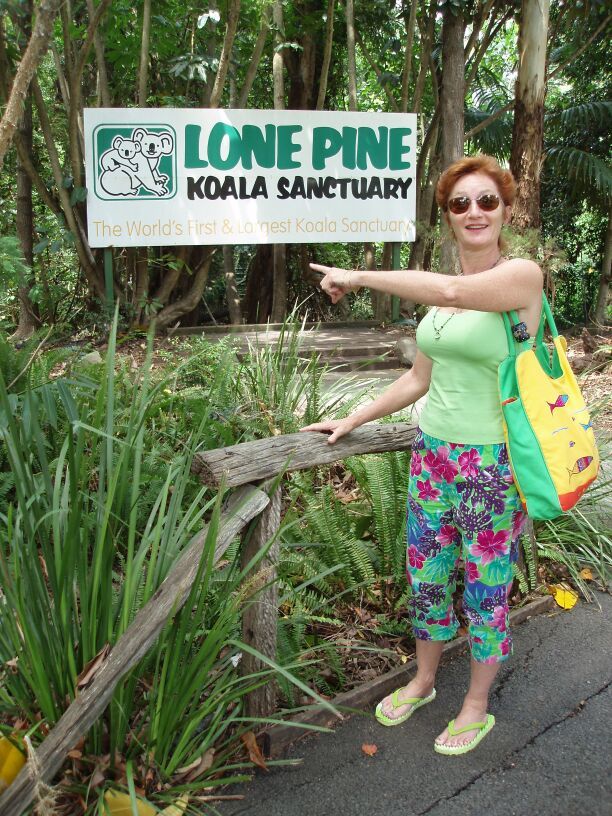
We visited the Lone Pine Koala sanctuary in the morning. The sanctuary has exhibits of Aussie animals such as wombats, kangaroos, koalas, emus, dingoes, reptiles,
birds etc. Annette got to hold and cuddle a koala - a bit like holding a slowly moving teddy-bear.


She thoroughly enjoyed the experience despite the animals incredibly sharp claws on its forelegs. If the koala ever properly woke
up, it could do some damage. Their peculiar metabolism, adapted for a diet of eucalyptus shoots, causes them to sleep between 18 and 20 hours per day. The
other big hit of the day was hand feeding the kangaroos. The sanctuary has about 130 of these in a large paddock and they can be hand fed some kind of
kangaroo chow pellets. They are amazingly gentle animals and patiently waited their turn to be fed.
Later that afternoon we met Frank and Jan on Freewind for a tour of the XXXX Brewery ("XXXX" is the way Australians spell "beer"). The brewery
was a huge establishment and as an aficionado of brewery tours, I can state that this was one of the better tours I have been on. Most of these tend to be a
quick sprint through the plant in order to arrive at the brewery bar as soon as possible to begin sampling. The brewery provides its product in bottles,
cans, and aluminum kegs. It also provides a single customer - the Breakfast Creek Hotel -

 with beer in wooden casks. This was our next stop for supper. The guide book recommended the steaks and we followed this advice. We also sampled
the XXXX Bitter from the "wood" - just for a scientific comparison with the earlier samples from the brewery, you understand...
with beer in wooden casks. This was our next stop for supper. The guide book recommended the steaks and we followed this advice. We also sampled
the XXXX Bitter from the "wood" - just for a scientific comparison with the earlier samples from the brewery, you understand...
February 9, 2006 thru February 13, 2006
Thursday morning we headed to downtown Brisbane to look for a nautical bookshop. The downtown area has lots of small specialty shops, as well as department stores,
restaurants, and crowded malls. We found the bookshop we sought and although they had a huge array of cool books on every maritime subject
imaginable, we were reluctant to load up just before we got on a flight. We did order some Mediterranean cruising guides for pickup when we return by auto
in three or four weeks time. Next stop was a high end jewelry shop selling opals. Australia is the place to buy opals and we needed educating as to
what was what. We received a mini-lecture from the sales girl about the different types of opal, coloring, substrates, how they are mined, prepared, set
in mountings etc. I found a nice, small opal amongst the "loose" stones for about $15,000. No, I didn't buy it! Are you
kidding? Real money for a polished pebble?!
We flew to Melbourne that afternoon and discovered that Melbourne had just switched from an unseasonably hot

 spell to the coldest day of the year - the day we arrived of course. Friday morning we traveled downtown and visited the
Melbourne museum. The museum was interesting but not one of the best we have seen. There was an IMAX theatre attached to the museum and we watched sharks in
3-D. They are not nearly as frightening when watched from the comfort of a theatre seat. That evening we traveled to the southeastern suburbs of the city
to stay with my cousin David and his family.
spell to the coldest day of the year - the day we arrived of course. Friday morning we traveled downtown and visited the
Melbourne museum. The museum was interesting but not one of the best we have seen. There was an IMAX theatre attached to the museum and we watched sharks in
3-D. They are not nearly as frightening when watched from the comfort of a theatre seat. That evening we traveled to the southeastern suburbs of the city
to stay with my cousin David and his family.
Melbourne is Australia's second largest city, sitting on the Yarra River with a population
of around 3 million - similar to Houston, Texas. It is spread out by Australian standards but not as much by US standards. David and his family have
been living here in the southeastern suburbs for about twenty years now. He is a doctor and has his practice nearby. His wife Kathie also works in the medical
field as an X-Ray nurse in a local hospital. We last met David in Houston in 1986. At the time Kathie was his fiancée and we did not meet her. In
the past years they have produced two delightful children -son Aidan and daughter Fiona. On Saturday they took us on a tour up Dandenong Mountain where
we could get a spectacular view of the Yarra valley with downtown Melbourne in the distance. The early settlers had stripped the native vegetation and replaced
it with vegetation from England. The drive up to the lookout was very pleasant, with tree-lined winding lanes, through pastures and farm-land and looked
.......just like England. The Dandenong Mountain overlook had a nature walk and a restaurant. Any trees that we could not identify as imports, I confidently
identified as a "variety of eucalyptus". That evening David and Kathie fixed a delicious barbeque, while talented Fiona entertained us by
playing classical guitar.


Sunday we toured downtown Melbourne beginning with lunch at an upscale Chinese restaurant "Bokchoy Tang". (Similar to P.F. Chang). We rode the trams
around the city and almost lost Annette on the first tram when it started. Nobody had told her to hold on tight (same problem as the broken ribs
incident in 2004!). The trams are boggling for the visiting tourist. They run on tracks down the middle of the street with automobile lanes on either side.
The traffic is supposed to stop when a tram stops - sort of like the school bus rule in the USA. Remember now, we are driving on the left side of the road.
To make a right turn at a stop light, you must pull over to the LEFT side of the road and wait with your right indicator going, while the straight
ahead traffic passes you on your right. When the light changes to red (and green on the cross street) then you make the turn. As you are sitting on
the left side of the road with the right indicator flashing, you are also holding up traffic - who actually want to turn left, so they have their
left indicator flashing. Utterly mind boggling. I am sure that the crew of DoodleBug left a wake of angry Melbourne drivers, when we drove through on
Friday.


Next stop was the observation deck on the 55th floor of the "Rialto Towers" office building. The day was clear and sunny and you could see
right across the Yarra valley in one direction with Port Phillip Bay to the Bass Straits in the other direction. The River Yarra was laid out below us,
with all its bridges, marinas, and wharfs. We could see sailing vessels scattered like dandelion seeds across the blue of Phillips Bay. A great finale
to a very pleasant day.


Monday we left Melbourne and drove south to Phillip Island on the Bass Strait. Phillip Island is connected to the mainland by a bridge and is the home to a colony of
"Fairy" Penguins. They are the smallest known breed of penguin and about a thousand or so live in burrows on the western tip of the island. During
the day we visited the sights such as the small islets the "Nobbies" and tidal blow holes. The latter are close to the penguin colony and the
coast here is very rugged, with spectacular waves being thrown up as the swells come in from the Antarctic


 through the Bass Strait. Near sunset we decamped to a viewing platform set up near the beach at the penguin sanctuary. The temperature was dropping noticeably after the sun set and we were huddled
between a pair of blankets we had purchased earlier in the day. Nothing was stirring except a lone kangaroo on the hillside behind us and we were
beginning to mutter about Australian sense of humor, when suddenly - they were there at the waters edge. First twenty or so penguins clustered in a
tight group. Then behind them a cluster of another fifty and then a hundred or so. This accumulation of normally solitary birds is called a "raft".
The rafts form just behind the surf line and then the birds awkwardly waddle out of the sea and across the beach to their burrows. They wait until dark and
cross the beach in groups to avoid predators such as eagles. It was an amazing sight. There was no noise from the hundreds of penguins moving up the
beach and little noise from the spectators. Then the baby penguins began to call loudly for their parents. They had been waiting patiently all day in their
burrows for their parents to return and now they were hungry! This was an unforgettable experience for us.
through the Bass Strait. Near sunset we decamped to a viewing platform set up near the beach at the penguin sanctuary. The temperature was dropping noticeably after the sun set and we were huddled
between a pair of blankets we had purchased earlier in the day. Nothing was stirring except a lone kangaroo on the hillside behind us and we were
beginning to mutter about Australian sense of humor, when suddenly - they were there at the waters edge. First twenty or so penguins clustered in a
tight group. Then behind them a cluster of another fifty and then a hundred or so. This accumulation of normally solitary birds is called a "raft".
The rafts form just behind the surf line and then the birds awkwardly waddle out of the sea and across the beach to their burrows. They wait until dark and
cross the beach in groups to avoid predators such as eagles. It was an amazing sight. There was no noise from the hundreds of penguins moving up the
beach and little noise from the spectators. Then the baby penguins began to call loudly for their parents. They had been waiting patiently all day in their
burrows for their parents to return and now they were hungry! This was an unforgettable experience for us.
February 14, 2004 - February 17, 2006
Tuesday morning we left the penguins behind and headed for the Australian gold-fields. The destination was the Long Tunnel Extended Gold Mine in Walhalla, Victoria.
This mine was begun after alluvial gold was found on December 26, 1862, along Stringers Creek. The mine produced nearly $1,000,000,000 worth of gold at
today's prices, during the period 1871 to 1911.
We drove our rented car into the interior of Australia and were soon on deserted roads passing through the charred and blackened stumps of a recent forest fire.
Some of the ashes were still smoking and many of the road signs had been scorched by the blaze, the bubbled paint on the buckled metal surfaces,
being virtually unrecognizable as to their intent.
The sleepy little town of Walhalla was untouched by the fires and is sunken deep into the heavily wooded hillsides of the canyon of Stringer's Creek. We found a
sign announcing that there were tours of the Long Tunnel Extended Gold Mine at 1:30 p.m. I checked my wrist watch. The time was 1:30 p.m. We tore through town,
crossed a rickety wooden bridge that looked like it wouldn't have supported a wheelbarrow, and parked at the mine entrance. I jumped out of the car and
plopped our tour money down, just as the tour operator was locking his office.
The retired fire-fighter who gave the tour was both knowledgeable and animated. We walked up the main entry shaft to the chamber where they had at one time
installed six huge boilers, some three hundred yards from the mine's entrance. These boilers produced steam to power the hand chisels (looked like today's
pneumatic drills). The mine workings were immense and extended some 3,500 feet below the shaft we were in. In the past few years, an exploration company has
extensively sampled the surrounding rocks using core sampling by horizontal drilling from within the mine. With the price of gold approaching
US$600 / ounce, they have reopened some portions of the mine and it was being actively operated during our visit.

 I had noticed a narrow gauge mine railway on our approach to Walhalla and had wondered why such a thing was necessary for operating a gold mine. As we learned
on the tour, the mine was closed around 1911 because the surrounding land had been totally denuded of timber during the mine operations, to a radius of 20
miles. Timber was used to fuel the steam furnaces, to shore up the mine workings, as sleepers for the railroad and fuel the steam trains. The cost of
shipping timber in had finally made the mine operations uneconomic.
I had noticed a narrow gauge mine railway on our approach to Walhalla and had wondered why such a thing was necessary for operating a gold mine. As we learned
on the tour, the mine was closed around 1911 because the surrounding land had been totally denuded of timber during the mine operations, to a radius of 20
miles. Timber was used to fuel the steam furnaces, to shore up the mine workings, as sleepers for the railroad and fuel the steam trains. The cost of
shipping timber in had finally made the mine operations uneconomic.

 We next explored the nearby graveyard where many of the miners killed in mine accidents were buried. The grave stones of family plots showed the effects
of the several smallpox epidemics. Most of the miners who died of silicosis from inhaling the drill dust had left damp and dark Walhalla to die elsewhere and
were generally not represented. By evening we had found a motel at Lakes Entrance and celebrated Valentine's Day by feasting at Miriam's restaurant.
We next explored the nearby graveyard where many of the miners killed in mine accidents were buried. The grave stones of family plots showed the effects
of the several smallpox epidemics. Most of the miners who died of silicosis from inhaling the drill dust had left damp and dark Walhalla to die elsewhere and
were generally not represented. By evening we had found a motel at Lakes Entrance and celebrated Valentine's Day by feasting at Miriam's restaurant.
On Wednesday morning we visited the nearby winery that was operated by the same family. The mother "Miriam" had several pieces of the art we had
admired the previous evening at her daughter's restaurant displayed on the walls. They also had catalogs of her work on display but nothing for sale
however. We sated our disappointment with a fine lunch and then headed north to Merimbula.
The drive north along the highway number 1 - "Princess Highway" was not what we had imagined Australia to be. My imagination had dusty road stops
(probably like Walkabout Creek) with a few kangaroos hopping around and the occasional aborigine, too dazed by the heat to bother to chuck a boomerang at
us. In fact, the land was heavily forested and the roads almost empty of traffic. We saw no sign of wildlife or even road-kill, other than
 frequent road signs warning of kangaroo / koala / wombat crossings. We supposed that these were nocturnal hazards. Annette attempted a to generate a photo - essay of
Australian road-signs. I told her that if we passed a crocodile eating an emu, her camera battery would be dead at the time but this threat had
no effect upon her enthusiasm.
frequent road signs warning of kangaroo / koala / wombat crossings. We supposed that these were nocturnal hazards. Annette attempted a to generate a photo - essay of
Australian road-signs. I told her that if we passed a crocodile eating an emu, her camera battery would be dead at the time but this threat had
no effect upon her enthusiasm.
When we arrived in Merimbula we met cousin Marie, cousin Anne and her husband Joe, cousin Geraldine and her husband Gerard, and cousin Una and her husband John.
The four girls are the daughters of Ed's aunt Mary - Ed's father's oldest sister. Aunt Mary had seven daughters and the missing three sisters still live in Ireland.
 Marie is visiting from Toronto but her sisters all live in Melbourne. The girls had rented a holiday townhouse in Merimbula and we stayed
and visited with them. I (Ed) had met cousin Marie about 52 years ago but had never met the others. It was great to catch up on family gossip and to
swap stories of relatives both distant and close. They were a very hospitable, welcoming and fun group and we thoroughly enjoyed our stay.
Marie is visiting from Toronto but her sisters all live in Melbourne. The girls had rented a holiday townhouse in Merimbula and we stayed
and visited with them. I (Ed) had met cousin Marie about 52 years ago but had never met the others. It was great to catch up on family gossip and to
swap stories of relatives both distant and close. They were a very hospitable, welcoming and fun group and we thoroughly enjoyed our stay.
February 17, 2006-February 20, 2006
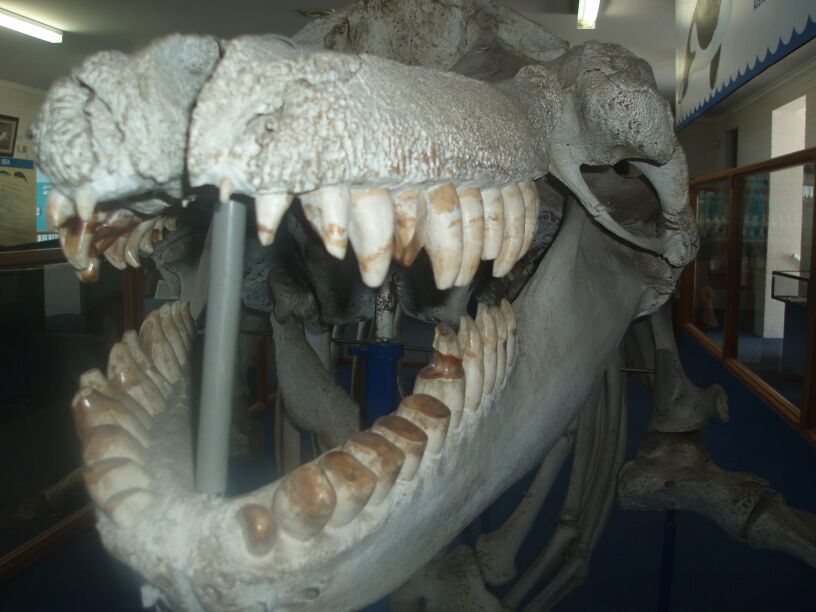
We bade farewell to all of the cousins on Friday morning and backtracked south to the town of Eden, in order to visit the Killer Whale Museum. This had been
firmly closed when we had driven by on our way to Merimbula. The museum had several interesting exhibits but the story of "Old Tom" was the most
fascinating. Over a period of many years and ending around 1930, packs of wild Orcas, led by the pack leader "Old Tom", would herd whales into the
Bay at Eden. Old Tom would splash around outside the Whaling Station at Kiah Inlet until the men launched a boat. Tom, in his impatience, would sometimes tow
the boats by grabbing a rope in his teeth and would also slow the whales down by doing the same with the harpoon line, after the whales were harpooned.
All of this was watched by the residents of Eden from the nearby cliffs. The Orcas were rewarded for their assistance with the tongue and lips from the
butchered whale. Tom died in 1930 and his skeleton is displayed at the museum with several of the teeth on the left side of his jaw, deeply notched from
the towing ropes. An incredible and bizarre story!


 One other memorable exhibit was a mock up of a whale boat with two dummies for crew, one of which was supposed to be hurling a harpoon. The dummies looked like
they had been extracted from a 1950's clothing store selling boy's school clothing. The harpoonist wore a check shirt, polyester trousers with a
sharp crease, and a prissy little gray sweater. No sign of Captain Ahab's tattooed Fijian warrior.
One other memorable exhibit was a mock up of a whale boat with two dummies for crew, one of which was supposed to be hurling a harpoon. The dummies looked like
they had been extracted from a 1950's clothing store selling boy's school clothing. The harpoonist wore a check shirt, polyester trousers with a
sharp crease, and a prissy little gray sweater. No sign of Captain Ahab's tattooed Fijian warrior.
We stopped for the night at Bega and the motel provided us with complimentary movies of "Spartan" and "The Castle". The
"Spartan" was an utterly forgettable movie starring Val Kilmer but "The Castle" was a masterpiece! It is wonderful Australian humor, on a
par with "Waking Ned Devine" and we highly recommend it.
The town of Bega is in the middle of cheese country and home to the Bega Cheese Museum attached to a cheese factory. We were told by the lady in the gift shop
that the museum here is very popular and is often quite crowded. This museum had some photographs of cheese making and lots of large unlabelled
stainless steel machines but the photos bore little resemblance to what we were observing from our observation post above the factory floor. There is no
way that Wallace and Grommit would have stopped here. We headed out.
We took the highway inland to Canberra crossing the Snowy River Mountain Range. You know the line,"..a man can be hard to find in the mountains....". The
summit of the mountain pass was wreathed in mist and the damp vegetation smelled wonderful when we took a break at the view point - now without
a view. We had two wildlife sightings on this drive. The first was a dead wombat that looked fairly ripe, so we did not stop to visit. The
 second was an echidna or spiny anteater. It was definitely alive and walking along the roadside verge. I screeched to a halt in a shower of gravel so that we could get
close up photographs - mainly of it's butt of course, as it tried to hide under a stump.
second was an echidna or spiny anteater. It was definitely alive and walking along the roadside verge. I screeched to a halt in a shower of gravel so that we could get
close up photographs - mainly of it's butt of course, as it tried to hide under a stump.
On Sunday we took a day tour of Canberra. The layout of the city is quite interesting. It is a "planned" city in that after Australia's
federation in 1901, both New South Wales - Sydney and Victoria - Melbourne, claimed their capital city as the capital of the federation. A compromise was
made to build a new capital - midway between the two cities, in it's own "district" - just as the USA created it's capital as Washington, "District"
of Columbia. American architect Walter Griffin won the competition to design the capital in 1911, although the construction took another half century
and the current population is around 300,000. The tour bus driver noted that the gas stations, supermarkets etc. are hidden in neighborhoods off
the main arterial highways. This information was to prove valuable later.
In the morning we stopped at the Australian War Memorial and a brief tour convinced us that the exhibits here
 cannot be viewed in a 90 minute stop. The next stop was at the "Old House of Parliament". We were supposed to visit the
"New House of Parliament" after a lunch break but we decided to skip this in order to spend more time at the Canberra Museum. This museum was well
laid out with some fascinating exhibits. The aboriginal exhibits were a bit of a disappointment as the majority of artifacts were created post 1970 and the only
items pre-dating Cook's visit to Botany Bay are stone hand axes. This has been true of the other museums we have visited and is just unfortunate that
aboriginal society was based upon "organic" articles that did not survive the passage of time.
cannot be viewed in a 90 minute stop. The next stop was at the "Old House of Parliament". We were supposed to visit the
"New House of Parliament" after a lunch break but we decided to skip this in order to spend more time at the Canberra Museum. This museum was well
laid out with some fascinating exhibits. The aboriginal exhibits were a bit of a disappointment as the majority of artifacts were created post 1970 and the only
items pre-dating Cook's visit to Botany Bay are stone hand axes. This has been true of the other museums we have visited and is just unfortunate that
aboriginal society was based upon "organic" articles that did not survive the passage of time.


Monday morning we headed back to the Australian War Memorial where we viewed the marvelous dioramas that they have created showing the various conflicts that
Australia has participated in. The aircraft display was fabulous and they have put together several really well scripted sound and light displays to
enhance the experience of viewing the exhibits.
The next stop was the Telstra Tower for lunch in the revolving restaurant. The latter was closed - "it's Monday!"
 so we had to satisfy ourselves with the 360 degree view over the City of Canberra from the viewing galleries above the darkened and empty restaurant.
We headed out of town towards Sydney with nothing even resembling a restaurant in sight. Fortunately I had been awake during the previous day's bus tour
and by following an exit sign for "petrol station", found a hidden trove of restaurants.
February 21, 2006 - February 25, 2006
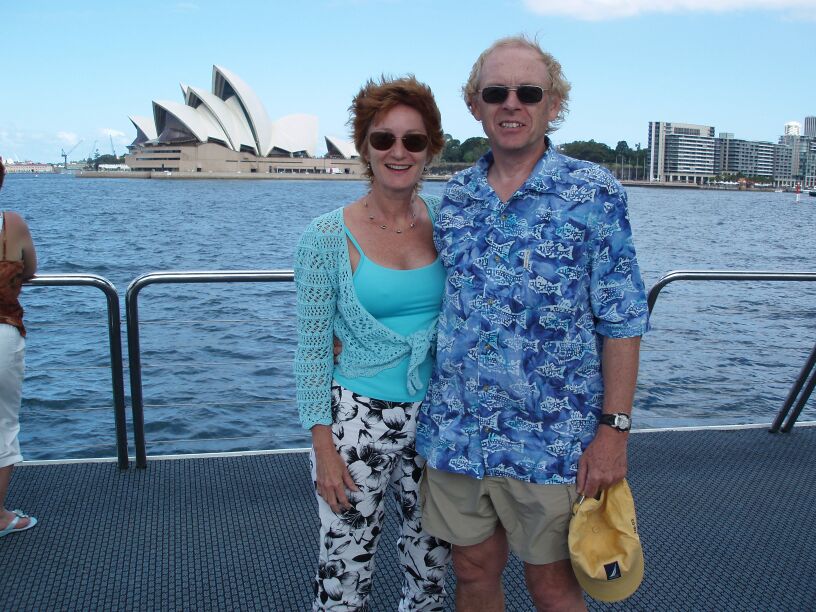
Tuesday we moved to a downtown hotel which is within walking distance of the main city sights. We began our Sydney tour by taking a boat cruise of the Sydney Harbor
and Middle Harbors. The day was sunny and the views
 of the Sydney Harbor Bridge and Opera House were just breathtaking. Sydney has a lot of boats of all kinds. We kept looking around as we passed the marinas, to see if we could spot
anyone we know, such as "Tiki" - the copra schooner we passed through the Panama canal with and which was last seen in French Polynesia. The captain -
John Murphy is a resident of Sydney, when he isn't out sailing. We never did spot anyone we know but nevertheless had a great cruise. An examination of the
Sydney phone book that evening showed hundreds of listings for J. Murphy, so we just toasted John in absentia in the hotel bar. Sorry John!
of the Sydney Harbor Bridge and Opera House were just breathtaking. Sydney has a lot of boats of all kinds. We kept looking around as we passed the marinas, to see if we could spot
anyone we know, such as "Tiki" - the copra schooner we passed through the Panama canal with and which was last seen in French Polynesia. The captain -
John Murphy is a resident of Sydney, when he isn't out sailing. We never did spot anyone we know but nevertheless had a great cruise. An examination of the
Sydney phone book that evening showed hundreds of listings for J. Murphy, so we just toasted John in absentia in the hotel bar. Sorry John!


Wednesday morning we headed over to the Australian National Maritime Museum. We had planned to spend just the morning here but the exhibits and guided tours were so
good, we spent the whole day. We toured the destroyer "Vampire", described as "the last of the big guns" and which served in the Royal
Australian Navy from 1959 to 1986. Vampire is 389 feet in length, 43 feet breadth, and a displacement of just under 4,000 tons. As she was taken out
of service just 20 years ago, we got to see a warship that was virtually intact.
The next vessel we toured was a replica of Cook's "Endeavour". The modern replica has electric navigation lights and two diesels buried on the lower decks
to provide auxiliary propulsion but the modern navigation equipment etc. has been skillfully hidden. The current vessel is sailed to various cities as a kind
of floating museum. The ship had been fitted with period artifacts to try to give the visitor as authentic an experience as possible, as to what it must have
been like to be part of Cook's crew during his famous circumnavigations. Well done and a lot of fun.
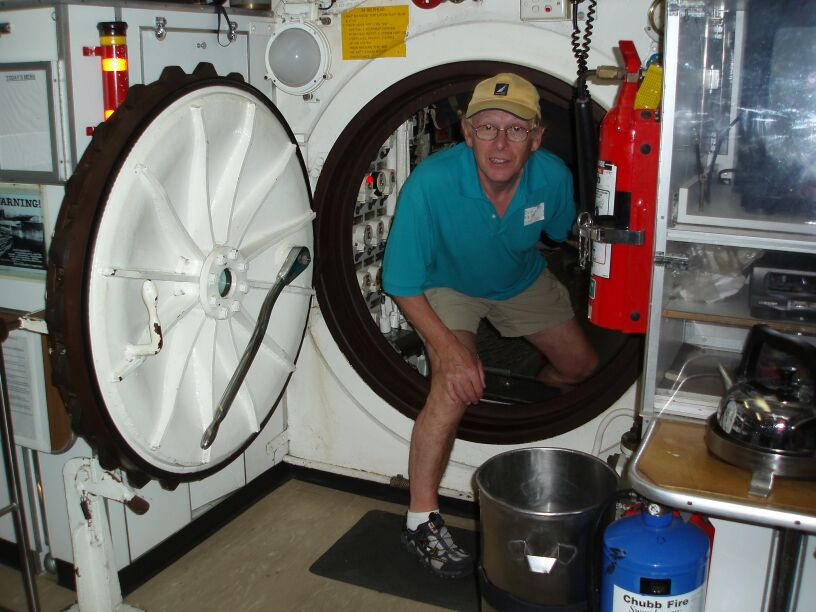
Next was a tour of the submarine "Onslow". Onslow is a diesel powered Oberon class attack submarine that served from 1969 to 1999. Again this was a
vessel just recently removed from service and provided an authentic feel for the cramped conditions of submarine warfare. More room than seen in the movie
"Das Boot" but far less than that portrayed in the movie "Hunt for Red October".
The vessels we toured are all moored outside the museum building which we toured next. Lots of great exhibits
 and we enjoyed touring a 31.2 foot cutter "First Lady", that Kay Kottee, an Australian girl used for her 1988 non-stop circumnavigation. We admired her boat but would still stick with DoodleBug.
Thursday morning we visited the excellent Powerhouse Museum and followed this with the Sydney Aquarium in the afternoon before bidding Sydney a farewell and heading inland on
Friday to "Dubbo". Dubbo is described as the "gate to the outback" and is home to the "Western Plains Zoo" as well as the
"Old Dubbo Gaol". We hit the zoo at 0630 hours (ouch!) for a guided tour before the zoo officially opened. The zoo is well laid out with the animals
in large paddocks separated from the viewing public by artfully disguised ditches and electric fences. Typically you drive around the zoo and I would
expect that the perfect vehicle would be a bicycle - except on the occasions

 when the tigers escape of course. Our favorite experiences were hearing and seeing a Kookaburra and hand feeding the giraffes with carrots. The
Kookaburra was not a part of the tour, it just happened to perform in the neighborhood. While Annette and I were being overcome with excitement, the
Australians who were also on the tour didn't even look up. I think they may have seen a Kookaburra before...
when the tigers escape of course. Our favorite experiences were hearing and seeing a Kookaburra and hand feeding the giraffes with carrots. The
Kookaburra was not a part of the tour, it just happened to perform in the neighborhood. While Annette and I were being overcome with excitement, the
Australians who were also on the tour didn't even look up. I think they may have seen a Kookaburra before...
The Old Dubbo Gaol was a sleeper. We did not expect it to be such a fun visit. The cells had been "decorated"

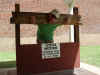 with animatronic dummies to represent the inmates and warders and the audio visual effects were extremely well done. We particularly enjoyed the gruesome presentation of the 8 inmates who were
executed here by the New South Wales hangman "Nosey Bob". Bob's face had been kicked in and his nose had been ripped off by a horse. He made a
successful career change from cab driver to hangman as some form of therapy.
with animatronic dummies to represent the inmates and warders and the audio visual effects were extremely well done. We particularly enjoyed the gruesome presentation of the 8 inmates who were
executed here by the New South Wales hangman "Nosey Bob". Bob's face had been kicked in and his nose had been ripped off by a horse. He made a
successful career change from cab driver to hangman as some form of therapy.
February 21, 2006 - February 22, 2006
We left Dubbo and headed out "Beyond the Black Stump". This expression is part of the Australian language and means "beyond
civilization". We discovered that the black stump really existed and was near an early wine saloon or pub of the same name. It lay about 10 kilometers
north of the small farming town of Coolah and both the


 stump and the pub burned down in a bush fire around 1908. The site of the pub is marked with a black stump at a highway rest area. There wasn't a sign on the highway but, by
monitoring the odometer after we passed through Coolah, we found the "historic" site and used the handy rest-room. Anything west of the
black stump is the "outback" and we set off to explore.
stump and the pub burned down in a bush fire around 1908. The site of the pub is marked with a black stump at a highway rest area. There wasn't a sign on the highway but, by
monitoring the odometer after we passed through Coolah, we found the "historic" site and used the handy rest-room. Anything west of the
black stump is the "outback" and we set off to explore.
Next stop was the Siding Spring Observatory located in the Warrumbungle Mountains, west of the town of Coonabarabran. As we approached the Warrumbungles, the sky clouded
over and it began to rain. We had originally planned on booking a night tour of a nearby commercial observatory but a low pressure system located

 off northwestern Australia was pumping clouds and rain over the Warrumbungles and it was obvious there would be no stargazing tonight. We were entertaining ourselves
with the views of the spectacular rock outcroppings and by keeping track of the road kill. We hadn't seen anything alive but had logged 2 dead rabbits, 2 dead
kangaroos, and a dead fox.
off northwestern Australia was pumping clouds and rain over the Warrumbungles and it was obvious there would be no stargazing tonight. We were entertaining ourselves
with the views of the spectacular rock outcroppings and by keeping track of the road kill. We hadn't seen anything alive but had logged 2 dead rabbits, 2 dead
kangaroos, and a dead fox.
The telescope at Siding Spring was at the summit of a steep hill (2000 feet - 610 meters) and we were the only visitors. The girl at the reception centre was
closing up her gift shop as we arrived and waved us towards the huge building holding the telescope. We rode the elevator to the visitor's gallery on the
fourth floor of the building and gazed at the huge device. With a mirror at just under 13 feet (3.9 meters) diameter, this is the largest
reflecting telescope in the southern hemisphere. The machinery and control devices to swing and track this huge precision device were very impressive. The
astronomers and telescope operators must have also been watching the weather forecast as the entire building was deserted.
We continued west and for 10 km. or so, the road deteriorated to dirt and gravel. The scenery was very pretty and we saw no other cars or trucks for
the next hour. I was comforted by the thought that we did have the satellite phone in our luggage in the event of a vehicle breakdown. The wildlife spotting
began to improve as we passed 2 or 3 live rabbits, 8 live kangaroos and a 1,000 or so head of cattle. These were being lazily herded down the road by a
cowboy on a four-wheel motorcycle. He had his dog sitting on the seat behind him. We asked him where he was taking his herd, which was dispersed over a
couple of miles and he said he was taking them to the creek for a drink.
By late afternoon we arrived at the farming hamlet of Coonable and found a motel for the night. There was a walking tour of historic sights in the town center
but we initially never made it past the first pub. When we realized that we either had to have another round of drinks and blow off supper for the night, or
continue our walking tour, we opted for the latter and headed off through the empty streets. Several of the downtown buildings were in the process of being
renovated but, like the American mid-west farm communities, many of the stores were empty and closed. One store window had a puzzling sign advertising two
school bus routes for sale but more on this later.
When we returned to our motel, the only other folks staying there were two men who worked as contract harvesters. They travel in a north-south migratory pattern
providing temporary labor to the farmers during harvesting. Their opinions on eating establishments reinforced the intelligence we had already received, that
the hot spot in town for food was the Bowling Club. Now in the USA, bowling means 10 Pin bowling in an "Alley" but in Australia it means lawn
bowling. The bowling club had exquisitely manicured lawns for the bowls and inside, a bar, restaurant, and all important "pokies". These are slot
machines and Australia has more per capita than anywhere else in the world. We shared a table with Dawn and Lloyd (club members for 28 years!) and shortly
after we

 arrived, we were approached and I (Ed) was asked if I would draw the tickets for a type of lottery. There were drawings for about a dozen or so
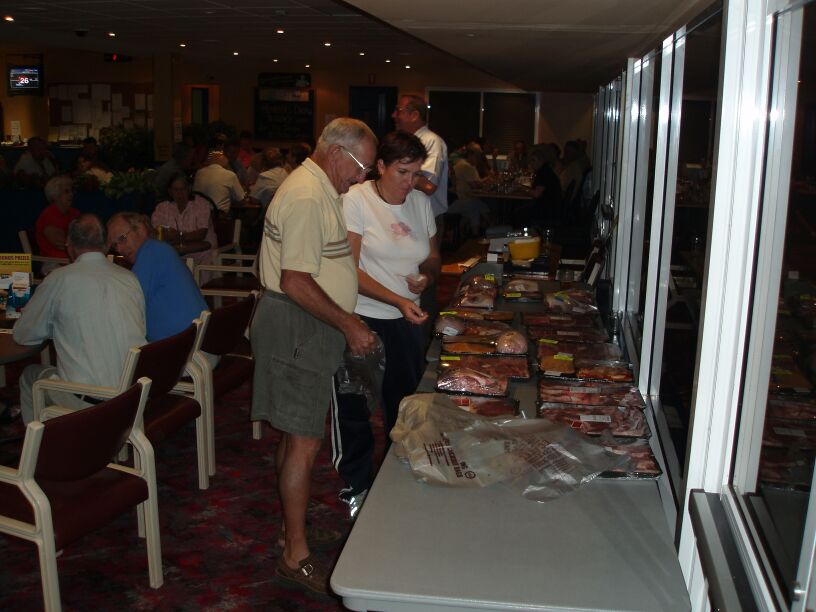
"meat trays". I thought a meat tray was "ready to eat" cuts from the delicatessen but, these were packages of raw steaks, roasts, chickens
etc. I then drew tickets from a huge drum and the winners got to burst a balloon they selected. Inside the balloon were voucher prizes that were then exchanged
for $100 to $500 cash. The club operates as a cooperative and the crowd there was having a good time. Before we left, we were approached by club member Norman
Fulmer (aka "Pickle"), who asked us if we would like to ride the 0710 hour school bus with him in the morning. Shortly afterwards, the club Secretarial
Manager, Annette McMullen, introduced us to Lindsay Parsons, a local rancher. He invited us to take a tour of some properties on the morrow to look
at cows etc. We accepted both invitations with alacrity and set our alarm clocks for an early start in the morning.
arrived, we were approached and I (Ed) was asked if I would draw the tickets for a type of lottery. There were drawings for about a dozen or so
"meat trays". I thought a meat tray was "ready to eat" cuts from the delicatessen but, these were packages of raw steaks, roasts, chickens
etc. I then drew tickets from a huge drum and the winners got to burst a balloon they selected. Inside the balloon were voucher prizes that were then exchanged
for $100 to $500 cash. The club operates as a cooperative and the crowd there was having a good time. Before we left, we were approached by club member Norman
Fulmer (aka "Pickle"), who asked us if we would like to ride the 0710 hour school bus with him in the morning. Shortly afterwards, the club Secretarial
Manager, Annette McMullen, introduced us to Lindsay Parsons, a local rancher. He invited us to take a tour of some properties on the morrow to look
at cows etc. We accepted both invitations with alacrity and set our alarm clocks for an early start in the morning.
At exactly 0710 hours, "Pickle" drove up in a medium sized white bus that had recently been equipped with curtains provided by one of the route mothers.
We headed out of town to a beautiful morning, while "Pickle" gave us a running commentary of the family histories, types of vegetation, flora,
fauna etc. as we passed. The loop trip took almost one and three quarter hours, making five stops at different farms and collecting about a dozen children, ranging
from pre-school through junior high school. Perhaps half of the trip was on paved roads. We


 were excited to see lots of kangaroos, perhaps 30 to 40 emus, a pair of wallabies (smaller and darker than kangaroos), vast quantities of
different parrots and to us - lots of exotic birds. The children were all very well behaved. We were delighted to note that one mother had driven the children
from the farm house to the dirt road on a four wheel motorcycle. According to our guide Norman, the children loved this. We learned that the oldest bus rider
"Jake" is also a National (junior) champion bull rider. He plans to travel with his grandparents to visit rodeos in Oklahoma and attend the famous
Calgary Stampede in the coming year.
were excited to see lots of kangaroos, perhaps 30 to 40 emus, a pair of wallabies (smaller and darker than kangaroos), vast quantities of
different parrots and to us - lots of exotic birds. The children were all very well behaved. We were delighted to note that one mother had driven the children
from the farm house to the dirt road on a four wheel motorcycle. According to our guide Norman, the children loved this. We learned that the oldest bus rider
"Jake" is also a National (junior) champion bull rider. He plans to travel with his grandparents to visit rodeos in Oklahoma and attend the famous
Calgary Stampede in the coming year.
I asked Norman about the advertisements we had noticed the previous day and he explained that he owns the bus we were riding in. You apply to the
Australian government for a contract to run a rural school bus route. The advertisement we had seen the previous day, was a retiring couple's attempt to
sell two existing contracts and the two buses necessary to service them.
After our school bus tour, Lindsay Parson drove up in his F150 flatbed truck to pick us up from our motel. Lindsay has spent his whole life in the cattle business
and gave us the practiced view of a third generation rancher. It was fascinating to hear from an expert, the ins and outs of the economics and
practicalities of ranching. Lindsay could glance at a steer and determine its breed, mix, condition, age etc. whereas my expertise extends as far as the
sex of the beast. We learned about water supplies, feed, seeding, clearing land, grass leases etc. while we were seeing foxes, kangaroos, emus etc. scatter
before us like shoals of fish as we drove

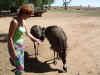
 through the paddocks. We drove over to visit Lindsay's daughter for tea and cookies. She and her husband have an elegant home complete with duck pond, swimming pool, rabbit hutches, pet emus,
miniature horse and so on. Their yard was guarded by a chubby Rottweiler that looked like a Chihuahua next to the Irish wolfhound / deerhound mix named
"Tiny". Tiny apparently hunts kangaroos for fun. All in all, it was a fantastic experience and we were humbled by the generosity of both Norman
and Lindsay in sharing a little of their life with us.
through the paddocks. We drove over to visit Lindsay's daughter for tea and cookies. She and her husband have an elegant home complete with duck pond, swimming pool, rabbit hutches, pet emus,
miniature horse and so on. Their yard was guarded by a chubby Rottweiler that looked like a Chihuahua next to the Irish wolfhound / deerhound mix named
"Tiny". Tiny apparently hunts kangaroos for fun. All in all, it was a fantastic experience and we were humbled by the generosity of both Norman
and Lindsay in sharing a little of their life with us.
February 27, 2006
This afternoon we left hospitable Coonable and headed north to Lightning Ridge. Lightning Ridge is opal central in Australia and is where the bulk of the black
opals, the rarest and most valuable, are mined. As we approached town, we saw lightning on the horizon, which seemed particularly appropriate. The town was
allegedly named after a shepherd and his entire herd of 500 sheep when they were all found dead following a lightning strike on the ridge, where he was
flocking about - or whatever it is that shepherds do when they are bored. The "black" opals were discovered here in the 1880's with the first mine
shaft being sunk in 1902. We pulled into the town's information center and immediately met a real opal miner. Richard runs the information center and had
mined for 12 months with his father. In twelve months they found virtually nothing. He dumped his partner (no inheritance anyway) and went by himself for
two years and did reasonably well. Then he took a partnership with a bigger enterprise and worked with them for another two years. He said that he had
made an OK income - averaged over the five years but, he felt he could keep his average up by running the information center for a regular paycheck. We booked a
tour for the morrow and checked into the motel that our Coonable itinerant harvesters had recommended.
February 28, 2006 - March 1, 2006
John picked us up in the morning in his huge "Outback Tours" motor coach. We were the only passengers but as he was leaving the motel property,
another couple flagged us down and he thereby doubled his tour group. John is another opal miner who runs the tour bus as a second job. He was a wealth of
information. The government owns the mineral rights in Australia and occasionally holds a lottery type drawing for 6 people to win the rights to
explore an area about 2 km by 2 km., approx 1,000 acres. These six people then have 30 days to peg a claim. An individual may have up to two 50 meter by
50 meter claims and a company can have up to four claims. The exploration is done by drilling 9 inch bore holes to about 80 feet with a small drill rig
and examining the drill cuttings for signs of opal bearing clay. After the first six have filed their claims, it is "free for all" with anyone
else filing a claim.


In Australia, everyone of voting age must vote by law. John said that perhaps a third of the town's residents are registered to vote and it is considered rude
to ask anyone their surname. Most "real" miners go by nick-names. It is said that many of the miners are hiding out from the law, from child support,
or whatever and tend to keep a low profile in remote camps. Their camps were almost all primitive - corrugated iron shacks, decaying caravans (trailers) with
only a few mobile homes on the more affluent appearing sites. 95% of the camps have no electricity and only a few are occupied throughout the heat of the
summer months. The only water is from rain captured off the shed roof or trucked in and purchased by the tanker load. Some of the miners move south to
their gold mining claims in the summer and return during the winter months to opal mine. During the winter months you can heat your shed with a cow dung fire
that will also keep the mosquitoes at bay. Many of the miners were retired or semi-retired "hobby" miners. Very little capital is needed to set
up your mine. A 36 inch diameter drill is used to drill a hoist shaft and a nearby escape shaft to the opal level - usually shallower than 70 feet. A small
generator provides power for a hand held electric chisel, mine lighting, and for a device that hoists the extracted dirt to the surface. The dirt is loaded
into trucks and then hauled to an agitating plant where it is dumped into large cement mixers and the mixer allows the separation of the dirt from the stones
that may contain the opals. Opals can vary in price from a few dollars to $5,000 or more per carat, depending upon the color, thickness, lack of imperfections,
etc.
The opal miners were definitely an eccentric crowd and we enjoyed the stories of the occupants, both former and present of the odd looking habitations.
Over the next couple of days, Annette and I toured the many opal shops in town, looking at the final product of all of this industry. Annette particularly liked
the opals at "Down to Earth Opals" and managed to correct any possible deficiencies in her jewelry collection.
March 2, 2006
We motored out of Lightning Ridge this morning in a light rain. We were slightly concerned about the rain because our next destination was "in the
bush" and via dirt roads. We therefore stopped at the information center on the way out of town, to enquire about the possible road conditions. The
information center did not open for another twenty minutes but we complimented the man standing outside the adjacent local radio station for the Lyle Lovett tune he was playing.


The man turned out the be the local radio DJ - named "Grassy" (a Country and Western station - how did you guess?) and who was preparing to go on the air within the next ten minutes. He
invited us into his studio and had Annette sit in front of "the microphone" with "the earphones" on, so I could take pictures.
The only time he seemed to move swiftly, was after I pointed out to him that he was due on the air within the next two minutes.
We next met Conrad who was "noodling" on the dirt pile next to the information center. "Noodling" is looking for opal bearing stones that
have washed to the surface. Conrad showed us how to break the edge off the stones to see if they contained opals and how to look for "color".
He has been opal mining and living in one of the local camps on a year around basis for the past decade. He was slightly depressed when we met him, as his
best laying "chook" had just been killed by a brown snake.
By this time Richard had arrived at the information center. Richard assured us that the roads would be fine and added to our mining knowledge with the
information that the best way to select a mine shaft location, is to take off your left boot, throw it as far as you can and dig where it lands. Good to know.
Our first destination was the "Glengarry Hilton". A sign outside called it the "Pub in the Bush." Glengarry is a
 mining camp and was described to us earlier as, "what Lightning Ridge looked like 30 years ago." Opal miner's camps, littered with abandoned equipment, derelict
cars, lean-tos, tires and piles of earth showing the location of their mine shafts, were scattered everywhere throughout the bush. Andrea at the pub
served us lunch and explained to Annette what a "floater" is. This is a day old meat pie, floating in pea soup and served with ketchup. Yummy! Annette ordered the spaghetti.
mining camp and was described to us earlier as, "what Lightning Ridge looked like 30 years ago." Opal miner's camps, littered with abandoned equipment, derelict
cars, lean-tos, tires and piles of earth showing the location of their mine shafts, were scattered everywhere throughout the bush. Andrea at the pub
served us lunch and explained to Annette what a "floater" is. This is a day old meat pie, floating in pea soup and served with ketchup. Yummy! Annette ordered the spaghetti.
A mile or so away was the next civic center - okay, the next pub - the "Sheepyard Pub." Here we chatted with the pub owner Ted and an
official "colorful character," Les. They explained that the local telephone company would not provide service unless there was a physical
address on the application.


The local miners simply made up addresses and everything was then fine. Many of the local roads (dirt) had acquired their
names from road signs stolen from Sydney. Ted gave Annette an old Australian penny that had been reforged into a miniature "slouch
hat" as worn by the Anzac warriors of the Great War. He also provided us with directions to the local Anzac memorial which we found deep in the bush.
We walked around the memorial and were both touched and impressed with the amount of industry it had taken to create this. One monument I
particularly remember was a stone with a brass plate bearing the legend, "In memory of Ronald "Doc" Jones, "A Good Mate"".
There was a third pub but we by-passed this in order to be in a condition to make the drive north to the town of Diranbandi. On the way, we had been told
under no circumstances should we miss the "Yum Yum Cafe" in Hebel. We found that it had been closed for four months. We also by-passed the Hebel
Pub for the same reason as we had by-passed the third bush pub earlier in the day.


Besides the countless kangaroos and emus we were passing, the highlight of the drive was passing a dead guana - rather like a huge iguana and much bigger than we had expected from seeing pictures in the guide books. We
found a motel in Diranbandi and that evening walked through the main street of the town to the local public establishment sited at the other
end of town. In front of each store was a mosaic tiled picture embedded into the sidewalk. We were admiring these when Greg, the local butcher, stopped to
explain the significance and history of the symbols, some of which were local cattle and sheep brands that belonged to the different generations of his
family who had lived in the area. That evening we chatted with Graham, Joe and Perry in the local pub.
March 3, 2006
This morning the rain was bucketing down and the weather forecast told of gale force winds with huge seas and trees blown down at Bundaberg. The remains of a
cyclone was off the east coast and causing widespread flooding. We had intended heading northeast from Diranbandi but this would require driving on
50 kilometers or so of dirt. Our landlord at the motel confirmed that this road was now impassible and instead we headed north in the rain to the town of
St. George. Here we found "The Unique Egg," where there was a display by a local artist of carved emu-eggs.
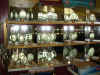


The eggs were elaborately carved and had been drilled with fine holes in lace like patterns. They were
internally lit with a small bulb and were quite beautiful. The artist, Steve Margaritis gave Annette a pair of earrings she had admired, that are made
from kangaroo claws. Roo' fingernails as jewelry? Steve plans to be in Greece in May of 2007 and gave us his cell phone number so we could call him when we
are in the Mediterranean.
By now it had stopped raining and across the street was a ranch supply store where I (Ed) bought a genuine Australian stockman's hat - model "Coober
Pedy" by Akubra . Annette said I looked really cute but you can't pay too much attention to what a "sheila" says. Annette got to
see what a "swag" is - which is a uniquely Australian combination of groundsheet, sleeping bag and mattress.
We headed out west on the highway and stopped at the little town of Bollon. There was a public toilet next to the river and after partaking of this hospitality,
we walked behind the restrooms on a short pathway. Almost
 immediately Annette spotted a koala in the gum tree along the river. It was actually awake and stared gravely at us. It even moved it's head - proving that it wasn't stuffed
and nailed to tree. Awesome!
immediately Annette spotted a koala in the gum tree along the river. It was actually awake and stared gravely at us. It even moved it's head - proving that it wasn't stuffed
and nailed to tree. Awesome!
Wildlife sightings on the road to the next town of Cunnamulla included a Wedge-tailed eagle chewing on a dead
 'roo and a large roadkill snake. We were also entertained by listening to the local radio stations. Here we learned that "Slippery Bob" is a dish made from kangaroo brains
and flour mix, fried in emu-fat. Add thyme to taste.
'roo and a large roadkill snake. We were also entertained by listening to the local radio stations. Here we learned that "Slippery Bob" is a dish made from kangaroo brains
and flour mix, fried in emu-fat. Add thyme to taste.
Outside the information center in Cunnamulla is a twice life sized bronze of the "Cunnamulla Fella". The latter gentleman was immortalized in the
song written by Stan Costner, sung by the famous Slim Dusty. The sculptor was Archie St. Clair who cast the huge bronze in Grapevine, Texas.
Among St. Clair's other major works is the

 bronze of a Hopi Indian woman in downtown Santa Fe. Small world! Mary in the information center was a wealth of local knowledge and showed us around the small museum. Amongst the
various exhibits, Annette got to see what a "billy can" is.
bronze of a Hopi Indian woman in downtown Santa Fe. Small world! Mary in the information center was a wealth of local knowledge and showed us around the small museum. Amongst the
various exhibits, Annette got to see what a "billy can" is.
Later that evening, at the bar of the Billabong Hotel where we spent the night, we quizzed the locals on what a Coolabah tree looked like. There was general
puzzlement for a while but one grizzled "Cunnamulla Fella" not only knew what a Coolabah tree is but pointed at a specimen growing on the opposite
side of the street. The next
 word was translated by the girl behind the bar who explained that a jumbuck is a sheep. I had always thought it was a kind of antelope. Everyone knew what a billabong is (it's a pool in the river caused
by a natural dam) , as they were all sitting in the Billabong Pub and by now, some of the patrons were beginning to twig that we were attempting to
translate the words of the song, "Waltzing Matilda".
word was translated by the girl behind the bar who explained that a jumbuck is a sheep. I had always thought it was a kind of antelope. Everyone knew what a billabong is (it's a pool in the river caused
by a natural dam) , as they were all sitting in the Billabong Pub and by now, some of the patrons were beginning to twig that we were attempting to
translate the words of the song, "Waltzing Matilda".
March 4, 2006
We drove west from Cunnamulla this morning, deeper into the outback. Next stop was the Palm Grove date farm at Eulo. Ian Pike, the owner, drove up a few
minutes after we arrived and seemed both pleased and surprised to have visitors "out of season." Ian gave us samples to taste of date
wines, both fresh and preserved dates and of figs - all produced on his farm. His presentation was interrupted by a very loud noise, that seemed like
a small siren nearby. Ian was unfazed and explained that this was a tree frog. The tree frog was sitting on a shelf in the store and Ian held it so that we
could take pictures before returning it gently back on the shelf. He explained that the frogs are beneficial, as they keep down the insects in the store. On
a nearby shelf Annette found jars containing preserved kangaroo ticks, spiders, and a mouse. Not your typical store display.



Ian showed us around the adjacent property, where he had collected all sorts of ancient and bizarre artifacts. The date farm lies next to an artesian mud
spring and Ian has built a type of spa, where you can enjoy a mud bath. His brochure showed photos of clients, laying in their mud baths, drinking glasses
of champagne. The effect for us was spoiled however, by the swarm of small annoying flies that seemed to be omni-present in the outback and which bought
to mind the Australian wide brimmed hats of legend that have corks dangling from strings around the rim.
A few kilometers beyond the date farm, we spotted one of the artesian mud springs and walked over to investigate. This part of Australia covers a
huge subterranean aquifer and the mud springs are a natural safety

 valve for the build up of pressure within the aquifer. The mud over the spring dries into a huge grey-white hillock and occasionally a portion of the hillock is
blown off by the over-pressure. The hot mud then erupts - rather like a miniature volcano. Fortunately, none of this happened during our visit
and we stood on top of the miniature mud mountain and looked out over the Australian bush in all directions as it lay shimmering in the heat.
valve for the build up of pressure within the aquifer. The mud over the spring dries into a huge grey-white hillock and occasionally a portion of the hillock is
blown off by the over-pressure. The hot mud then erupts - rather like a miniature volcano. Fortunately, none of this happened during our visit
and we stood on top of the miniature mud mountain and looked out over the Australian bush in all directions as it lay shimmering in the heat.
Our next destination was Yowah, a remote opal mining town with a population of perhaps 200. The road had narrowed from a two lane to single lane paved /
metalled / bitumened highway and now deteriorated further to a dirt road. We spotted an eagle eating a "roadkill" kangaroo but it
flew away before we could get a good picture. Yowah seemed entirely deserted, as every advertised business showed no sign of life. We found "Ossie's
Opal Workshop" with an "Open" sign and Carol walked over from her home to show us her opals. The displayed opals were
"boulder opals" and lay across a pool table. Annette commented on the raucous noise coming from Carol's home and Carol invited us to see her
pet parrots. All but one were native Australian parrots and flew or walked about her house like mobile flowers. While Annette perused the opals, I
chatted with Carol's son, who was in the process of building a Chevrolet "hot-rod." There were several unusual pieces of furniture in the
store and Carol's son was the artist. He had the front end of a '55 Chevy (??) made into a computer desk with pistons for legs and the rear end of the
vehicle was on the opposite side of the room and had been made into an upholstered couch. An old style gas-pump opened at the touch of a
button to access the interior, set up as a stereo with built in speakers. An "art-car" artist in the middle of the outback!


Annette wanted to buy a few stones but Carol could not take credit cards and the last town we were in had no ATM machines. Carol just wrote down her bank
account details on a scrap of paper and asked Annette to deposit the cash to her account, the next time we passed a branch of the National Bank.
On the road again, we headed north towards Quilpie. Miles of single lane highway stretched before us through the bush, with the occasional red pillar
of a dust devil swirling by. Several times, emus tried to commit suicide and forced us to brake sharply. We paced one emu at 25 kph (16 mph)
"loping" speed - since they don't seem bright enough to actually "run" away. We have been amused to see that Australians as well as
Americans from the southern States, entertain themselves by shooting holes in the road signs as they pass. This practice is equally regarded by law
enforcement officials in both countries.


Between Yowah and Quilpie is the pub at Toompine. The road sign proclaimed it as the "Pub with no town" and sure enough, the only building there was the
pub - where we stopped for a refreshing beverage. On the outskirts of Quilpie, we spotted huge Brolga Cranes in a field. They were hunting for
something but exactly what we could not determine.
March 5, 2006
We spent the night in Quilpie and now turned back east towards Roma. We had just passed the town of Eromanga which is proclaimed to be as far from sea as
it is possible to get in Australia. Now we were pointing towards Bundaberg and DoodleBug. The road began to improve from single lane to occasionally two
lanes and Annette began a scientific survey of roadside adornments. In 30 minutes she counted 54 dead 'roos and 38 dead truck tires. During this
same interval, we passed 3 "road trains" -18 wheeler trucks pulling two trailers - and no automobiles.

 We passed through the small towns of Cheepie and Cooladdie but although these towns professed museums and information centers, all were closed tightly
on a Sunday. At Charleville we stopped to visit the Graham Andrews parkland where two Steiger Vortex Guns are displayed.
We passed through the small towns of Cheepie and Cooladdie but although these towns professed museums and information centers, all were closed tightly
on a Sunday. At Charleville we stopped to visit the Graham Andrews parkland where two Steiger Vortex Guns are displayed.
In 1902, there was a severe drought in the Charleville area. Some six "Vortex" guns were imported from Germany in an attempt to create
rain. 6,000 of these guns had been in use throughout Europe and the Charleville

 folks were desperate to try anything. The guns were distributed around the town and their charges of 6 ounces of gunpowder per gun were fired
off at the signal given by meteorologist and rainmaker, Clement Wragge. Several of the guns imploded and shrapnel narrowly missed hitting bystanders.
Needless to say there was no rain produced although, the drought was broken later that year.
folks were desperate to try anything. The guns were distributed around the town and their charges of 6 ounces of gunpowder per gun were fired
off at the signal given by meteorologist and rainmaker, Clement Wragge. Several of the guns imploded and shrapnel narrowly missed hitting bystanders.
Needless to say there was no rain produced although, the drought was broken later that year.
A few kilometers outside the town of Roma, Annette spotted a large stately bird about half the size of an emu.
 The bird book we are carrying identified it as an "Australian Bustard" and notes that it is "rare." It was an impressive bird but cannot be all that rare as we spotted two more
before we arrived in town.
The bird book we are carrying identified it as an "Australian Bustard" and notes that it is "rare." It was an impressive bird but cannot be all that rare as we spotted two more
before we arrived in town.
March 6, 2006
Today was a rest day to catch up with laundry and e-mails but, in the morning we visited "The Big Rig." Roma is the center of the Australian oil
industry and where the first finds were made. The local industry had sponsored a museum / exhibition of the early days of Australian exploration and
had set up two huge rigs - one dating from the 1920's and the other from the 1970's.


They had set up the latter as realistically as possible with mud pits, tools, sheds, generators etc. as well as both Halliburton (drilling fluids) and Schlumberger wireline trucks (well logging). It was fun to see all the
equipment, so much of it I have been around over the past decades. We watched a 30 minute movie produced as a "new employee orientation" movie by a
local oil company. Their movie, "Rig Boss," was polite and professional and quite unlike any of the rig bosses that I have had to deal with
in the past years. They mentioned in the display that Australian oil finding relied heavily on seismic exploration as earlier methods dependant
upon the surface mapping of geologic outcroppings did not work. I had sold 4 or 5 "Phoenix" seismic processing mini-computers for use in Australia in
the early 1980's but was disappointed to find no reference in the museum. We thought we would watch a movie at the local cinema in the afternoon but found it closed
on Mondays and Tuesdays.
March 7, 2006
We checked out of the motel and headed over to the local stock exchange for the days auctions. Roma has the
 largest stock auction in the area and we were to see the sale of "unfattened" stock. There were about 2,000 or so
cattle for sale and we chatted to Marty, a fourth generation rancher. Like all good cattlemen, Marty also worked part-time as a lease man for a local oil
company. Marty was selling today and so he was basically hanging around like us and provided a wealth of information. The cattle were divided into heifers
and steers. We learned that they are not all "cows." In fact a "cow" is a heifer that has had it's first calf. Steers are the male
counterpart and are castrated at a very young age. Some of the unfattened cattle were being sold because their owners could not sustain them on their
property due to the drought inflicting this part of Australia. These animals would be purchased by other, more fortunate, property owners and would be
fattened up before being re-sold. Other stock at this auction were already in condition for slaughter and would be trucked directly to the abattoirs. The
stockyard was divided into pens and the animals in each pen were numbered with a lot number. Some of the animals had additional color markings indicating
that although they were in a particular lot, they were to be sold separately from the other animals in the lot.
largest stock auction in the area and we were to see the sale of "unfattened" stock. There were about 2,000 or so
cattle for sale and we chatted to Marty, a fourth generation rancher. Like all good cattlemen, Marty also worked part-time as a lease man for a local oil
company. Marty was selling today and so he was basically hanging around like us and provided a wealth of information. The cattle were divided into heifers
and steers. We learned that they are not all "cows." In fact a "cow" is a heifer that has had it's first calf. Steers are the male
counterpart and are castrated at a very young age. Some of the unfattened cattle were being sold because their owners could not sustain them on their
property due to the drought inflicting this part of Australia. These animals would be purchased by other, more fortunate, property owners and would be
fattened up before being re-sold. Other stock at this auction were already in condition for slaughter and would be trucked directly to the abattoirs. The
stockyard was divided into pens and the animals in each pen were numbered with a lot number. Some of the animals had additional color markings indicating
that although they were in a particular lot, they were to be sold separately from the other animals in the lot.


The auction process itself was fun to watch. The auctioneer stood on a platform above the particular lot being sold and produced the usually
indecipherable gibberish that was either the proposed selling price of the animals in cents per kilo or simply the words to the latest rap song. The
buyers were clad in their uniform of Akubra stockman's hat, shirt, blue-jeans, and boots. They hung over the rail of the pen as though they were just hangin'
out and indicated their bid by the least movement of their fingers or head nod. The selling went quickly and while the auction was progressing,
a ballet of animal movements was performed for our entertainment. Men would open gates in the pens and chase the cattle out by waving plastic grocery
sacks attached to the ends of broomsticks. Then, a lone stockhand, sitting tall in the saddle, would ride his horse at the cattle and they would run
before him the length of the stockyard and into a further system of gated pens. As each "lot" of cattle would arrive, they would be shuffled
from pen to pen, in an elaborate Rubik's Cube type puzzle until they had been weighed and allocated to a shipping pen to await the truck of their new owner.
It was fascinating to watch and we could have stayed all day but instead we drove eastwards to the town of Mundubbera where we spent the night.
March 8, 2006
Mundubberra is the "Citrus Capital of Queensland" and lies only a few hundred kilometers from Bundaberg. The town is on the Burnett river that also runs
through Bundy and is home to the "thought to be extinct" Ceratodus forsteri or "lungfish". We looked down into the muddy brown river
and didn't see any. The town also boasts a company, "Bugs for Bugs", that breeds insect predators to control citrus pests. They provide tours on
Thursdays and this was Wednesday so, they directed us to the town information center. It was tightly closed when we arrived and showed little sign of life. We headed east.
The road grew from single lane to two lanes as we neared Bundaberg and the vegetation on the sides of the road was lush and green instead of the scorched
red earth of the outback. We discovered our only live snake of the entire trip by running over it as we left a rest stop. It was about five feet long,
olive green with a yellow head, and slithered off into the bush. We hoped it was not too badly injured and wisely decided not to follow it into the deep grass.
In early afternoon we arrived back at the Bundaberg Port Marina where DoodleBug was in the process of being bottom-painted. All looks well on board.


 a late breakfast together at a nearby cafe. We bade farewell to Freewind and headed north up the coastal highway as far as Gympie. Here the effects of jet lag began
to be felt, so we checked ourselves into the "Muster Inn", where we found showers, air-conditioning, and beer in the fridge.
a late breakfast together at a nearby cafe. We bade farewell to Freewind and headed north up the coastal highway as far as Gympie. Here the effects of jet lag began
to be felt, so we checked ourselves into the "Muster Inn", where we found showers, air-conditioning, and beer in the fridge.