


Australia
March 9, 2006 - March 22, 2006
Bundaberg:The plan was to launch DoodleBug back into the Pacific Ocean on Monday, March 13th, spend the next 10 days preparing for sea, and then take off sailing for Darwin around March 23rd. This part of the plan worked fine. We were dropped neatly into the water and motored carefully to a nearby marina slip. We backed into the slip with 20 knots of gusting wind off the beam, fortunately missed hitting everything expensive and were soon swathed in lines holding us to the dock. We then began the "lists". Sailors have lots of lists. We have lists of things to clean, lists of things to oil and adjust, lists of spares to buy, lists of groceries, lists of bills to pay, lists of documents and permits to apply for etc. etc. The best advice we were once given, was when you get down to the last page of items "to do" - just leave.
We were approaching that departure point when Larry showed up. Larry was a category 5 cyclone (called a hurricane in the northern hemisphere) that went ashore on Monday as a category 4 and caused the most damage in over thirty years to the coast some 400 miles north of Bundaberg. This is exactly where we are supposed to heading. A few days behind Larry is "Watti". Watti is only a category 3 cyclone at the moment but has slowed down and is building strength. It's path is unknown but there exists the possibility that it will swerve south and travel down the coast towards us. The current local marine forecast for Bundaberg predicts 30 to 40 knot winds offshore, with 4 meter (13 feet) swells. We are getting 30 knots across the marina and DoodleBug occasionally heaves at her mooring lines to a particularly strong gust.
Needless to say we don't plan on leaving tomorrow and will continue to monitor the weather closely, as both of these cyclones have tracked nicely along our intended course to Darwin.
March 24, 2006
Bundaberg: We are ready to set sail and Tropical Cyclone Wati lies just offshore, now at category 3. Wati had followed the earlier track of Cyclone Larry but then stopped and hovered several hundred miles offshore while it gathered strength, before turning towards Bundaberg and beginning to move again. This changed it from an annoying meteorological phenomenon that was delaying our departure, to a category O.S. (Oh Shit!). The wind and rain in Bundaberg increased with the approach of the cyclone and an examination of the charts and harbor showed no place to run. The Bundaberg Port Marina lies just inside the mouth of the Burnett River and has low lying sand hills protecting the estuary. These would soon be submerged in a storm surge. The marina has floating docks but the piles holding the dock sections in place are too short to accommodate a large tidal surge. We had decided "decision time" would be this morning (Friday) as to our defensive plans if any. Late yesterday afternoon came the report that Wati had swerved again and is now paralleling the coast and heading southeast towards New Zealand. This direction remains unchanged this morning with Wati now quite close to Bundaberg but supposedly passing by. The extended forecast predicts that by Monday we will be in the clear and if the weather is appropriate, we will plan on setting sail on Tuesday morning.
March 9, 2006
Position: 22 32.7 S 150 45.5 E
Yesterday we topped up with diesel and set sail from Bundaberg Marina at 0830 hours. We are finally moving again! For the first thirty miles we had little wind and motor-sailed north towards Darwin. At 1620 hours we were under full sail - Genoa, main and mizzen and beam reaching under fair skies. There was still some residual swell from cyclone Wati but overall it was a very pleasant sail to Port Clinton - an overnight run of 165 miles. The night passage was clear with a fantastic display of the southern heavens and no moon. We of course have not sailed in over five months and struggled to stay awake keeping watch.
The entrance to the anchorage was exciting of course, - this is the first time we have made an entrance over an Australian river bar in "primitive" conditions. The chart showed "overfalls", reefs, rocks, and whirlpool symbols but we managed to arrive near high tide and the extra twenty feet of tide had buried most of the obstacles. We entered the hidden river estuary behind the entrance headland, accompanied by a swarm of butterflies and anchored in a quiet little bay with only one other vessel in sight. This belongs to an elderly gentleman who is "crabbing" and has already stopped by to ask us if we eat tuna. He only uses the fish for crab-bait and was going to throw the fillets away.


later that day.....
It was Wednesday afternoon in Port Clinton and Barry Phillips stopped by in his dinghy to give us a couple of Yellowfin tuna fillets he "didn't need". We then enjoyed an afternoon nap to catch up on some missing sleep, while Barry motored around the small inlets, taking advantage of the 18 foot tide to set his crab traps in the remote and hard to get to spots. That sunset Barry joined us for sundowners and Annette fed us home made "chili" in deference to Barry's earlier comment that he was not particularly partial to tuna. Barry used to be a commercial fisherman - "we used to starve a lot" - but retired three years ago. He now motors some 40 miles from his home to crab for a day or so and then trolls fishing lines on his return, "to see what he can catch". We chatted with Barry about the merits of becoming grandparents (he has five grandchildren and enjoys them all). Barry's wife does not approve of his solitary expeditions but Barry seemed both careful and meticulous in his boat handling skills and as we say in the bush, "he should be right"
March 30, 2006
We raised anchor at 0900 hours and set sail for the port of Mackay - the world's largest cane sugar terminal. We passed the Port Clinton river bar near high tide and were immediately broad reaching under poled Genoa, main and mizzen. It was hot and almost cloudless as we sailed along the coast but by early afternoon the sea had developed a steep and choppy 6 foot roller from the stern quarter, which produced an occasional vicious 20 degree roll on DoodleBug. The water speed indicator had been behaving erratically but it was obvious by our GPS speed (satellite derived "Speed over the Ground"), that we were sailing through a strong counter-current, both slowing our motion and producing the choppy sea. We expected this current to be tidal and sure enough, evening brought relief from the awkward motion.
1930 hours local time: Position 21 48.4 S 150 14.9 E
This is our second night at sea on this section of our passage and it is getting a littler easier as we get back into "sailing" rhythm. The almanac gave us a 2% moon tonight but this sliver would have already set - even if we could see a "2% moon". At dusk the sky was overcast and the night soon became very dark with only an occasional glimpse of the brightest stars. We are sailing inside the Great Barrier Reef and although we are now 50 miles from the Australian coast, at this latitude the barrier reef lies more than 150 miles offshore. To the sailor this means that we are "at sea" with no coastal lights and no shipping but it also means that the sea bed is shallow and our path is sprinkled with reefs, shallows, sandbars and islands. We have to thread our way between these hazards and rely heavily on satellite guided chartplotter, radar and fathometer. By necessity we pass very close to and between some island chains and there are strong cross currents as we cross the sand bars between the islands. It was just possible to see the islands in the starless gloom using binoculars but we could also see islands dead ahead and the binoculars could give no sense of distance. It was with some relief that the clouds cleared around midnight and we had both starlight and a jeweled sky with the broad brush stroke of the milky way. On warm night watches at sea, it is easy to spend hours just looking for shooting stars.
March 31, 2006
At 0300 hours the radar showed a regular pattern of large obstacles. These obstacles were also covered in bright lights like oil refineries. It was a
little like sailing the Texas coast at night, dodging oil production platforms that don't move and (effing) shrimpers that do. Sure enough what we were seeing
were moored bulk
 sugar carriers and like a giant game of "Pac Man", between the moored behemoths came a swarm of pilot boats and fishing boats. It
takes a combination of radar and careful watching to sort out which set of lights is trying to run you over.
sugar carriers and like a giant game of "Pac Man", between the moored behemoths came a swarm of pilot boats and fishing boats. It
takes a combination of radar and careful watching to sort out which set of lights is trying to run you over.
Dawn found us off Mackay Harbor and we passed through the gap in the huge concrete seawall and pulled into a slip at the clean and modern marina within at 0900.
Position: 21 06.7 S 149 13.6 E.
later that day.....
This afternoon we took the local bus from the Mackay Marina through downtown Mackay and on to the "Canelands" shopping center on the south side of the Forgan Smith Bridge, that spans the Pioneer River. We never did find out who Forgan Smith was but the derivation of "Canelands" was obvious, as the bus ride passed through the now familiar sugar cane fields. Our urgent business at the shopping center was to buy a DVD copy of the latest "Harry Potter" movie, that had been released for sale in Australia, whilst we were at sea. The shopping center was huge and contained a Target, Woolworth's, Big "W" (Australia's answer to Wal-Mart) etc. It was just like every other shopping center on the planet that has a Target and a Wal-Mart. After satisfying our video fix we had about an hour to wander around before catching the last bus back to the Marina.
April 1, 2006
By now we have realized that Australia closes down at around 11 o'clock on a Saturday morning - even those great looking shopping centers close up tighter than a drum before noon - some kind of "union rule" I suppose. We spent Saturday doing boat chores like climbing the mast to replace the Genoa tell-tales - a chore I had been procrastinating about doing since Bundaberg.
We have been closely following the weather and the forecast shows a wind shift from the southeast trades to northerlies, beginning tomorrow and lasting for at least the next four days. A low pressure trough is expected through Mackay tonight, bringing the wind shift with light winds tomorrow morning and then increasing in strength as the day wears on. Since we are supposed to be heading north, a direct headwind is not particularly helpful. We decided that we will leave in the morning, for if we are to be trapped someplace for several days while waiting for a weather window, we would rather sit out the delay in the nearby Whitsunday Islands (we have already "done" the Mackay shopping center after all).


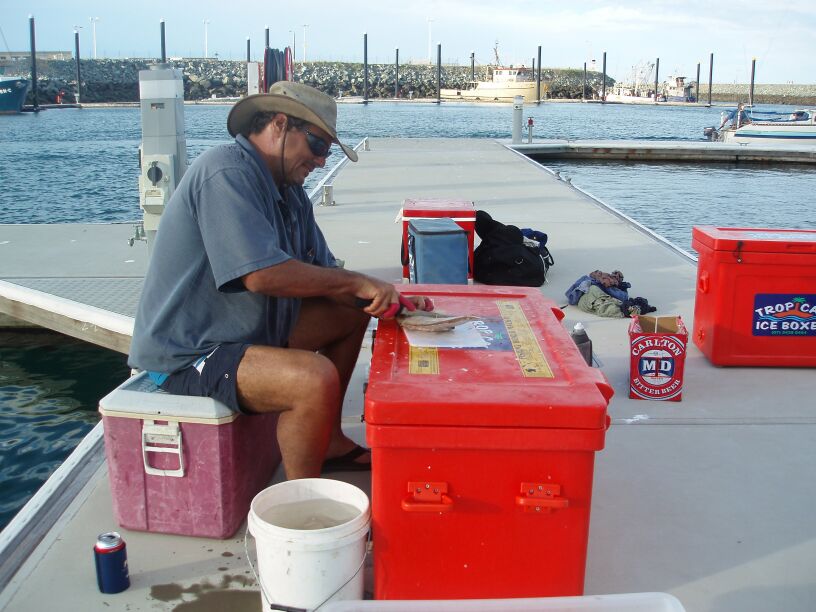

Annette took the opportunity to harass a group of fishermen from "MV Yarralee" who were cleaning a fabulous array of large and colorful fish ("Sweet-lips" and "Coral trout") at the end of our dock. They bantered back and forth good naturedly, as she took about a hundred pictures of each fish. Annette was impressed that they had pre-wrapped their fingers in red "vet wrap" before beginning the fish cleaning operation. This was so they would still have the same number of fingers at the end of the cleaning operation and I suppose reason for the choice of red colored wrap is obvious.
April 2, 2006
The weather front came through just after midnight with pounding torrential rain. I lay in bed listening to the drumming of the rain on the mizzen deck above where I was trying to sleep and congratulated myself on the facet of boat design, that requires them to be waterproof. At 0400 hours I was jerked from sleep by the memory that I had been trying to "air out" the forward port anchor locker and had left it open. Everything in this locker was designed to get wet but a couple of inches of water swimming around in the bottom was not my intent! I closed the locker and since by now all hope of returning to sleep was gone, we motored out of Mackay Marina at first light and motor sailed in the light northerlies to Hamilton Island in the Whitsundays. The weather cleared as we left Mackay and we managed to get a wind angle so that we could at least deploy the main sail "close hauled" -to offset the effects of the current we were motoring through. It was a very pretty "drive" to the Whitsundays. The water is shallow throughout the area and this depth produces a pretty turquoise water color around the 90 or so wooded islands that rise steeply from the sea bed. The island group was discovered by Captain James Cook in 1770 when he sailed through on... Whit Sunday (seventh Sunday after Easter). He came close to becoming trapped or "embayed" in nearby Repulse Bay but just managed to slip between Cape Conway and the Lindeman Islands, without the aid of the diesel auxiliary engine which we were now employing.
I had read about how Cook was trapped in the space between the Great Barrier Reef and the Australian coast and I had always visualized him thrashing back and forth, looking for an escape in something that was a mile or so wide. In fact the distance between the Reef and the land is over a hundred miles at this latitude and this area is one of the prime vacation spots in Australia with resorts, marinas, charter boats etc. everywhere. We saw just a few power boats during the 50 mile passage to the Hamilton Island marina but as we approached, we watched jets taking off from a runway near a towering block of vacation homes and had to change course to avoid a water skier and a jet skier. These were never problems for Cook.
April 3, 2006
Position: 20 20.8 S 148 57.0 E
This morning Annette did several loads of laundry and dried the clothes in the cockpit under the shelter of the bimini, while I attempted to undo the effects
of yesterday morning's faux, by drying the ballooner (spinnaker-like sail) and all of the contents of the forward locker that had been rain-soaked. The locker
was still swimming in several inches of water and all had to be bailed out and mopped. I can now rightly claim to have cleaned and repacked both of the forward
lockers.

 We had seen an advertisement for a seaplane / snorkeling trip, where they fly you out to a remote reef location for an hour or so and this sounded like fun.
We walked over to the location of the business office shown on the marina map but couldn't find the company. Enquiry provided the intelligence that
the seaplane company had moved out of that location several years ago and was now out at the Hamilton Island airport. We called the company and they confirmed
that they could do a snorkel trip for us but the price had somehow increased from $500 to $1,400. Perhaps the snorkel location was now Miami? We declined.
We had seen an advertisement for a seaplane / snorkeling trip, where they fly you out to a remote reef location for an hour or so and this sounded like fun.
We walked over to the location of the business office shown on the marina map but couldn't find the company. Enquiry provided the intelligence that
the seaplane company had moved out of that location several years ago and was now out at the Hamilton Island airport. We called the company and they confirmed
that they could do a snorkel trip for us but the price had somehow increased from $500 to $1,400. Perhaps the snorkel location was now Miami? We declined.
Hamilton Island has over 30 hotels and vacation apartment complexes, plus over a dozen independent restaurants. We have now discovered the best food is from the "Fish and Chip" take-away along the marina frontage. You pick up your order at a window (they sell beer too) and can sit at a table with a sea / marina view and chomp away while you are being hustled for food scraps by a flock of exotic parrots. There were large sulphur crested cockatoos and multi-colored lorikeets, as well as the boring ol' seagulls. Quite a change from pigeons and sparrows and much more upscale in an avian sort of way.


We rented a golf cart in the afternoon, in order to explore the perhaps 10 miles of paved roads on the island. The views were awesome as each rise would produce vistas of lush tropical islands sprinkled across a turquoise sea. There was construction of new homes everywhere and many of the vacant building sites had raised platforms made of scaffolding, so that the potential purchaser could appreciate their future view. Clever idea.
We returned our chariot to the buggy rental and informed the marina office that we plan to leave on the morrow. We thought we would head up to the northern islands and play in the water until the winds are more favorable for a departure.
April 4, 2006
It began to rain last night and dawn brought a gray day with pouring rain. It looks like a "post-card writing" and "book reading" day at the dock for DoodleBug.
April 5, 2006
This morning we slipped out of Hamilton Island Marina and motored 14 miles north to Hook Island. The wind is still from the north and is forecast to remain so until Friday. We entered a narrow fjord-like bay called Nara Inlet and anchored near it's head at 20 08.2 S 148 54.8 E. The scenery here is so unexpected for Australia. The steep and thickly wooded hillsides remind us of the spectacular anchorages of the Marquise Islands in French Polynesia - until you realize there are no coconut palms. What first appear to be pine trees are in fact a mixture of cedars and native gums.


We launched the dinghy for the first time this year and motored over to a small beach where two other dinghies lay. From here I used my aboriginal tracking skills to follow an obvious set of stone built steps that wound steeply up the hillside and terminated at a small cave. The cave had ancient aboriginal paintings on it's walls and ceiling. The area outside the cave had middens - piles of mollusk shells indicating that this cave had been used by aboriginal peoples over a period of time. From the mouth of the cave a faint trail led along the hillside towards the point of the fjord. We heard voices that indicated that we were going in the correct direction and soon passed the owners of the other dinghies on the beach, on their return journey. Bolstered by their vague directions, we eventually heard the sound of a waterfall and discovered the small stream that formed a series of waterfalls and rock pools before plunging into the sea. It was a beautiful spot and we explored it's nooks and crannies while marvelling at the variety of plants and insect life. Annette was particularly fascinated with some "green butted" ants.
As we returned to the beach, we met three young people who are touring the islands by sea-kayak for a week's holiday. They have their camp in the next bay and had paddled over to see the cave and waterfalls. Later that afternoon as the kayakers were passing DoodleBug, we invited them to come on board for a beer. They had no sooner made the tricky transfer from kayak to DoodleBug, when the heavens opened and it began to bucket with rain. They of course are camping and had been thoroughly soaked the previous night. The afternoon wore on and it was with some reluctance that they set off for the couple of miles paddle back to their camp. The kayaks had been tied alongside DoodleBug and the plastic seats now contained and inch or so of rainwater to sit in. The one plus is at least this rain is not cold! We watched Louisa, David, and Julia paddle away in the still pouring rain, until they were just specks in the distance and we wished them a comfortable night.
April 6, 2006
We had received several recommendations of places to go for great snorkeling but assumed that the current northerlies would render most of these untenable. We set out in the morning to circumnavigate the Island and take at look at the moorings at one of the recommended sites. As soon as we passed through the channel between Hook Island and Whitsunday Island, we were no longer sheltered from the wind. The 15 knots of wind were already producing sizeable waves along the eastern shore of Hook Island and our objective was on the northern shore. We reversed course and reanchored in Nara Inlet to continue our intense project of reading and bird watching between the heaviest rain showers. We have noticed a pair of Brahminy Kites (White head, rufus body) roosting in the trees close to our anchored position.
Last night we had watched a crew from a nearby catamaran swimming from the stern of their boat. We had counted them both leaving and returning to their vessel and they seemed to have a quorum. They had even tested the waters for predators by successfully throwing in and retrieving a three year-old - so I finally convinced Annette to brave the Bull sharks and jelly-fish to cool off with a dip. We swam around and under DoodleBug, cleaned the diesel smoke marks off the hull and checked the prop etc. The water clarity was not particularly good but we knew it was perfectly adequate for the man-eaters to home in on their victims......
Last night there were perhaps five other vessels anchored here but, as the day closed, more and more boats poured in as the rain poured down. At nightfall there were some 22 boats in the anchorage, several of them are large "party" boats. The rain continued all night.
April 7, 2006
The weather forecasts all agreed that today is the day for a wind shift back to the "normal" south-easterlies, thereby blowing us sailors the direction we want / need to go. We raised anchor and headed out of Nara inlet in a light drizzle. An hour later we could see the gloom of rain heavy clouds over the Whitsunday Islands behind us and the sky began to show streaks of blue with a curious bright light occasionally glimpsed in the sky. We spotted flying fish and dolphins nearby - we were now feeling positively tropical. By noon we were motor-sailing beneath sunny skies with light southerly winds and near calm seas. The wind soon clocked back to the northeast but we were by now close reaching under full sail. Not the forecasted wind direction but hey, we are sailing instead of burning diesel!
As the afternoon wore on, the wind became more northerly and increased in strength. We were still sailing close hauled but there were storm cells everywhere with frequent flashes of lightning. Annette gathered an armful of some of the critical electronic gear - iPod (all our music!), spare GPS etc. and stuffed them in the microwave oven in case DoodleBug was hit. It rained. Then it rained some more. Then we had more rain. I don't think we have ever experienced such a sustained heavy soaking. It lashed us from just about every direction as the wind clocked every point of the compass and forced an evacuation of the cockpit when it came in horizontally over the stern.
By the time we passed Cape Bowling Green, we were reefed down, with heavy seas, pitch darkness, and near zero visibility. There was an illuminated channel marker just opposite the lighthouse on the nearby Cape. The lighthouse was invisible in the gloom and the corresponding navigation channel marking light was only seen when we were abreast of it.
The problem with sailing in these conditions is that the commercial shipping channel also passes close to the Capes and the currents and shoals off the Cape attract commercial fishermen. The radar shows nothing but huge red blobs of rain and we are reduced to peering through the rain streaked windshield. When there are no lights, does this mean there is no shipping on a collision course, or in the absence of a horizon, are we simply gazing at the deck or the back side of the sail?
April 8, 2006
At 0400 hours we turned behind Cape Cleveland and anchored on a 100% "instrument" approach. A couple of hours later, a gray dawn showed
that we were indeed anchored behind the Cape, in shallow water about half a mile off
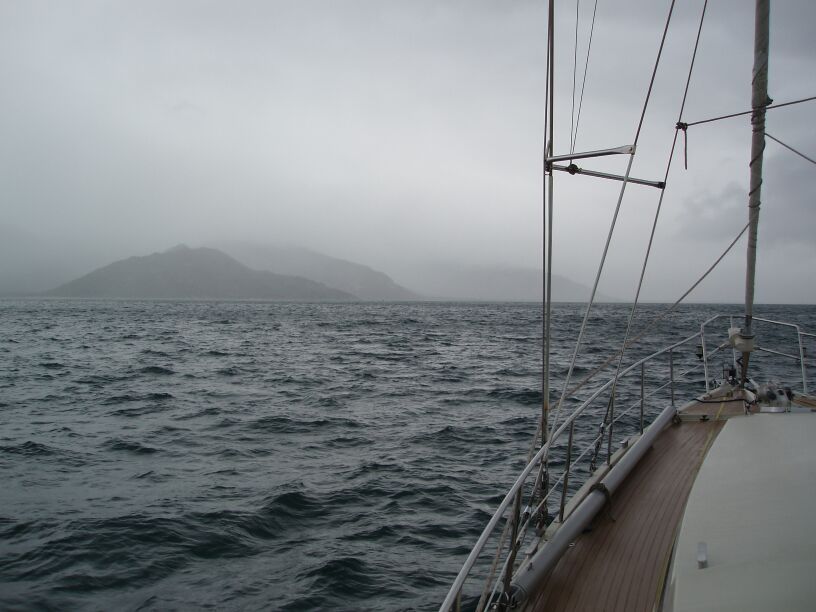
 the beach. We finished our coffee, tidied the boat, and motor sailed the 12 miles across the bay to the Townsville marina, where we picked up a slip at 19 15.1 S 146 49.4 E.
We now needed breakfast - nothing sensible mind you, we needed fat, carbs, and beer. These we found (two "big brekkies" - sausages, bacon, eggs,
potato, mushrooms, tomato, toast, XXXX Bitter) after a short walk from the marina into the town of Townsville. We saw little evidence of damage from the
recent cyclone "Larry" that hit Townsville and the walk along the sea frontage passed through a park area that was positively crowded with family
groups, barbequing, playing on the various water features, or simply celebrating toddler birthdays.

 We stopped to watch one birthday game where a bright blue sheet was laid out representing a river. The children in turn had to jump the
river. Then the river was expanded by unfolding the sheet. We could now see a green stuffed crocodile in the "river" and the children again had to
take turns to jump the "crocodile river" as it gradually became wider. I wouldn't let Annette play.
We stopped to watch one birthday game where a bright blue sheet was laid out representing a river. The children in turn had to jump the
river. Then the river was expanded by unfolding the sheet. We could now see a green stuffed crocodile in the "river" and the children again had to
take turns to jump the "crocodile river" as it gradually became wider. I wouldn't let Annette play.
April 9, 2006
This morning we gathered umbrellas and rain jackets to head downtown. We met Rodger on the dock and chaffed him about the inclement Australian weather. He assured us that this was very unusual weather and Townsville hardly ever gets rain. Yeah...Right! In fact the tourist brochure does claim 300 days per year of sunshine for Townsville. We never saw any.
Rodger was orphaned in WW II and was raised in "Dr. Barnado's Homes" (a charitable organization that operates orphanages in the UK). From there he was enlisted in the Merchant Marine at age 14 and a half. He then discovered he had managed to be eligible for "National Service" in the UK. This was the post war military draft and he was sent to Cyprus to try to separate the Turks and Greeks, who were busy shooting at each other. Around 1970, he somehow arrived in Townsville, where as he said, he jumped ship and never left.
Rodger was wearing a nautical looking "Greek Fisherman's" hat and although he had no beard, he looked somewhat like the author / sailor Tristan Jones. Rodger's story of his origins was so similar to that of Tristan Jones, I almost made a comment to that effect. We bade Roger farewell, told him to stay dry, and headed off along the sea front towards town.
About half a mile from the marina, we were surprised to see a pair of USA and Australian Flags. These marked a memorial to the Battle of the Coral Sea, where in May 1942, a major engagement was fought between American and Australian warships on the one side and the Japanese fleet on the other. A result of the battle was that the Japanese abandoned their planned invasion of Port Moresby. There was a marble tablet at the memorial with an engraved map showing the location of the various actions in relationship to Port Moresby and to Townsville. I had never really realized how close the Japanese advance came to Australia before it was rebuffed. At the time of the Coral Sea action, Townsville was a major support base for American operations and thousands of US servicemen were posted here.
Our destination was the Townsville Reef HQ Aquarium. The centerpiece of this facility is a living coral reef in a tank that is 125 feet long, 55 feet wide and 15 feet deep and in which reef conditions are artificially maintained. To keep the inhabitants of the tank alive, it is necessary to supply wave action, tidal action, and a farm of algae to supply the nutrients and oxygen balance for the 150 species of coral and 200 species of fish contained therein. Naturally, they keep the sharks in a separate tank.
We attended a lecture / tour at the aquarium given by one of the docents. The subject of the tour was "Dangerous Creatures". We learned that the most lethal animal on earth is the box jelly fish. It is transparent when healthy and cannot be seen by swimmers. It's sting kills within two minutes or so and therefore there is little hope of treatment. The jellyfish has such a toxic poison because it cannot pursue it's prey and it cannot risk having its own delicate tissues damaged by struggling, dying prey. It needs to kill almost instantly and it does. The jellyfish in it's juvenile state lives around the roots of mangroves. In spring the tiny animals swim out to sea and continue to grow (up to 15 feet or so including tentacles) and then feed in the shallow waters along the Townsville beaches and until the cooling sea temperatures of Autumn kill them off. This is why Townsville has lots of swimming pools and signs all along the beachfront warning people not to swim.


We had noticed these signs the previous day and had also noticed a mailbox on the beach with the name "V NEGAR". Now why would Victor(?)...Vincent(?)...Veronica (?) Negar collect their mail near the beach and why would they put up with a politically incorrect name like "NEGAR"? How did they handle roll call at school? All was made a little more plain with the label on the side of the mail-box which read "VINEGAR". Our tour guide at the aquarium informed us that the vinegar kills the possibility of receiving further stings from a jellyfish but does nothing for the venom already injected.
It rained the rest of that afternoon.
April 10, 2006
Position: 18 38.3 S 146 29.3 E
We sailed from Townsville this morning and anchored off Orpheus Island at 1500 hours this afternoon. All well on board.
We motored out of the marina this morning at 0830 hours and were soon sailing with poled Genoa, goose-winged main and mizzen in 20 knots of wind from dead astern. It rained on and off all day and at 1445 hours we anchored behind Orpheus Island at 18 38.3 S 146 29.3 E. Nearby was a resort on the island and as we anchored, a seaplane landed and a few minutes later took off again. There was no other sign of life and the rain began to fall even heavier. There was little incentive to try and go ashore because even if we wanted to brave the weather, the guide book warned us that the resort tolerates no visitors. It rained all night.
April 11, 2006
We left our anchorage in pitch darkness at 0500 hours for a 66 mile run to the port of Mourilyan. We were almost immediately broad reaching under sail in the pouring rain. By mid morning we noticed a squall line on radar, and after a few gusts the wind shifted direction and we were then close reaching at 8 to 9 knots with reefed Genoa and mizzen in up to 8 foot seas. The great wind died about an hour before we arrived at Port Mourilyan and we motored the rest of the way in light rain.


Port Mourilyan is a commercial harbor containing little else than a sugar loading plant. There were three tugs for use in the turning basin but no ships, just a handful of trawlers and some deserted looking pleasure craft. We anchored at 1430 hrs at 17 36.2 S 146 07.3 E on the edge of a shallow area in the middle of river and at low tide. In the evening we walked our deck for the first time in days when it was not raining. I was a little concerned that the incoming tide would sweep us onto the flats in the middle of the river and then leave us stranded when the tide went out. We watched the tide tables carefully and as hoped, the ebbing tide swept us back into deeper water.
April 12, 2006
Another departure in the darkness at 0500 hours. It was heavily overcast with light rain and we prepared to retrieve the anchor, miss the various marker buoys we were behind, and make our way out of the harbor. I felt "things" hitting my face in the darkness. The flashlight showed we were being besieged by thousands of small flies. They didn't appear to be biting but nevertheless had to be fished out of my coffee. Them coffee ground's got legs! A few liberal sprays of aerosol insecticide covered the deck thickly in little bodies but did not make a great deal of impression on the bugs. Let's get outta here!


 Morning was beautiful with the gold of a sunrise over the low clouds to the east and the Australian coastal mountain range with the summits wreathed in light
clouds and with higher clouds tinted in gold. The wind was blowing from the southwest and the smell of wet vegetation came across the water. We broad reached all morning with rain cells all around and with fishing
boats passing down both sides. The sun even appeared long enough forme to apply sunscreen. We arrived at Marlin Marina in Cairns at 1400 hours and are docked at 16 55.0 S 146 46.9 E
Morning was beautiful with the gold of a sunrise over the low clouds to the east and the Australian coastal mountain range with the summits wreathed in light
clouds and with higher clouds tinted in gold. The wind was blowing from the southwest and the smell of wet vegetation came across the water. We broad reached all morning with rain cells all around and with fishing
boats passing down both sides. The sun even appeared long enough forme to apply sunscreen. We arrived at Marlin Marina in Cairns at 1400 hours and are docked at 16 55.0 S 146 46.9 E
April 13, 2006
Today we shopped for several boat projects with mixed success. Cairns is the last "big" town before we reach Darwin, a distance of 1500 statute miles. When you look at a map of Australia, Cairns is where the highway stops. In fact, we were told that the section of paved / bitumened / tarmaced highway between Cairns and Cooktown was just opened last week. Most of the shopping items we were seeking were the kinds of things we will have to order from the internet anyway and this was more of an excuse to explore Cairns - mostly by taxi and mostly in the rain. The highlight of our day was finding a green 220 Volt LED warning light for our power breaker board and a USB digital television tuner for our laptop. We can now tell if the A/C Power to the dock is connected and we have confirmed that we have missed nothing by our previous inability to watch local television.


Annette has been busy shopping for kangaroo skins and bought me a crocodile teeth hatband for my Akubra hat. This is expected to get me free meals at Outback steakhouses throughout the USA.
April 14, 2006
This morning we took a shuttle to the Tjapukai Aboriginal Culture Park. Tjapukai is pronounced "Jab-a-guy". We know that the aborigines had no form of writing so who decided that "Jab-a-guy" was to be written as "Tjapukai"? Was this some deranged Welshman?
The Culture Park was very smoothly executed and had won several tourism awards from the Australian Government. We watched aboriginal dancers, displays of spear throwing, didgeridoo playing and a talk on bush food and medicine. We then watched a predictable and very ordinary slide show depicting the story of the Aboriginal peoples following European contact but this was followed by a very slick laser and holograph light show performance, of the spiritual beliefs of the Tjapukai people regarding creation. The interaction of the holographs and the human actors was very well done.
April 15, 2006
The weather is not cooperating with our departure north, with strong winds and rough seas warnings. We spent the day doing exciting chores such as laundry. The rain kept us indoors but, as the marina is adjacent to a very nice shopping mall with ine restaurants, the crew managed to stay entertained.


April 16, 2006
We have decided to brave the strong wind warning and have been preparing the boat for a Monday morning departure. We have serviced the engine and transmission and made a reservation at the fueling dock to top up with diesel. The weather was reasonably clear today and we have walked the Cairns promenade in the evening, as have most of the population of Cairns.
The strip along the sea front is crammed with bars, restaurants, gift shops, Chinese massage parlors, art galleries, etc. These have stayed open until into the late evening and it has been a lot of fun to shop, while grazing at the various eating establishments and people watching. We need to get out of here before we overdose on Baskin Robbins ice cream.
April 17, 2006
This morning we woke to bucketing rain. Our refueling appointment is for 0830 hours and we began to make the final preparations for leaving the dock. I did a final check of the weather forecast and noticed a gale warning and a low just north-east of us. The other weather forecasts make no mention of this but, by plotting the low on the chart, I see our projected paths will intersect just north of Cooktown tomorrow. The Cairns meteorological office came on the VHF radio and gave a weather forecast, mentioning the low but with the same general forecast as yesterday and never mentioning the word "gale". At the end of their forecast another ship cut in and said, "You never discussed the low, so you're not expecting much out of it?". The meteorologist came back on the air and said, "Well, we expect it to cross the Cape York Peninsula and think it will be upgraded to a cyclone later this morning". DoodleBug is still moored at the marina dock and will be sitting this one out for a while.
April 19, 2006
DoodleBug is moored in Cairns marina while Monica, a category 3 cyclone passes by to the north. Monica is forecast to cross over the Cape York Peninsula in the area of the Lockhart River around noon today. Here in the marina we are getting gusts of 30 knots and the rain is torrential. This latter statement is almost redundant, as the rain has been torrential on and off for the past week. From the shelter of DoodleBug the most interesting view is of a man fishing with a hand-line from the dock about 30 feet away. It is 0730 hours and he has been there since dawn. The man is hunched over (in the shelter of his bicycle!) to protect his face from the driving rain and his upper body is clad in nothing more protective than a tee-shirt. He must really like fish.


We expect the wind and seas to drop by tomorrow morning following the passage of the cyclone and we plan to leave here for a 4 or 5 day run to Thursday Island just north of the Torres Strait.
April 20, 2006
2200 hours. Anchored Cooktown harbor at 15 27.6 S 145 15.0 E. All is well on board.
April 21, 2006
Position: 15 27.6 S 145 15.0 E
Yesterday morning we finally left our marina slip and after topping up with diesel at the Cairns refueling dock, we headed north at 0900 hours. The forecast
had been downgraded from a gale warning to a strong wind warning and

 the forecast further indicated that the winds would decrease in ferocity by evening. We had a very fast broad reach, with frequent rain squalls and a wicked short
chop to the sea, producing an uncomfortable roll on board DoodleBug. The gaps between the reefs are quite narrow and we are sharing the seaway with large
commercial vessels. It was therefore very necessary to keep a careful watch on the radar and to play with the "rain" filter, to see if we could peer
through the murk surrounding us. One freighter slid by as a barely discernable gray ghost in a rain squall and less than 0.8 miles away. In between the
heaviest squalls we could see large vessels at about 3 miles, again with the radar providing the bearings as to which way to look.
The seas were forecast at 6 feet dropping to 5 feet later in the day but as dusk approached, the wind began to build again and we had 10 foot seas with breaking
crests. Some of these waves contained large trees with branches waving accusingly at us. We had originally intended to "straight shot" to the
Escape River just south of the Torres Strait but with the deteriorating conditions and the inability to "heave to" or maneuver amongst the
reefs, we made the decision to put into Cooktown for the night. We tore into the narrow dredged channel across the Endeavour River Bar with 30 knots of wind, a
strong cross-current and pouring rain. Fun, fun, fun!
the forecast further indicated that the winds would decrease in ferocity by evening. We had a very fast broad reach, with frequent rain squalls and a wicked short
chop to the sea, producing an uncomfortable roll on board DoodleBug. The gaps between the reefs are quite narrow and we are sharing the seaway with large
commercial vessels. It was therefore very necessary to keep a careful watch on the radar and to play with the "rain" filter, to see if we could peer
through the murk surrounding us. One freighter slid by as a barely discernable gray ghost in a rain squall and less than 0.8 miles away. In between the
heaviest squalls we could see large vessels at about 3 miles, again with the radar providing the bearings as to which way to look.
The seas were forecast at 6 feet dropping to 5 feet later in the day but as dusk approached, the wind began to build again and we had 10 foot seas with breaking
crests. Some of these waves contained large trees with branches waving accusingly at us. We had originally intended to "straight shot" to the
Escape River just south of the Torres Strait but with the deteriorating conditions and the inability to "heave to" or maneuver amongst the
reefs, we made the decision to put into Cooktown for the night. We tore into the narrow dredged channel across the Endeavour River Bar with 30 knots of wind, a
strong cross-current and pouring rain. Fun, fun, fun!
We dropped anchor across from the refueling station just at the edge of the ship turning basin at 2100 hours - a run of 100 nautical miles in 12 hours. The
dredged turning basin is quite narrow here and it was low tide, precluding us from moving anywhere else in the river. We turned on the deck lights as well as
the anchor light and went to bed. This morning we awoke to more rain and could now see that the Endeavour River is in flood (what a surprise with all the
rain!) and carrying all sorts of debris with it to the sea. Last night we discovered that we could not raise the bow thruster as something was jamming it.
Fortunately we managed to dislodge the "something" this morning and we are back in business.
 Captain James Cook and his crew put in here after freeing his ship from the Endeavour Reef. We managed to miss the reef last night and hope to be ready to
go in less time than the 48 days it took Cook to make his repairs. One hundred years after Cook, this place was the main port access for the Palmer River
goldfields and the population had swollen to 30,000. We were pleased to note that this included 163 brothels and 94 licensed purveyors of booze. When the
gold ran out, Cooktown degenerated into a 300 population ghost town. If it ever stops raining, we may go ashore and check out the ghosts.
Captain James Cook and his crew put in here after freeing his ship from the Endeavour Reef. We managed to miss the reef last night and hope to be ready to
go in less time than the 48 days it took Cook to make his repairs. One hundred years after Cook, this place was the main port access for the Palmer River
goldfields and the population had swollen to 30,000. We were pleased to note that this included 163 brothels and 94 licensed purveyors of booze. When the
gold ran out, Cooktown degenerated into a 300 population ghost town. If it ever stops raining, we may go ashore and check out the ghosts.
April 22, 2006
Yesterday it poured with rain all day and the wind gusted to 36 knots in the anchorage. This, plus the flood debris washing downstream in the Endeavour River, dissuaded us from launching the dinghy and venturing ashore. After catching a local weather forecast, we decided to day-sail up to Cape Flattery, a distance of around 40 miles and anchor there for the night. We raised anchor and set sail from Cooktown at 0650 hours. As we emerged from the shelter of the land, the winds were kicking up a vicious chop in the shallow waters of the Endeavour estuary. Deeper water brought a little relief and we were soon close reaching at over eight knots, with heavily reefed Genoa and mizzen. At this point of sail, we were taking a lot of spray over the bow and occasionally getting green water over the foredeck. About 10 miles from Cooktown, I noticed a squall line on the radar that was approaching. We were already heavily reefed, so I did not take in more sail but determined to "pinch up" if there was much wind in the squall. As the front hit, there was not much increase in wind but it did abruptly change direction and began to flog the small amount of sail that was up. I started to put away the Genoa completely, when I realized that it was now torn about a foot back from the leech, along it's entire length.
Cairns and not Darwin. We turned about and motor sailed back to Cooktown, anchoring on the same spot at 0930 hours. We informed the Cooktown harbor master by radio that we were again anchored off his wharf and received a call back from S/V Paradise Blue recommending a sail repair facility in Cairns. The former sail repair person in Cooktown had been eaten by a shark. This event was supposedly while scuba diving - not while repairing sails.


We eventually raised someone at the repair shop in Cairns by telephone and just caught the last delivery truck out of Cooktown, as today is Saturday. The truck was full and running late because the road to Cairns had been cut by floods for the past three days. Hopefully our torn sail will be in Cairns on Monday morning. Tuesday is a national holiday in Australia - Anzac Day. My guess is we will not see the repaired sail until Thursday at the earliest.
April 23, 2006
The Cooktown harbor has a very small area beyond the turning basin, where it is deep enough for us to anchor but even this area has mooring buoys within feet and is directly across and less than two boat lengths from the refueling dock. There is an alternate anchorage in the main channel of the Endeavor river but it is blocked by a "bar". A river bar is a zone where the incoming tide counteracts the river current and causes the river to drop its sediment - causing a shallow "bar" of sand or mud directly across the mouth of the river. For us, we can only transit this at high tide, giving us perhaps a three foot clearance below our keel. We decided to take the opportunity of a high tide this morning to make the move to this anchorage and are currently anchored a few hundred yards offshore in a deep (13 feet) part of the main river channel.
The wind blew hard all day with gusts of up to 35 knots. Although we got some rain, we also saw the sun for the first time in weeks. The current in the main
channel was running at up to 2 knots but against the strong wind on

 the ebbing tide. This caused large standing waves to form promising a very wet ride to the dock. We watched as huge waterlogged logs and tree-trunks headed
past us towards the sea and several times had to grab the boathook to try to fend off those that were on a collision course.
the ebbing tide. This caused large standing waves to form promising a very wet ride to the dock. We watched as huge waterlogged logs and tree-trunks headed
past us towards the sea and several times had to grab the boathook to try to fend off those that were on a collision course.
April 24, 2006
Monday morning and it is still blowing at over 30 knots. We had planned to go ashore to call the sail repair company in Cairns and to call Helen on the land-line.
Unfortunately the waves are too high to make a "casual" trip by dinghy. At around 1100 hours we called the sail company by sat phone and learned
that they had not received
 the sail from the trucking company. We promised to call again in the afternoon. We next called Helen and discovered that she was at
the hospital in Houston and was in labor. At that moment all thoughts of sail repairs and trucking companies evaporated.
the sail from the trucking company. We promised to call again in the afternoon. We next called Helen and discovered that she was at
the hospital in Houston and was in labor. At that moment all thoughts of sail repairs and trucking companies evaporated.
 We called every hour
by sat phone to check her progress and Maddox John Hendrix was born at 2210 hours Houston, Texas time on Sunday, April 23rd.
-St. George's Day - or on a Monday afternoon, on Cooktown, Australia time. By 1500 hours the tide had reversed and we launched our dinghy
and went ashore.
We called every hour
by sat phone to check her progress and Maddox John Hendrix was born at 2210 hours Houston, Texas time on Sunday, April 23rd.
-St. George's Day - or on a Monday afternoon, on Cooktown, Australia time. By 1500 hours the tide had reversed and we launched our dinghy
and went ashore.
We tried to use the phone but could not get an intelligible signal. From the post office we learned that all of Cooktown's landlines, cell phones, ATM's, Point-of-sale terminals for credit cards etc. were inoperable and had been "down" since yesterday. The only folks able to communicate with the outside world were those with satellite phones........
 We visited the RSL (Returned Serviceman's League) club for a beer, to "wet the baby's head" before zig-zagging our way from boat to boat at anchorage,
in the general direction of DoodleBug. The latter procedure was necessary to let everyone know we are
GRANDPARENTS!!!
We visited the RSL (Returned Serviceman's League) club for a beer, to "wet the baby's head" before zig-zagging our way from boat to boat at anchorage,
in the general direction of DoodleBug. The latter procedure was necessary to let everyone know we are
GRANDPARENTS!!!
April 25, 2006
Today is ANZAC day in Australia - the 91st. anniversary of the Gallipoli landings and also the first day in weeks where there has been a sunrise. We had wanted to attend the sunrise memorial service at the Cooktown Anzac memorial park but the winds were howling across the anchorage, gusting to 40 knots and producing big standing waves in the river against the ebb tide. The trawler moored behind us had his "tinnie" dinghy flip and had to wait for the current to drop before attempting to right it and repair the damage to the drowned outboard engine. By lunchtime, the tide turned and we escaped to the shore to find the telephones had just begun to operate again.


Each time we had passed the RSL Club (Returned Serviceman's League) the noise from inside seemed louder. We just had to check this out! The party had been going since early morning and everyone was having a good time. Annette watched the game of "Two Up" being played and managed to lose a whole $1.40 playing "Crowns and Anchors". "Two Up" is the game that was played by Anzacs during Gallipoli and in the trenches in WW I. It is obviously a complex and sophisticated game. The thrower placed three coins on a small piece of wood and then tossed them into the air. The players bet "heads" or "tails". Higher mathematics will prove that the coins will land in a configuration that is either three heads or two heads and a tail - in which case "heads" wins OR three tails and two tails and a head - in which case "tails" wins. Even though Australia has more slot machines per capita than any other country on earth, "Two Up" is illegal. It is "de-criminalized" on a single day per year - Anzac day. I expect that the reason this game is so morally sapping and needs to be banned is that unlike the "pokies" (slot machines), the government doesn't get a cut of the "Two Up" revenues.


Many of the Anzac celebrants had ridden from Cairns to Cooktown on their Harley Davidson motorcycles for the memorial observance. They had really cool black leather vests proclaiming, "Vietnam Veterans M.C. Australia". They were uniformly impressed to hear that our daughter Marian is a qualified Harley Davidson mechanic and she has received several offers of marriage - sight unseen.
We left the RSL club somewhat later than we had intended and weaved our way back across the now darkening anchorage to find DoodleBug. As we approached, we saw that another yacht had anchored nearby. It was Krista and Pascal from S/V Titum - first met last year in Vanuatu and last seen in Cairns, heading north into the path of cyclone "Monica".
April 26, 2006
This morning I called the sail repair company to check on progress and was told they hadn't seen the sail yet. After some delay, the "overnight" freight company answered their phone. "Yes, I've got your sail right here at the depot. Where do you want it sent?".
Annette called Helen who had a roomful of visitors at the hospital. She talked to all who have held the baby and demanded a detailed telephone description. This was a lengthy procedure and failed to assuage the frustration of not being there.
We next visited the James Cook Museum. The museum is located in a building that was the former convent/ boarding school for Cooktown. The school was evacuated during WW II, as a precaution against the threatened Japanese invasion and was then occupied by American troops. After the war the building was returned to the church but never re-used as a convent. It was saved from demolition to become the museum it is today. The exhibits included displays from the days when it was both a convent and school, plus displays of Cooktown's aboriginal origins, Cooktown as a gold mining supply town, Cooktown when the town was populated by over 20,000 Chinese and even had a resident Chinese consul etc. Other exhibits covered Cook's visit in 1770 to repair the Endeavour, with artifacts that were recovered from the Endeavour Reef where they had been thrown overboard to lighten the vessel. It was impressive to see the variety and quality of the artifacts that were shown at this small museum. An excellent visit.


More telephone calls and by late afternoon we knew that the torn sail had made it to the sailmaker. It has significant Ultra-Violet damage on the leech of the sail where it had torn and it would be next Tuesday before we might see it repaired and back in Cooktown.
We retired to S/V Titum for sundowners and an enjoyable evening visiting with friends.
April 27, 2006
This morning began with blue skies and sunshine and we determined to hike the Grassy Hill that Cook had climbed as a look-out point, while he too waited for his ship to be repaired. We walked through town to the Botanic Gardens and from here a trail led to Finch Bay on the east side of the headland protecting the mouth of the Endeavour River. The trail was muddy from the recent rains and led through rain forest and then between huge granite boulders before terminating at a deserted beach. We carefully observed the sign warning of estuarine crocodiles while we explored the beach front. Next we hiked north along the cliff tops towards Cherry Tree Bay. This beach had a lot of storm debris piled up along the high tide mark and we looked carefully for large biting lizards while we searched for the next trail head. We eventually found the trail which climbed steeply up the face of Grassy Hill before traversing the flank towards Cooktown. The views from the summit were fabulous, both of the Endeavour River's sandbanks and loops and across the Coral Sea towards the Great Barrier Reef.
Cook must have spent some hours here with his telescope, searching for a path through the hazards to the open sea. Our task was easier than his and we headed downhill to find a restaurant open for lunch.


On our hike today we had observed termites, green-butted ants, lizards, butterflies and the like. We had spotted three kangaroos and two of our kangaroo sightings were near the spot where Europeans had first laid eyes upon such a strange animal. A plaque marks the site with the legend, "Observed, Amazed, Described, Sketched, Shot, Eaten and named Kangaroo". We did the first two but had Barramundi for lunch.
We had seen no crocodiles but we did spot a lot of semi-submerged logs that could well have been crocodiles. We continued our non-crocodile spotting aboard DoodleBug that evening and enjoyed watched a pair of large Ospreys hunting from a nearby log.
April 28, 2006
Today we walked through to the far end of town and visited the Cooktown Cemetery. The oldest graves date back to the 1870's in the gold rush days. Of the nearly 6,000 deaths in the area, only about half were buried here and of these, only a few hundred have grave markers. The richest families would have paid the expense for markers and of course many arrived in Cooktown without family or relatives. Many of the graves were in disrepair and throughout the cemetery there were termite mounds that looked like eroding headstones.


Mrs. Mary Watson and her son are buried here. She is called the "heroine of Lizard Island". She died in October 1881 aged 23 years. Mary had emigrated from England with her parents in the 1870s. She had married her husband, a beche-de-mer fisherman and moved with him to Lizard Island in 1880, where she had her child in 1881. When her husband was away, aborigines attacked, killed one Chinese servant and wounded the other. She fled the island with her baby and the wounded servant in a rendering tank (like a bath tub) that they used as a canoe. They drifted to nearby Howick Island where all three died of thirst. Mary had kept a diary that detailed her ordeal and which was discovered with the bodies.
Many headstones reflected the high infant mortality in the community. One listed Matthew Carroll who died in 1915. He is buried here together with his six sons. The boys died at ages 7 months, 6 weeks, 3 months, 2 and 1/2 years and 10 years old. Only one of his sons made it to adulthood - John Thomas, who was killed in action at Gallipoli aged 25.
A more recent headstone was elaborately decorated with a photograph of the deceased on his Harley Davidson motorcycle. He was 41 when he died and the headstone was further decorated with a U.S. Confederate flag, engine block and push rods. The portion of the inscription written by his wife "Chopper" reads (in part), "...You lived the life you loved and loved the life you lived until someone took it all away....". The children wrote, "Dad, You taught us to be strong, You taught us to survive, You taught us the right way, Never trust a soul and you were right...." by Chantelle, Emmalene, Bonny, Brumby, Cheyanne, and Savannah and grandchildren Lucifer and Blitz. Quite a young man to have grandchildren. (...we later were told he had been the local drug dealer who had been shot by his own brother...)
In the afternoon we dinghied across to the north shore of the Endeavour River. This is the only area that was explored and scoured for botanical specimens and the like, by Banks and Solander of the Cook expedition and which has remained untouched since 1770. On this bank there are mangroves, mudflats and sand dunes, plus - as we were warned - estuarine crocodiles.


The current was swift along the sandbank where we landed and we kept a close eye on the rising tide as we explored the huge sandbank. The river had deposited feet thick layers of vegetation, that was springy to walk on, like a huge coconut fiber floor-mat. This organic layer had channels carved in it and lateral abrupt steps of two or three feet. Since this is all covered by the swiftly running river and the tide, it was hard to imagine what kind of hydraulic phenomenon had carved these strange shapes into the sea-bed. We walked over to visit a catamaran that was tied to the mangroves, with anchor lines running in the opposite direction. From DoodleBug we had seen that it was sometimes afloat but high and dry at low tide. When we got close to the vessel, we could see that it was in disrepair and showed no sign of life.
April 29, 2006
Today we took a tour up the Endeavour River with Nicko in his skiff to look for crocodiles. Nicko picked us up from DoodleBug just after high tide and with a 60 h.p Yanmar
outboard, we weaved our way through the serpentine river bends at velocities that cannot be matched by our little inflatable. Nicko was a wealth of
information on local history (supposedly someone lives on the catamaran we visited yesterday - we suggested checking for blow-flies!), bird species, trees,
flowers, species of mangroves and of course crocodiles!
We first made a visit to the remains of the Laura Railroad bridge. The railway was built by the government around 1885 after the local residents had petitioned and bitterly complained about its need. It was supposed to serve the Palmer gold fields but the gold ran out before the line was completed. It languished in a state of partial completion for 70 years or so, before the rails were torn up for cane railways down south. The bridge across the branch of the Endeavour River was made of local Cooktown iron-wood, that the white-ants (termites) are incapable of ingesting. The copper sheathing on the pilings was still visible and had been nailed on with hand-made nails.


As we headed deeper into the bush, the river banks became narrower and we began to spot the crocodiles. We spotted some 12 crocodiles over the next few hours ranging in size from 4 foot up to perhaps 14 feet. Most of these huge lizards would launch themselves down the bank into the water at our approach and we could see the marks in the mud left by their heads and clawed feet. It was an eerie feeling to be looking at these claw marks from a distance of a few feet when you know that two huge crocodiles are now somewhere in the murky water below your boat. Most of the crocs we spotted were sunning on the banks and only one was visible in the water. Of course we scoured the water for crocs and saw many "log-odiles".


We did spot a "Taipan" snake swimming down the middle of the river. This is an exceedingly venomous snake that has a reputation for fierceness. Before an anti-venom became available in 1955, it's bite was invariably fatal. Since we were also in the river, it assumed we were attacking it and attempted to return the attack. Nicko fended it off with a paddle and with a degree of alacrity unnoticed when dealing with mere crocs. We saw many different species of mangroves and Nicko pointed out their different root systems. As we moved deeper into the bush and away from salt water towards fresh water, we saw more rainforest trees such as huge "Strangler Fig" trees overhanging the river. This was a great trip and the beauty of the river and the bush will remain with us forever.
April 30, 2006
We languish in the middle of the Endeavour River waiting for our repaired sail. In mid-morning Nicko from yesterday's croc tour stopped by and asked if we would like to come up to his home and perhaps take a bush walk. His home is a spectacular "pole" house that lies at the edge of the national forest on the slopes of nearby Mount Cook - a peak of 1,414 foot elevation (431 meters). We had noticed references in the local real estate listings to "pole" homes and this refers to the pilings used in their construction. The house is built on a slope and huge "poles" or trees of native timber are used as the vertical support columns. The result is a timber home with elevated decks and a much more airy and open look.
Australians like to elevate their homes for air circulation, to get away from the bugs and to get above potential flood waters where appropriate. Nicko's home is far enough up the mountain that the latter is unlikely unless Noah drops by with the ark. He has obviously put a huge effort into the building and landscaping of the lot. There were huge granite boulders that had been used to buttress the terraces and Nicko had decorated one feature with "found" antique nautical objects gathered during his years working with fishing trawlers in the Torres Strait. We sat on the deck that extends from his living room, supping tea and trying to identify the many exotic birds that flitted about through the adjacent tree tops. The deck was sufficiently high that we often felt we were looking down on the birds.


That afternoon we hiked Mount Cook up to a look-out point before bush-wacking down a rocky, boulder strewn mountain stream and back to Nicko's property. It was a great hike and we were particularly impressed with the Golden Web spider that had built a web across the trail. I have seen larger tarantulas in New Mexico but for a spider that builds webs - that was by far the biggest bug I have ever seen.
May 1, 2006
Monday the 1st. day of May. Visions of parades of Soviet might in Red Square - actually Labor Day in Australia. They really love their public holidays here. Everything shuts down for Labor Day. I try to get hold of the sail repair place in Cairns, to get an update on expected job completion, shipping etc. but I knew it would probably be a useless attempt and it was. In a fit of optimism, we waited until high tide and then moved Doodlebug across the river bar and moored her at the refueling dock, off the dredged turning basin. This way, if a miracle happens and the repaired sail really does ship as promised, we can leave Cooktown on any tide. It is really cool being moored to the refueling dock as there is a small cafe directly behind DoodleBug and they deliver food orders to the boat.
We met Steve and Leone on the dock and chatted to them. Steve is retired and together they are building a "dream home" on a river lot on the Endeavour River. They invited us to see their property and we rode out to a place we had passed the day before yesterday, while "croc" spotting. They had cleared the lot of the denser brush and had erected a three bay commercial metal storage building on the site. It housed a tractor, a caravan and all of their furniture. Steve and Leone had set up their living room, kitchen, bathroom and were sleeping in the air conditioned caravan - all inside the building. A clever use of the storage "barn" while they construct the "home". We admired their lot and as we walked down to the river, we spotted wallabies, a bush turkey, and an orange footed Scrubfowl. The latter looked a lot prettier than it's name.
May 2, 2006
We got the repaired sail this morning at 1030 hours and set sail at 1100 hours. Current position: At sea at 14 38.8 S 145 03.7 E at 1830 hours local time. All well on board.
later that day....
Tuesday and a working day. I telephoned the Cairns sail repair at 0800 hours, 0830 hours, and 0900 hours. Finally I found a human voice instead of an answering machine. The sail was shipped "overnight" last Friday. It had probably been sitting in Cooktown all week-end. I called the freight company and was told, "30 minutes, mate". We frantically ran down our departure list, paid docking fees and checked the nearby wharf office for our sail. During this time it had again begun to rain and with all of the phone calls, we had used up all of the "time" on our telephone access card.
Back to the downtown post-office to buy another. Doesn't open until 0900 hours. Need more beer but the liquor store across from the post office doesn't open
until 1000 hours. At 1030 the sail is finally delivered and we unpack it and install

 on the forestay in the pouring rain. By 1100 hours we are leaving the Endeavour River channel and set sail for the Torres Strait.
The rain stayed with us all day and we were soon broad reaching under full sail and with the repaired Genoa. The wind stayed in the 17 to 20 knot range with 6 foot
choppy seas. By nightfall, we found ourselves maneuvering through relatively narrow channels between the reefs and of course the rule that says that any
shipping you encounter will be at the narrowest passes, fully applied. We had to make several sharp course changes to avoid other
 vessels and when under sail at night, in the rain, limited visibility and with reefs close at hand, this raises the ol' stress level. On one narrow pass, we had to make room for two cargo
ships that were overtaking each other as they passed us. I usually raised the vessels on VHF radio to ask if they have seen us and to ask if they have room to
pass us etc. One vessel who approached us at high speed identified itself as "Australian warship". Unlike the cargo carriers and trawlers, there
was hardly a light showing as the warship passed in the rain and gloom.
vessels and when under sail at night, in the rain, limited visibility and with reefs close at hand, this raises the ol' stress level. On one narrow pass, we had to make room for two cargo
ships that were overtaking each other as they passed us. I usually raised the vessels on VHF radio to ask if they have seen us and to ask if they have room to
pass us etc. One vessel who approached us at high speed identified itself as "Australian warship". Unlike the cargo carriers and trawlers, there
was hardly a light showing as the warship passed in the rain and gloom.
May 3, 2006
Position: 12 08.00 S 143 14.8 E at 1830 hours local time.
We are about 110 miles from the Torres Strait and will arrive near the Escape River tomorrow morning. All is well on board. Lots of rain, rain, rain - tricky navigation, lots of freighter traffic. Ran 189 miles in first 24 hours after we left Cooktown.
later that day.....
Wednesday continued with more high winds and rain but by 1100 hours we were 189 miles from Cooktown - a very respectable 24 hour run. By early afternoon a squall line
passed and brought an abrupt wind direction shift and light airs.
 The weather forecast had predicted this, due to a low pressure trough we were approaching. Behind us and down south, the forecast was for building high pressures and winds in
the 25 knot range. We were glad to be out of the narrow reef passages without the added misery of
these high winds - which can last for months in Australia. Although we had been passing through the easternmost reefs, we were still finding whole trees floating in the sea, as well as a large steel gas cylinder of some kind.
The weather forecast had predicted this, due to a low pressure trough we were approaching. Behind us and down south, the forecast was for building high pressures and winds in
the 25 knot range. We were glad to be out of the narrow reef passages without the added misery of
these high winds - which can last for months in Australia. Although we had been passing through the easternmost reefs, we were still finding whole trees floating in the sea, as well as a large steel gas cylinder of some kind.
By early evening we were off Cape Grenville and although we would have very much liked to anchor behind the Cape, we decided to take advantage of the current weather situation, to press on further north. The possibility of strong northerlies (head-winds) was in the forecast for the week-end and we had decided to "turn the corner" off Cape York before we were trapped by such winds.
May 4, 2006
0745 hours local time, anchored in the Escape River at 10 58.4 S 142 40.1 E
All well on board. We passed two large crocodiles swimming in the mouth of the river. We will not be swimming here.
later that day....
0200 hours, the pleasant motor in light winds is over. The wind is now blowing from the northwest at 25 knots - a direct headwind and is kicking up a vicious chop
and sending green water over the bow. It had also began raining in earnest and even heavier than before if that were possible. Sheets of water are sweeping
DoodleBug. A dragonfly comes aboard and gratefully clings to the shelter afforded by the side of the bimini cover. Amazingly there are a flock of white
birds screeching and flapping around just off our stern in the dark. Perhaps they assume we are trawler and will be providing
 them food. All we have is one dragonfly and he doesn't look like he wants to go anywhere. I am wishing I was safely anchored behind Cape Grenville some 40 miles to the south and enjoying a
restful night after a nice meal, instead of bashing through these seas. The question was, "What do we do next?". The nearest refuge was the Escape
River, a further 35 miles ahead. This wind would soon build up bigger waves than the ones we were pounding into and if the wind grew stronger, progress would be
impossible.
them food. All we have is one dragonfly and he doesn't look like he wants to go anywhere. I am wishing I was safely anchored behind Cape Grenville some 40 miles to the south and enjoying a
restful night after a nice meal, instead of bashing through these seas. The question was, "What do we do next?". The nearest refuge was the Escape
River, a further 35 miles ahead. This wind would soon build up bigger waves than the ones we were pounding into and if the wind grew stronger, progress would be
impossible.
We decided to press on and if conditions deteriorated enough, we could either "heave to" using the motor or turn and run back to Cape Grenville. We
further changed course to edge closer to the land hoping that this might reduce the possible wave build-up. At 0745 hours we had passed over the bar and entered the
Escape River. The river is choked with "rafts" of
 pearl oysters and we had to maneuver around these until we found a spot to anchor. Any thought of a cooling swim was tempered by the two large crocodiles we saw swimming near the
river entrance.
pearl oysters and we had to maneuver around these until we found a spot to anchor. Any thought of a cooling swim was tempered by the two large crocodiles we saw swimming near the
river entrance.
We checked our e-mails as soon as we anchored and received a warning from our son Matt about tsunami warnings that were issued for Fiji and New Zealand early today after a massive 8.0 earthquake shook the southern Pacific Ocean. The quake's epicenter was reported as about 90 miles off the coast of Tonga at 4:26 a.m. local time in Tonga. We pulled out a chart and confirmed that the Great Australian Barrier Reef is about 80 miles east of here and will provide protection. Nevertheless we let out more anchor chain before taking a nap.
and later still, that day....
Today we had lazed around at anchor in the Escape River. The only sign of habitation is the pearl farm near the mouth of the river. We can see two or three buildings at a distance of over two miles from us and with the binoculars, we see two figures moving in a pattern that suggests children playing soccer. There is no other sign of life. No other buildings. No fishermen. No pearling activity. The Escape River was absolutely still, with the only ripples caused by the current passing DoodleBug. At low tide we scanned the mud banks under the surrounding mangroves for crocodiles. We saw no more crocodiles but we KNEW they must be lurking nearby.
In order to leave we have two problems. First, we need enough water to float over the river bar - at least half tide. Next we need to transit the Albany Passage on a rising tide. This passage is the narrow channel between the mainland and Albany Island and the currents run up to 6 knots in each direction, according to the tide. The current running against the usual prevailing wind produces huge, ship-killing waves. The passage lies about three hours sailing distance from where we are anchored and so the logistics are problematic. We decided to leave at precisely 0500 hours - which is very dark. With luck we will transit the Albany Passage on slack high water.
May 5, 2006
1130 hours local time. Anchored off Thursday Island at 10 35.3 S 142 13.1 E.
We are in the Torres Strait! All well on board.
later that day....
The air was completely still in the blackness at 0500 hours. From our previous experience we knew this meant bugs! We sprayed ourselves liberally with mosquito repellant and covered the cockpit doorway with a mosquito net before heading out. Annette was on the bow with a flashlight, while I (Ed) attempted to exactly follow our inbound GPS "bread-crumb" track, while monitoring the radar for obstacles. We had to maneuver around the pearling rafts without getting entangled in them and without going aground. I could see most of the rafts on radar but not all and Annette had to shout course corrections from the bow. The small midge-like bugs were swarming around Annette's flashlight and getting in her eyes, her ears and up her nose. A shooting star flashed across the heavens. She opened her mouth to say, "Aah..." and received a mouthful of bugs! In the cockpit, all the lights were off and the captain was having a better time of it. As we moved closer to the mouth of the river, the breeze picked up and we were then thankfully bug-free.
We crossed the Escape River bar in light winds and watched anxiously as the depth counter counted down, breathing a sigh of relief as the numbers began to
increase, showing we had passed into deeper water. We turned north towards the pass
 and with the wind from the east, were soon beam reaching under full sail and with a very pretty sunrise. It was not the best sunrise we have ever seen
but one of the first we have witnessed in the weeks of rain we have experienced.
and with the wind from the east, were soon beam reaching under full sail and with a very pretty sunrise. It was not the best sunrise we have ever seen
but one of the first we have witnessed in the weeks of rain we have experienced.
At 0730 hours we entered the Albany passage and it began to rain. Fortunately this shower was over in five


 minutes or so and we were able to enjoy the wild and rugged scenery with its rocks, trees and spectacular cliffs, as we passed close
by. At 0800 hours we passed north of Cape York and were now in the Torres Strait. The sea is even a different color - a light green as opposed to the
slate color (or mud color!) of the east coast of Australia. The wind now clocked around from the east to the north and then to the northwest. Not a convenient
direction and for the next 12 miles we motored into a direct headwind of up to 25 knots, until we rounded Horn Island, passing the Tuesday Islets and Wednesday
Island.
minutes or so and we were able to enjoy the wild and rugged scenery with its rocks, trees and spectacular cliffs, as we passed close
by. At 0800 hours we passed north of Cape York and were now in the Torres Strait. The sea is even a different color - a light green as opposed to the
slate color (or mud color!) of the east coast of Australia. The wind now clocked around from the east to the north and then to the northwest. Not a convenient
direction and for the next 12 miles we motored into a direct headwind of up to 25 knots, until we rounded Horn Island, passing the Tuesday Islets and Wednesday
Island.
At 1130 hours we dropped anchor off the beach at Thursday Island at 10 35.3 S 142 13.1 E
May 6, 2006
Thursday Island. We had made a brief visit ashore yesterday to check in with both the Australian Customs and Agriculture departments and also to do a little shopping for fresh fruit. One does get tired of a diet of processed food after a while. It was fortunate that we made these call when we did, as most stores and offices are closed on the week-end, including of course the Agriculture department. After making our purchases, we trekked back to Agriculture with our store receipts (from "approved stores"), to get a "pre-clearance certificate". This is so that any food left on board by the time we get to Darwin won't be confiscated by the Darwin Quarantine officers. The only launderette in town was closed when we arrived there. We can wash clothes on board DoodleBug but the problem for the past four or five weeks was how to get them dry again! We walked over to the four star hotel where we had just eaten a fine lunch and Annette asked if we could use their "guest's only" laundry room. They kindly concurred and we returned to their restaurant for beer and pizza while the clothes went round and round....
It had been steadily raining all night and this morning we decided we must brave the wet and see the sights, or risk being trapped all day onboard DoodleBug by the steady downpour. We also needed to find an internet cafe and a source of current / tide predictions for our departure on Sunday. The dinghy had been tied off the stern of DoodleBug and the floor was now several inches deep in rain water. We had to make several additional slow "loops" between DoodleBug and the dock in order to give the dinghy drain, time to do it's work. The dinghy drain on our dinghy is not automatic. You pull out a rubber bung at the stern as soon as you are moving and remember to put it back in again before you stop - otherwise the dinghy just fills up with water again!
The first stop was the newsagent - alleged source of tide tables. Yes, they normally sell them but they were out of stock. The post office also carries them and will be open again on Monday. Yes there is just one internet cafe in town. That's it across the road with the "Closed" sign in the door. Now we know why this place is called "Thursday" Island and not "Saturday" Island. Back to the friendly hotel and we were given a Xerox copy of tomorrow's current / tide forecasts and were allowed to use the Manager's internet. After 10 days we were finally able to see and download the pictures of the most beautiful grandchild yet born - Maddox John Hendrix. These photos had been e-mailed to us but our sat phone is not able to receive large files such as photographs.

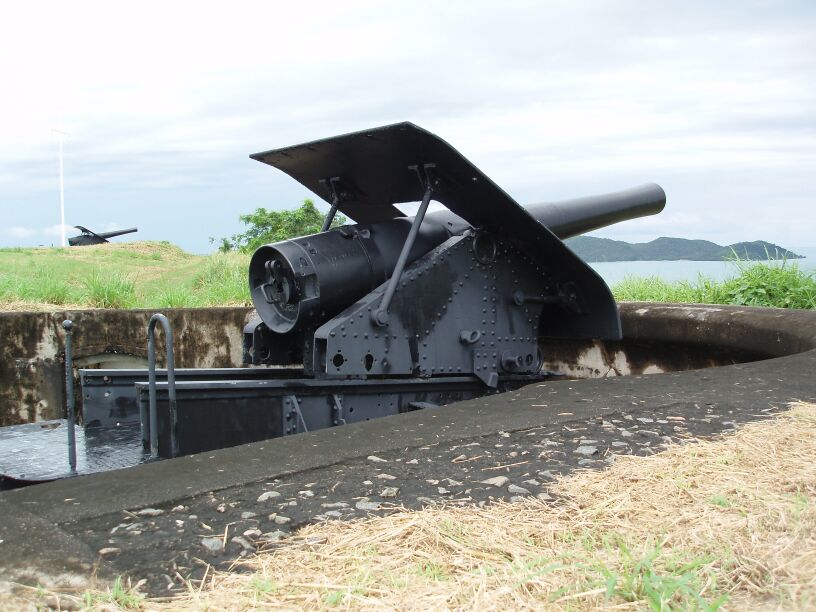


Next stop was the 19th century fort - "Green Hill Fort" that was built at the time of the Crimean War to protect Australia from a feared Russian invasion. It had three large breech loading 6 inch guns in concrete emplacements on the nearby hill-top. The rain had slowed to a trickle as we toiled uphill towards the fort and we noticed a large blue and gray bird walking in the puddles ahead of us. It politely waited to be photographed and then flew up into a nearby tree. It was an eastern blue winged kookaburra and we noticed several others roosting nearby. They entertained us while we explored the fort with their characteristic "extended manic laughter".
The fort had naturally been sited to obtain great views of the sea approaches to Thursday Island but we just took photos instead of firing 100 lb. armor piercing shells. It seemed slightly amusing to defend this isolated, barely populated part of Australia but the Torres Strait is a choke point between the Indian Ocean and the Pacific Ocean. Both military and commercial, coal-burning steamers passed nearby and to refuel these, Thursday Island was the location where large numbers of coaling "hulks" were moored. The fort was really to protect these strategic assets and construction was begun in 1891.
It was an interesting fort to visit, as it was built between the time of the American Civil War and the First World War. By this time, military design had recognized the utility of concrete and earth ramparts, connecting stone lined trenches and barbed wire entanglements. The guns themselves had armor plate shields to deflect incoming shot and were flush with the concrete parapet, with their ammunition stored in recesses in the thick concrete walls. To my eyes, what was interesting was that there was no protection against plunging projectiles - that is, the fortifications had been designed without the knowledge of the future use of aircraft. The fort was active until 1927, was used as a weather station from 1954 to 1993 and was extensively renovated in 2001, with the underground concrete bunkers now converted to a museum. This was tightly locked and closed during our visit.
Next stop was the "Gab Titui Cultural Center", a very modern and architecturally imposing building, funded by the Australian government. Australia is unique in that it is the only country with two indigenous peoples - the Aborigines and the Torres Strait Islanders. The latter look quite different from the Aborigines and are a mixture of Melanesian / Polynesian / Maori ancestors. We had met our first Torres Islander at a bus-stop in Mackay and we had thought she was an "African-American", visiting from the USA. We were a little surprised when she said she was from the Torres Strait. Now we had arrived at Thursday Island and this was the first town that looked quite different from the rest of Australia. The reason was, of course the local population, as the mainland Australian towns and cities we had visited were predominantly "Anglo", with a thin scattering of aborigines but Thursday Island was more like inner-city Houston, Texas.
The Gab Titui center had some nice displays of artifacts dating back to the early colonization period and the artifacts showed a level of sophistication, well beyond that of the aboriginal displays we have seen on our trip. We chatted to Frank David at the center and he was a wealth of information on the history and development of the T.I. culture. Frank had worked on trawlers for five years before coming to the Gab Titui Center and he was able to translate the tide and current predictions for me. His weather forecast was less accurate as we shall see.
May 7, 2006
That night at anchor, I (Ed) had been awakened to the sounds and flashes of an electrical storm. At 0500 hours we had a lightning strike that was within 1.5 seconds of DoodleBug, before we heard the crash of thunder. Shortly afterwards, the VHF radio began making complaining noises. We powered it off and it continued to make popping noises. By removing the cover, we discovered a small burn hole through the printed circuit board that was producing tiny discharge flashes. We made and attempt to insulate the burned portion of the board with a dab of silicone glue but the control functions of the radio were scrambled and the radio was useless. We checked for damage on the other instruments and found none. The likelihood of finding a replacement radio on Thursday Island and on a Sunday, we estimated at close to zero. We have a back-up hand held VHF radio on board that is only 4 watts output, versus the 25 watts of the "main" VHF but it would have to do. For emergencies, we still have a high frequency single side band radio, plus two satellite phones.
We raised anchor at 0720 hours and set sail for Darwin.
Position: 10 36.4 S 140 44.4 E at 1920 hours local time.
We maneuvered through the narrow channels with the current in our favor and were motoring in seas with a 3 foot swell and light winds. A pleasant morning with no rain! Just
after noon the storm clouds began to
 form up behind us and the seas began to build. The weather forecast was for two days of light conditions and the seas
were now producing an uncomfortable roll. That afternoon we were back to the familiar heavy cloudcover and the drumbeat of rain but now spiced up with frequent lightning flashes.
form up behind us and the seas began to build. The weather forecast was for two days of light conditions and the seas
were now producing an uncomfortable roll. That afternoon we were back to the familiar heavy cloudcover and the drumbeat of rain but now spiced up with frequent lightning flashes.
Just after dusk an aircraft flew low and directly at us and we were challenged for our identification by the Australian Customs service. We were relieved that the hand-held back-up VHF radio worked perfectly for this encounter.
May 8, 2006
Position: 10 42.9 S 137 53.7 E at 1915 hours local time.
All well on board. Very difficult sailing conditions today. Heavy rain all day. Lightning in storm cells. High winds. Large breaking seas. The latest forecast has been changed to reflect worsening conditions tomorrow. We will attempt to find shelter / anchorage behind Cape Wessel. Currently we are 78 miles away and expect to be there at first light tomorrow morning. We will then review the weather options.
later that day.....
We motor sailed on through the night and by first light the wind was at a broad reach and up to 16 knots. We were under full sail with engine off for the first time since we raised anchor. It was also pouring with rain of course and the seas continued to build. That afternoon we spent trying to unsuccessfully dodge the heaviest rain cells with their lightning strikes and the seas had built to the 10 foot mark in a short steep chop. At 1530 we got a weather forecast from the SSB radio that placed us squarely in the middle of a depression and predicted gale force winds. The customs aircraft overflew us at 1945 hours and only confirmed the forecast we had heard. The voice on the radio then enquired as to our vessel length, a question that did not dispel the gloom that was settling over DoodleBug.
May 9, 2006
0650 hours local time; Anchored 11 04.5 S 136 43.9 E
Marchinbar Bay, Marchinbar Island, south of Cape Wessel. All well on board. Will review weather options before leaving here.
later that day....
We sailed on through the night and in the wee hours of the morning had weathered Cape Wessel. There was little change in the seas but the deep roller that had been coming from the south from the Bay of Carpenteria disappeared as we crossed the Cape, leaving only the high wind driven seas.
The seas were rough off the cape as the currents were squeezed past the point of land but we turned north and after bashing our way into 30 knots of headwind for an hour, we were able to turn back to the east into the calm of Marchinbar Bay on Marchinbar Island. Our entrance to the bay was with radar and binoculars, as it was not quite dawn but although the winds still howled, the waves were gone! We dropped anchor at 0650 hours local time at 11 04.5 S 136 43.9 E.


What a wonderful place! Dawn showed us blocks of basalt black cliffs with white sand dunes between. The few trees looked completely blasted and there was no sign of life or the hand of man anywhere, except on board DoodleBug. Here we settled down with popcorn and candy to watch movies all day, while the wind blew at 30 knots across the tiny bay. The customs aircraft flew over that afternoon and again the handheld VHF did the job.
May 10, 2006
 A slow start to the day as we double-checked the weather forecasts and prepared to head out of the womb we had comfortable settled into in Marchinbar Bay.
The weather reports were again favorable and we set sail at 1030 hours with poled
Genoa, broad reaching with 18 knots of wind. The cloud cover was only 3/4 of the sky and we could catch glimpses of the sun! By afternoon the blue sky was
gone and it was raining again but the wind stayed in the south-east at just below 20 knots.
A slow start to the day as we double-checked the weather forecasts and prepared to head out of the womb we had comfortable settled into in Marchinbar Bay.
The weather reports were again favorable and we set sail at 1030 hours with poled
Genoa, broad reaching with 18 knots of wind. The cloud cover was only 3/4 of the sky and we could catch glimpses of the sun! By afternoon the blue sky was
gone and it was raining again but the wind stayed in the south-east at just below 20 knots.
May 11, 2006
Position: 10 55.0 S 134 11.5 E at 0600 hours local time.
Raised anchor yesterday morning and headed west again. currently 265 miles from Darwin. All well on board.
later that day.....
 Nightfall brought glimpses of a near full-moon but we were also reefed down with 26 knots
of wind and 8 foot swells. These conditions continued through the night but by morning, the winds had dropped to 20 knots and we had no more than 3/8 ths
cloud. It was sunny! Our only gripe was that the swells were in the 8 to 10 foot range, steep faced and just over a boat length apart. Every few minutes we would
partially broach, as a particularly steep wave would break as it reached DoodleBug. At 1430 hours we passed "New Years Island" indicating that
we were approaching the Coburg Peninsula and the big swells began to decline. Today was the first day since we left Mackay that it has not rained.
Nightfall brought glimpses of a near full-moon but we were also reefed down with 26 knots
of wind and 8 foot swells. These conditions continued through the night but by morning, the winds had dropped to 20 knots and we had no more than 3/8 ths
cloud. It was sunny! Our only gripe was that the swells were in the 8 to 10 foot range, steep faced and just over a boat length apart. Every few minutes we would
partially broach, as a particularly steep wave would break as it reached DoodleBug. At 1430 hours we passed "New Years Island" indicating that
we were approaching the Coburg Peninsula and the big swells began to decline. Today was the first day since we left Mackay that it has not rained.
May 12, 2006
Cleared Cape Dom and we are now in Van Dieman Gulf about 70 miles from Darwin.
Position: 11 51.8 S 131 27.2 E at 0900 hours local time.
Expect to be in Darwin this evening./ All well on board.
later that day....
The next challenge approached and this was Cape Don. The cruising guide warned of a boiling maelstrom of breaking seas, impossible sailing conditions and the like -
if we attempted transit with the wind against the tidal current. A formula was offered of passing Port Essington, four and a half hours before high tide in
Darwin.

 Where the hell is Port Essington? We calculated, converted from Universal Time to local time, double checked, triple checked and passed where we
thought Port Essington might be at 0230 hours. The dreaded passage past the cape was in near calm conditions, motor sailing with 8 knots of wind. The GPS showed
four knots of current and it was with some relief that we headed into Van Dieman Gulf. From here I had calculated that we could make a night arrival in Darwin
around 2200 hours and anchor somewhere in the harbor until morning. By first light the wind had picked up and we were again under full sail with sunny skies
and perhaps 2 foot, wind generated seas. On the leg to the southwest towards Cape Hotham, we were close hauled and the crew did not like the hobby horse
motion, as we crashed through the now bigger waves, heeled over and speeding at 10 knots over the ground with the help of the tide. We shot through the narrow
Howard Channel showing 12 knots over the ground with the assistance of near 5 knots of current. For the first time in weeks we had clear skies and sunshine, a
light-green sea and waves of less than two feet. This is what we had signed up for! We also realized that we approaching Darwin far faster than originally
computed and might actually make it in daylight. We frantically called the marina to find out its location and checked the tide heights in Darwin to see
whether we could transit the river. Everything clicked and we
Where the hell is Port Essington? We calculated, converted from Universal Time to local time, double checked, triple checked and passed where we
thought Port Essington might be at 0230 hours. The dreaded passage past the cape was in near calm conditions, motor sailing with 8 knots of wind. The GPS showed
four knots of current and it was with some relief that we headed into Van Dieman Gulf. From here I had calculated that we could make a night arrival in Darwin
around 2200 hours and anchor somewhere in the harbor until morning. By first light the wind had picked up and we were again under full sail with sunny skies
and perhaps 2 foot, wind generated seas. On the leg to the southwest towards Cape Hotham, we were close hauled and the crew did not like the hobby horse
motion, as we crashed through the now bigger waves, heeled over and speeding at 10 knots over the ground with the help of the tide. We shot through the narrow
Howard Channel showing 12 knots over the ground with the assistance of near 5 knots of current. For the first time in weeks we had clear skies and sunshine, a
light-green sea and waves of less than two feet. This is what we had signed up for! We also realized that we approaching Darwin far faster than originally
computed and might actually make it in daylight. We frantically called the marina to find out its location and checked the tide heights in Darwin to see
whether we could transit the river. Everything clicked and we

 headed up the tidal river to Bayview Marina where they opened the marina lock gates allowing us to enter the only other lock we have been in since the Panama canal. The
locks are to keep water in the marina at low tide, as Darwin has a near 30 foot tidal range! At 1730 hours we were inside the marina and tied to the dock at
12 26.4 S 130 51.6 E. We are in Darwin!
headed up the tidal river to Bayview Marina where they opened the marina lock gates allowing us to enter the only other lock we have been in since the Panama canal. The
locks are to keep water in the marina at low tide, as Darwin has a near 30 foot tidal range! At 1730 hours we were inside the marina and tied to the dock at
12 26.4 S 130 51.6 E. We are in Darwin!
