


Indonesia - Java
September 21, 2006
Yesterday we moved DoodleBug from a dock on the outside of the marina, to a slip in the sheltered inside. The prevailing wind had been pressing us hard against the dock and we had waited for two days for this to let up. Finally, yesterday morning at dawn was a perfect calm and the wind did not begin blowing hard until some fifteen minutes after we had made our move and were safely tied up. The reason we wanted to make this move was that we have booked airline tickets and wanted DoodleBug in a nice protected location as we fly to Java this afternoon.
It had taken close to two hours at the travel agent to make the reservations and create and print the travel vouchers. We were delighted to find that the airline check-in employees did not break into hysterical laughter when they received our tickets and our transfers and hotel reservations were all in order. We are in Yogyakarta, Java!
September 22, 2006
Background: What is today Indonesia, was a group of island communities, each with it's own group of disconnected kingdoms. At the beginning of the 7th. century, the island of Java was home to several of these Hindu-Buddhist kingdoms. On Java there are several elaborate temples dating from this time. In the late eighth century a new Buddhist kingdom under the Sailendra dynasty developed and built a massive temple monument at Borobudur - completed sometime in the mid-9th century. The Moslem religion arrived around the 14th. century followed by Portuguese traders in the 15th century. The Dutch and English traders soon followed the Portuguese but in the early 17th century, the Dutch grabbed Java and established a capital at the present Jakarta. The Dutch pretty much held on to Java for the next 350years, although by the beginning of the 19th. century, there was a Nationalist movement headed in the 1920s by Sukarno and Hatta. The Dutch suppressed the Nationalist movement fairly ruthlessly but this all changed with the 1942 Japanese invasion. Although the Japanese forced tens of thousands of Javanese into forced labor, they also allowed a degree of political freedom to Sukarno and Hatta, promised eventual independence of Indonesia and established militias on Java, Bali and Sumatra by giving military training to the local men. The result of this was that two days after the Japanese surrender in 1945, Sukarno and Hatta declared an independent Republic of Indonesia and established it's capital at Yogyakarta, where we are at the moment. The Dutch fought to restore their control of Java but the local boys now had guns and knew how to use them. By1950 it was all over and Indonesia had achieved independence and the new capital was back to the Dutch capital of Jakarta. Today's Java has a population of around 100 millions and is predominantly Muslim. Jakarta has a population of about 8 million and Yogyakarta is about 600,000.
We had booked a tour of Yogyakarta and our guide plus driver showed up a tour hotel promptly at 0800 hours. Our first stop was a tour of the Sultan's Palace in the town
center of Yogyakarta. How the Sultanship survived the various occupations is not entirely clear but the position seems to have been one of hereditary and symbolic


 significance and remains so today. We toured the palace and saw displays of uniforms, ceremonial dress, medals, antique musical instruments, china, glassware and the like but the most interesting part of the
visit was due to the fact that the Sultan still lives in the palace. There were sections of the palace "out of bounds" to visitors, since they are the present living
quarters but the dining rooms were also in use and they were preparing for a state dinner as we toured. The tables were set with china, utensils and napkins and there were palace employees setting up the food. We were a
little surprised that we were wandering through the middle of all this but the palace tour guide was watching us too closely for us to taste test the food. Another unexpected display was a photo
exhibit showing the young Sultan in Boy Scout Uniform. Boy scouts are still very popular here and Lord Baden-Powell is still well remembered and honored.
significance and remains so today. We toured the palace and saw displays of uniforms, ceremonial dress, medals, antique musical instruments, china, glassware and the like but the most interesting part of the
visit was due to the fact that the Sultan still lives in the palace. There were sections of the palace "out of bounds" to visitors, since they are the present living
quarters but the dining rooms were also in use and they were preparing for a state dinner as we toured. The tables were set with china, utensils and napkins and there were palace employees setting up the food. We were a
little surprised that we were wandering through the middle of all this but the palace tour guide was watching us too closely for us to taste test the food. Another unexpected display was a photo
exhibit showing the young Sultan in Boy Scout Uniform. Boy scouts are still very popular here and Lord Baden-Powell is still well remembered and honored.
Our next stop was a tour of the Ngasem bird market. This was a section of a general market specializing in every kind of pet animal imaginable. The small shops in the "bird market" were crammed from floor to ceiling with squawking, chirping cages and the alleyway between the stores was so narrow, you could stretch out your arms and shop in two different stores simultaneously. They had bats and pigeons, rabbits, mice, kittens, puppies, snakes and lizards.


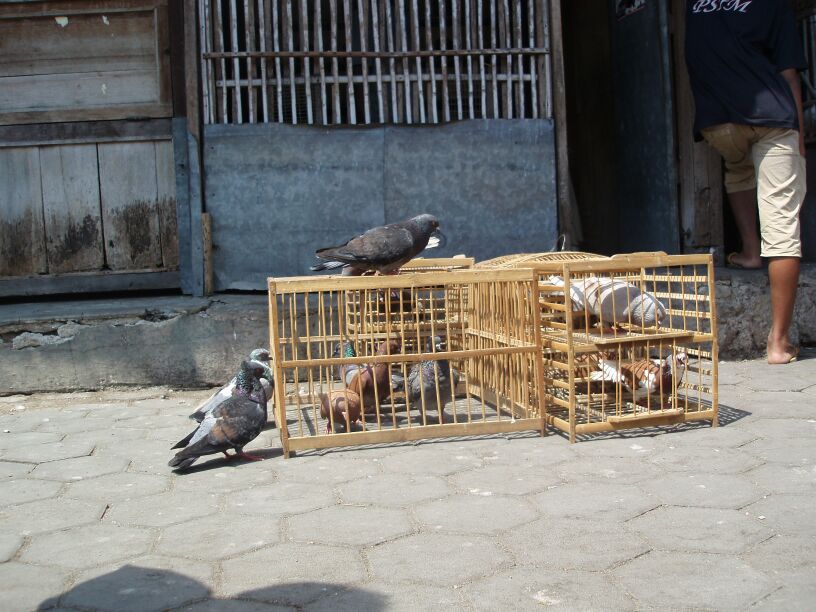
It was boggling how anyone could possibly make selection. The animals all had food and water but the cages were in general none too clean. Pet accessories were everywhere with mountains of cages and pet food. For the insectivore birds, they had mealworms and crickets and some kind of grub that were being tended by large ants. You could buy a small bamboo tube stuffed with whitish grubs and with the end of the tube sealed with a twist of banana leaf. Yummy! We left the claustrophobic confines of the pet market and walked over to an unusual structure. It was a sunken mosque with the deepest levels belowground and the upper levels partially damaged by the recent earthquakes. What was particularly interesting was that the mosque was circular. Most mosques are rectangular so that all of the worshippers can face Mecca while they pray. The central hub of the mosque was trisected with a series of arching stairways, a little like those perspective drawings that fool the eye with stairways that climb forever. The shadows and lighting were such that Annette could have spent the whole day taking photographs and nearly did.


The market and many of the nearby homes are built on the former ruins of the Sultan's Palace. The latter was so badly damaged by earthquakes that the Sultan must
have decided it would be cheaper to rebuild elsewhere. The tottering walls of the original palace occasionally fall and snuff out the lives of the squatters in their homes


 below the walls. We were grateful that our guide took us on a wide circumambulation rather than shortcutting through the tottering brick seracs of the original palace walls.
Annette has enough problems with multi-story car parks in the USA shopping malls to even consider this type of adventure. We next visited the Water Palace - a
below the walls. We were grateful that our guide took us on a wide circumambulation rather than shortcutting through the tottering brick seracs of the original palace walls.
Annette has enough problems with multi-story car parks in the USA shopping malls to even consider this type of adventure. We next visited the Water Palace - a

 series of large Romanesque swimming and bathing pools, where the early Sultans held wet tee shirt competitions to determine the afternoon's entertainment.
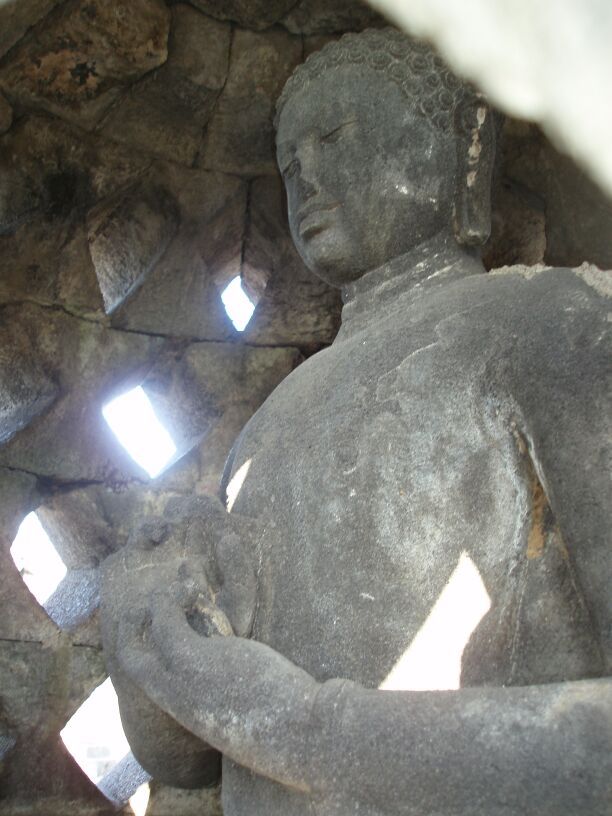
After lunch we headed out to Borobudur temple. Borobudur as I mentioned before was completed in the 9th century but abandoned in the 11th century. Why it was abandoned is not clear but when it was discovered by an English archaeologist in 1815, it was buried in volcanic ash and covered in jungle. The volcanic ash had protected the intricate carvings from erosion over the centuries and the site received extensive reclamation in 1983. The reclamation was funded by the "United Nations" and although dozens of countries were recognized as having contributed to the restoration work, I noticed that Uncle Sam was nowhere mentioned. The temple is constructed on a hill and consists of eight layers. The first five layers are square terraces with the sculpted walls showing scenes from Buddhist mythology. The topmost layers are circular and each has a circle of bell-shaped stupas (Buddhist shrines). Pilgrims would walk through some 3 miles of passages and stairways before reaching the summit. The design was meant to depict the structure of the Universe with man's progression through life towards Nirvana. This temple was certainly the highlight of our visit to Java and with the blue skies, sunshine and brooding volcano in the background, provided endless photographic opportunities.




As we were leaving the temple site, we came upon a huge crowd of locals with multiple groups of drummers beating enormous drums and with forty or fifty dancers wearing elaborate and colorful costumes. The dancers were very enthusiastic and we were at first confused as they seemed to be wearing American "Red Indian" costumes. They had long feather "chief" headdresses and square loincloths over the traditional black spandex bicycle shorts. The dancers towards the rear were wearing blue feathered masks and we concluded that perhaps this style of apparel is not unique to the plains of North America.


September 23, 2006
An even earlier departure from our hotel this morning as we drive to the town of "Solo". Another fascinating view of the countryside but on this trip, we could see that many of the homes and businesses showed damage from the May 2006 earthquake. The older buildings had the worst damage and many looked partially collapsed.
Our first stop was to visit the Sultan's Palace at "Mangkunegaran". As we walked into the palace with our guide, there was a whole orchestra of Gamelan players, who sprang to life and began playing - sort of like the automatic door chimes at a gift shop. The instruments are tuned gongs, xylophones, and metallophones (a percussion instrument with bars of metal). Now we have read that the second oldest human remains ever found on earth were found here - "Java Man". I am sure that some of these remains were playing in that orchestra. The music was fine but the old men sitting cross legged and playing the instruments could have been animatronic dummies for all of their facial expressions.


We saw more elaborate displays of antiques in this palace but the highlight of the tour was the display of male and female chastity belts. The Sultan was supposed to have worn his when he was out jogging around his Kingdom and his wife was also fixed up before he left home. We asked how her chastity belt was locked and were told that it was locked with a "special spell". This sultan must have been particularly gullible.
We visited a flea market at Triwindu and also the Rayda Pustaka Museum. The flea market was Annette's favorite and crammed with "stuff". We are very fortunate that we are traveling by boat rather than motor home.


In the afternoon we visited the Prambanan Hindu temple. Like Borubudur (the Buddhist temple we visited), this shrine was built in the mid 9th. century. The shrine had suffered from the several earthquakes over the centuries and was supported in many places with scaffolding. We were not allowed to approach the edifice too closely, because of the risk of further collapse but the towering structure built of carved basalt blocks was very impressive.


September 24, 2006
Our return flight today was at noon, so we took a taxi to the center of Yogyakarta and walked the stores along the main street. Java has one form of transportation that we did not see in Bali and these are tricycle rickshaws. There were hundreds of them scattered everywhere in town and we would see a dozen or so in ranks awaiting customers.


In this vehicle the passengers, (two) sit side by side at the front between two wheels and the driver pedals the balance of the tricycle from behind. We just had to try these! We climbed
aboard and the rickshaw man took off into the traffic. No traffic rules seem to apply. He ignored one way streets, traffic lights and crossed the heavy traffic stream as though the other
vehicles did not exist. My most vivid memory was when he wanted to turn right from a two way street (they drive on the left in Java). He did not want to slow down at a red light so he crossed over into
the oncoming lane just as the light was changing and ploughed into a horde of about fifty motorcycles who were all making a "Le Mans start" from the light as
it changed to green. He then
 made a right turn through their ranks. Of course the passengers (us) were seeing all this in 3D and full color from the exposed front of the vehicle. If you ever decide to
ride on of these contraptions, the downhill run is more exciting than the uphill return.
made a right turn through their ranks. Of course the passengers (us) were seeing all this in 3D and full color from the exposed front of the vehicle. If you ever decide to
ride on of these contraptions, the downhill run is more exciting than the uphill return.
We had made arrangements via e-mail to call Jack and Daphne on S/V Resolute by SSB radio, when we returned to Bali Marina. Unfortunately I had failed to realize that Java was an hour ahead of Bali and we were going to miss the scheduled call. When we arrived at the marina, Jack and Daphne were sitting in the marina bar so that problem was solved. We first met Resolute in Apia, Samoa in 2004, passed them at sea as we were leaving Opua, New Zealand and had last seen Resolute moored at Brisbane, Australia in 2006 (although her crew was not aboard at the time). We will part company again as DoodleBug heads west to Christmas Island and Resolute heads north to Singapore. The next time we may meet will be in the Mediterranean in 2007. Such is cruising.
September 25, 2006 - September 28, 2006
The past few days we have begun to get serious about putting to sea again. We have topped up our diesel tanks and conducted a search of Bali for additional fuel
jugs. Here's the math. It is about 3,200 miles from here to Male' in the Maldive Islands, where we could take on more fuel. If we should miss Male because of adverse weather and the like, we
would have another 2,300 miles to our next gas station. If we sail every inch of the way, we would be arriving in Djibouti in late December and would have used 900 liters of fuel just running the
generator on a daily basis to recharge batteries. The main diesel tank holds 600 liters. If we have adverse winds or no winds on the segment between Chagos and Male, as we cross the equator and
pass through the doldrums, we could need over 400 liters or so to motor. We normally carry an additional 200 liters of fuel in jerry jugs and have never really needed this reserve, although it
has certainly added to the comfort factor. We therefore decided to carry another 250 liters and to look for plastic jugs to carry it. This was mildly entertaining. We


 found that the commercial fishermen use 25 liter jugs from the laundry that have been used for powdered detergent. I asked at one marine supply store if they had "new" jugs and the owner
indignantly shook the jug, showing that the residual detergent powder was fresh and these were therefore "new". The standard rate was US$1.80 each and I asked if they
could be delivered to the marina. The ten jugs arrived by motorcycle.
found that the commercial fishermen use 25 liter jugs from the laundry that have been used for powdered detergent. I asked at one marine supply store if they had "new" jugs and the owner
indignantly shook the jug, showing that the residual detergent powder was fresh and these were therefore "new". The standard rate was US$1.80 each and I asked if they
could be delivered to the marina. The ten jugs arrived by motorcycle.
We have done our laundry, filled and stowed the diesel, topped up our groceries, updated the navigation, checked and rechecked the weather and we have applied for departure documents. It hasn't been all work though and we have been out to see Balinese dancing almost every evening (see www.nikkobali.com ) . The first two evening dances we saw were the classical Legong. The girls wear stunning costumes and the dance is very graceful, like a slow ballet. The wrist and hand and finger movements seem impossible for normal human beings but these girls train from early childhood.


We had seen a carved wooden board in several of the gift shops and at one point we did see it in action. It is a children's memory game involving counting beans in a series of shallow bowls in the board. The shape of the bowls are designed to train the hands of the future Legong dancers, so that they can bend their fingers to the required position. We also saw the Kecak dance. This is an Indonesian dance-drama using a "cak" chorus, supposedly singing in trance, instead of the orchestra with instruments as in Legong dancing. The Kecak drama is from the Hindu epic "Ramayana" and sung by a narrator while the dancers portray the characters. The dancers are surrounded by a seated circle of traditionally from 100 to 200 male singers. We had twenty four (I counted) but it still seemed a lot. The cak singers represent various forces in the drama and accompany the dance with interlocking vocal sounds - often the cak-cak-cak sound of monkeys. They are naked from the waist up and accompany their singing with choreographed upper-body swaying and arm gestures. For the finale, one of the cak men walks through a large bonfire of coconut husks that has been lit at center stage. He then proceeds to sit in the burning embers and spin around. He is restrained in his trance induced thrashing by fellow cak men, until a priest sprinkles him with holy water and he is immediately restored to whatever passes as normalcy. Impressive.
