 forecasts we consulted, we spent the whole day tacking back and forwards into a direct headwind. This morning there is little wind - just a huge uncomfortable sea. We are hoping
to pick up the trade winds later today.
forecasts we consulted, we spent the whole day tacking back and forwards into a direct headwind. This morning there is little wind - just a huge uncomfortable sea. We are hoping
to pick up the trade winds later today.Christmas Island
October 1, 2006
Position: 09 04.2 S 113 55.1 E
We left Bali this morning at 0700 hours local time heading for Christmas Island. Contrary to all three weather
forecasts we consulted, we spent the whole day tacking back and forwards into a direct headwind. This morning there is little wind - just a huge uncomfortable sea. We are hoping
to pick up the trade winds later today.
The past couple of days have been spent with the usual chores of checking the internet sites and paying bills, plus the last maintenance items and last minute souvenir shopping. We paid our marina bill and had our exit documents in hand stating that we were leaving Friday and which further warranted that we would be out of Indonesian waters within 24 hours of issue. We had told the marina agents we wanted to leave on Sunday morning but that does not fit with the bureaucratic week-end. Nevertheless, this is a laidback place and DoodleBug slipped her moorings shortly after dawn on Sunday and headed south to clear the island of Bali.
All available weather forecasts predicted light winds from the southeast, giving a broad reach (wind from behind) for the 580 mile run to Christmas Island. We made the turn to the west as we cleared the southern tip of Bali and could now feel the wind without the contaminating effect of the Bali landmass. The wind was blowing stubbornly from the west-southwest at between 8 and 12 knots. This was within 20 degrees of our direct heading. We began by tacking south assuming that the further south we got into the Indian Ocean, the more sensible the winds would become. No joy! Back and forth we tacked. Now DoodleBug is a cruising yacht and is not setup to go upwind - the technical expression is "wide sheeting angles". In the seas running and with the lightish winds, we managed to sail 45 degrees to the apparent wind direction. The apparent wind is what we feel at the boat, 'cos the boat is also moving through the water. The true wind angle was about 20 degrees more than these angles plus the boat slips sideways through the water when it is sailing upwind and this makes it another 15 degrees worse with "leeway". In fact, we were running about 145 degrees between tacks and after 12 hours of sailing at 5 to 6 knots, we were still only 28 miles from Benoa harbor. Late that night the wind died away and we began to motor sail and were at last pointing at our destination. A series of rain clouds appeared on our radar indicating a "not forecast" frontal system which brought a little rain and, shortly after it's passage, winds from the southeast. We are finally under sail on a rhumb line course for Christmas. Just enough wind to tantalize though and it soon swung back to a direct but light headwind. I was surprised to see that we in fact covered 90 miles during our first 24 hours at sea. We had made forward progress while under sail, at about two and a half knots in the direction we wanted to go.
October 2, 2006
Position: 09 28.2 S 111 28.9 E as of 2240 UTM
We are just beginning our third day at sea and have about 350 miles to go. We expect to be at Christmas Island on Thursday morning. So far it has been a bit rolly but not too rough. The swells are coming at us every 15 seconds or so from the SSW and they are in the 12 foot range. Like a line of hills coming at you. These are combined with the wind generated waves coming from the SE; they meet at right angles and makes the ride a bit sloppy. All well on board.
At noon today we were under full sail, beam reaching towards Christmas Island. Despite the light winds, the sea was not calm with 8 to 10 foot swells plus a chop. The Indian Ocean is well known for this phenomenon. To the west and south of the Australian land mass, there are huge storms producing swells (long period waves) that were coming at us from the southwest and which showed up on radar as a pattern of reflections from the advancing ranks of waves. Then you have the wind generated waves that are coming from the southeast. The two sets of waves sometimes reinforce each other and sometimes cancel but to the sailor in the middle, it means a jerky, unpredictable, and uncomfortable ride. It also means that we cannot see the local wooden fishing boats on our radar, unless we are on a short range six mile setting because of the wave clutter on the screen. We knew there were boats out there as they chatter at length on the VHF hailing channel. We set our "watch" cycle to every 12 minutes so that we might spot them but never did. All we saw that day were a couple of dolphins and some flying fish. That night, after the Ramadan moon had set, the bioluminescence of the water made us look like we were sailing through a sea of diamonds scattered in milk. Our run for the day was 140 miles.
October 3, 2006
Today we have the forecast trade winds blowing from 8 to 10 knots for most of the day, picking up strength in the late afternoon to the 18 to 20 knot range, as we reefed down to Genoa and Mizzen for the night. It would have been a great day but both Annette and I came down with almost identical stomach problems. Did we pick up a bug in Bali? Who knows, but we spent the day feeling sorry for each other. 143 mile run in the 24 hours.
October 4, 2006
Position: 09 52.1 S 108 53.8 E as of 2330 UTM
Big choppy seas all day with the wind steady from the southeast and blowing 15 to 18 knots all day and then strengthening in the evening to 18 to 22 knots as it had done the night before. We are about 190 miles from Christmas Island as I write this and should arrive tomorrow afternoon (Thursday). All well on board.
October 5, 2006
Position: 10 25.7 S 105 40.1 E
Dawn showed Christmas Island dead ahead. We passed our next 24 hour point just before we turned behind the Northeast point to anchor in Flying Fish Cove. We had run 192 miles in the previous 24 hours and have beaten this distance only a couple of times in the past three years and then only by a single mile on each previous occasion.


We had received printed instructions from Australian Customs in Darwin as to the arrival procedures for Christmas Island. We swung in next to the pier and dropped the anchor. The voice of the Harbor-Master immediately came on the radio and informed us that it was not permitted to anchor where we had just dropped the hook. We sucked the anchor chain back into the boat and asked where we could anchor. The slightly surly voice stated that all anchoring was forbidden and we should use one of the mooring buoys just west of us. No problem. Annette lassooed a mooring buoy that had no pigtail, just as though she was a Texas girl and we are moored at 10 25.7 S 105 40.1 E.
The next voice on the VHF was Australian Customs, asking basically who we were - in a slightly terse voice. We responded with the details and confirmed that they had not received our emailed yacht arrival notification we had sent four days earlier from Bali. On this notification, we had given our ETA as 0800 hours and the Darwin instructions said we should call on VHF after 0800 hours. By amazing coincidence, considering the real sailing conditions, we had arrived almost exactly as stated. This was of course tempered by the fact that the local Customs officer was unaware of the fantastic job we had done complying with the regulations and in addition we had just pissed off the Harbor Master by attempting to anchor on his coral reef.
At 0830 hours we dinghied to the dock and picked up the Customs and Immigration officer and the Quarantine lady. By now they had confirmed that we had valid visas and all of our paperwork was already completed, signed, and ready before they even came aboard - thanks to the complete set of blank forms we had taken in Darwin. A few minutes later we were legally back in Australia. Shower, change of clothes, head for the dock to see if we can find some Christmas breakfast!
October 6, 2006
Background: Christmas Island was so named by Captain William Mynors when he sailed by on 25th December, 1643. He didn't land. Later vessels just stopped by to load topsoil for transport to Cocos Keeling atoll, some 520 miles away. In 1887, a couple of surveys of the island were made and showed that the topsoil consisted of high grade phosphate. HMS Imperieuse annexed the Island for Britain on 6th June, 1888 and in 1891, the British Government granted a 99 year mining lease to a couple of entrepreneurs to extract the phosphate in exchange for royalties. The lads formed a corporation, the Christmas Island Phosphate Company, and brought in 200 Chinese laborers from Singapore to work the mine. The first shipment of Phosphate left the Island in 1900 and subsequent shipments were only interrupted by WWII and the Japanese invasion of the Island. The Japanese tried to export phosphate but, after the first two of their ships were torpedoed, they gave up. The phosphate operations continued after the war but in 1987, a group of Union organizers led by a man named Gordon Bennett, managed to force the mine company to recognize a mine worker's union. A brilliant victory! Brilliant timing at the end of the 99 year lease. The Company shut the mine down. The union organizer's then petitioned the Australian government to re-open the mine. The government agreed to accept bids from different companies but required the union to partially fund the expenses. The union finally bought the mine in 1991 and reopened operations in 1993.
Today was one of those awesome days. Yesterday we had hit the information center, rented a 4-wheel drive car, and booked a tour of the phosphate mine that is the mainstay of this island. I asked the information center lady, how we should pay for the tour. She asked, "Don't you want to know how much it costs?". "Okay then, how much?". "The mining company does the tours for free". "Well in that case, we will take two!"
At 0830 hours we were met by Gordon, the rehabilitation and safety manager for the plant. His employees were elsewhere so Gordon was giving the tour himself and we climbed into his 4WD truck and headed up the grades towards the summit of Christmas Island. Gordon was a wealth of information. Geologically, Christmas Island is five layers of limestone sitting on top of igneous or volcanic rocks. The summit is the top layer and had stockpiles of previously mined phosphate. Gordon showed us areas that had been left by the original company as well as areas that had been "rehabilitated" with plantings by the present mining company. Gordon explained that the phosphate is produced by the excretory habits of crabs over the period of the millennia (crab shit not bird shit!) and is essentially the topsoil of the island. The present company is not really mining but simply processing the existing stockpiles. The phosphate has to be graded as to purity, kiln dried, crushed or separated as to fineness, and then shipped. They expect to exhaust the original stockpiles in about five years and then the mining operations will shut down again. Any new mining operations on new leases would have to deal with the 135 shrines that the mine workers have established over the past century which are now "sacred ground" and cannot be disturbed. In addition, the heavy equipment used in digging, kilning, and transporting is both obsolete and worn out. A huge capital investment would be required to make the necessary upgrades. Besides, today the concept of stripping a beautiful tropical island of it's topsoil and leaving the resulting environmental disaster for the taxpayers to ponder is not as political acceptable as it used to be.
We next looked at the machinery that feeds the transportation system. The conveyors, motors, and machinery that drive them are huge and wonderful. They may be obsolete by today's technology but, to Annette and I, they just seemed "all powerful". The conveyors fed a huge drying kiln that then fed the conveyors heading steeply downhill towards a ship we could see in the harbor below. We followed the course of the processed phosphate and marveled at the transfer stations that exist whenever the conveyor system changes direction. All of this without visible human intervention. The only operator we saw was working the gantry crane that fed the output of the conveyor into the hold of a freighter. We walked out on a series of catwalks and ladders until we were far above the ship and over the incredibly clear sea below. We could see corals and fish of every kind in an amazing splash of colors. Then, the ship below us seemed to be moving back and forwards. This was an illusion. The ship was anchored and WE were moving back and forth over the hold, as the discharge pipe of the conveyor system was moved for and aft and side to side by the operator to ensure even product distribution. This was a fabulous tour and we thoroughly enjoyed it. The ship's destination was unknown to us but typically would be Belgium, Indonesia, or Singapore.


Our next destination was to visit Dolly Beach, an isolated location on the southeast coast. The map had indicated that it was four wheel drive only. The drive down
the single lane jungle road was worth the trip in itself. I was just thinking, "This road isn't so bad. We could have made this in a two wheel drive truck," when we came upon a sign that
read, "Four Wheel Drive Vehicles Only beyond this point". The track then plunged steeply towards the sea, with boulders and deeply eroded drainage channels to add to
the challenge. We were slightly relieved to see two other vehicles at the terminating car park as we had seen no sign of other humans for nearly an hour. The walk from the car
park was along a boardwalk that bridged the ragged limestone outcrops and wound through the dense undergrowth. After about 30 minutes walking, we came upon a sheltered cove with white powder
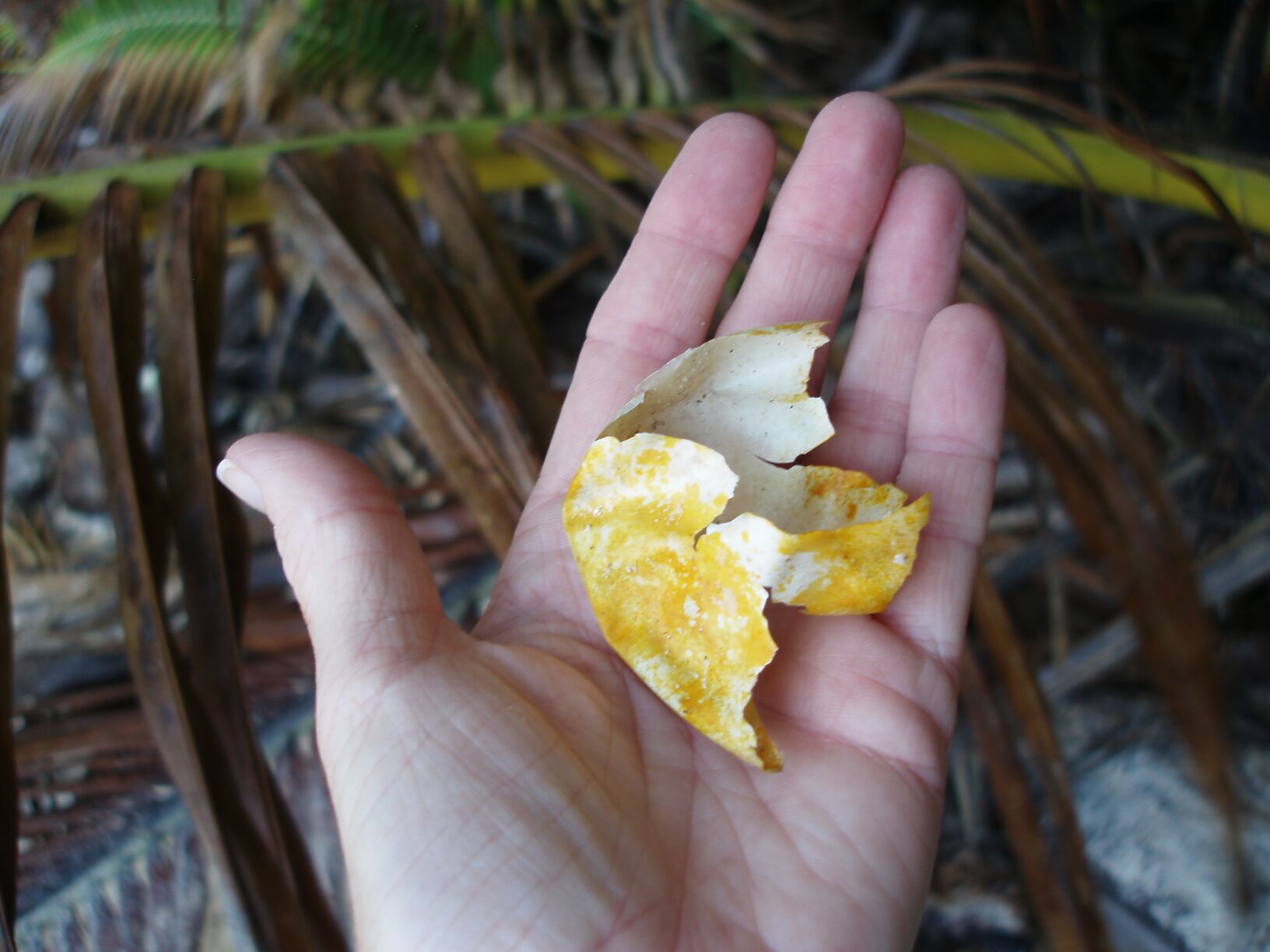
sand fringed with jungle. This beach is used year round by sea turtles to lay their eggs (they do this at night). As soon as we stepped on the sand, we saw the obvious tracks of a large turtle
and the depression she had made where she deposited her eggs. There were also fragments of rubbery turtle egg shells, from previously hatched broods, scattered around the beach.
There was a fresh water stream that trickled across the beach and into the sea and, as we explored landwards into the jungle, we found both blue crabs and robber crabs. These glowered at us as
only a crab can. Land crabs and robber crabs (also known as coconut crabs in the Pacific) are the largest specie known. The blue crabs would hide in their burrows at our approach but the robber
crabs would wave one huge appendage threateningly at us as if to say, "Move along there!".




The occupants of the other two 4WD vehicles were at the far end of the beach and they turned out to be from the dozen Spanish scuba divers, who are here on a two-week dive holiday and who represent the balance of the tourists on the island. The lady at the Post Office had told us about a local celebration hosted by the Chinese segment of the population that was to be held at 1830 hours that same evening. The holiday was the "Moon Cake Festival". Another yacht had arrived this morning and on our way to the festival we collected Noël French, who has been single handing around the world for the past seven years in a Bavaria 44. Noel hails from Ashford in Kent. We met the Post Office mistress, "Jo", at the festival as she had been expecting us. She immediately equipped us with a pair of candle lit Chinese paper lanterns and a pair of "Moon cakes". The celebration began with a deafening series of reports, followed by Chinese firecrackers. Then followed a fireworks display while simultaneously a Chinese band began to play with cymbals and drums and two "dragons" began a very energetic dance. It was hard to know what to look at. As the exotic and beautifully costumed dancers were going through their routine, high above them there were huge colored airbursts as the rockets soared in swift profusion. When the fireworks finished, the whole island, it seemed, headed down the road in a procession lead by the dancing dragons and band. Behind trailed everyone else clutching their Chinese lanterns. At the Police Station, the parade turned around and we headed back to where the food was laid out. We sailors declined the offer of free tea and instead headed over to the "Golden Bosun" (it's a type of sea bird) where we continued to celebrate "Moon Cake Day" with Newcastle Brown Ale and "chips" (French fries).


October 7, 2006
Today we took a break from our boat chores and drove over to the west side of the island to hike "The Dales". These are a series of fresh water streams that are sourced from springs at the interface between the limestone overburden and the igneous base of the island. Since these springs are an all season source of surface fresh water, they provide a wet area and habitat for "Blue" crabs. Christmas Island is world famous for it's annual migration of "Red" crabs from the deep rainforest areas to the sea to breed and then home again inland. They do this in the wet season, usually beginning in mid to late November. When they are on their march, they march over everything, houses, cars, just about anything that gets in the way. The information office offered a brochure with tips for driving with the crabs. If there are high numbers of crabs, they recommend having someone sweep the road with a broom ahead of the vehicle, or just give up and park. We may not see any Red crabs, as it is too early in the season but, we are off to see crabs!
As the road passed the northeasterly point of the island, we could see a huge construction project in progress. Just about everyone we had met at the popular
"Golden Bosun" bar we have been patronizing is working on this project (Annette is in love with the restaurant's "Ninja" chef - aka Neil and particularly his lamb
shanks). The
 task is to build a detention or relocation camp for illegal immigrants to Australia. At least that is the official version. The construction men referred to their project as
"Guatanamo Bay". They said it was very nicely decorated but very solidly built. One of the phosphate mining officials we had met wondered why the facility needed an armory and explosives
storage if it was just to house Indonesian "boat people".
task is to build a detention or relocation camp for illegal immigrants to Australia. At least that is the official version. The construction men referred to their project as
"Guatanamo Bay". They said it was very nicely decorated but very solidly built. One of the phosphate mining officials we had met wondered why the facility needed an armory and explosives
storage if it was just to house Indonesian "boat people".
We speculated our way onwards and soon found ourselves on another 4WD track, plunging through the rainforest. We arrived at a forest car park and from this, a boardwalk wound through the trees with signs every hundred yards or so providing information on flora and fauna. At the second stream we came to, a boardwalk trail climbed steeply up to a waterfall. We were midway up the western edge of the stream and looked down across the wet area. The trees were mainly fresh water mangroves and with their complex and twisted root patterns and the draping creepers and air-roots, the scene was something out of a Tolkein dream. Everywhere on the floor of the stream bed were crabs. The largest populations were blue crabs but as we gazed higher and drier amongst the roots of the trees and even beneath the boardwalk we were on, were huge numbers of the massive Robber Crabs. Our trail terminated at a waterfall and we stood beneath the shower of warm droplets but decided to keep our bathing suits dry.


The hiking trail continued south but was now marked with red survey flagging on occasional trees and was often difficult to follow. After a mile or so, it turned and followed the stream bed but in the stream bed itself. The Blue Crabs and Robber crabs were everywhere underfoot and scuttled to get out of the way with their pincers held up threateningly. The ground was very spongy underfoot as their burrows had undermined just about every place you could step. The Robber Crabs did not move much; they just wagged their warning at us to keep moving. It was on this portion of the walk that we did finally see a live Red crab. Our previous sighting did not count, as it was baked and dead on the road. A beautiful hike.


October 8, 2006
Annette went shopping today and Ed went out with the scuba company. I (Ed) did three dives; the most I have
 ever done in one day. The first morning dive was a "wall", with huge and pristine corals and good visibility in the water. The next two dives were cave dives. Now I have never
experienced a cave dive before. The route led in single file through a long and dark winding passage way and then into a chamber that had trapped air. The air was moist and warm but
breathable and the walls of the chamber were covered in stalactites. I asked if they ever had earthquakes here, knowing full well that Christmas Island had experienced two good shakes the
week before we arrived. This elicited a laugh from the guides but my corresponding laugh was decidedly hollow. The second cave dive, which surfaced in a pool, was followed by a winding surface
snorkel. Then, we dropped our tanks and proceeded by foot across tilting broken rock to another subterranean pool. We turned our lights off and, within a few seconds, could see lantern fish in
the pool below us. This pool also contained a population of crimson colored shrimp. As we exited the caves back into the open sea, I could see the air from our tanks trapped under a huge sloping wall
and looking like inverted mercury droplets. It was a wonderful dive and one that I am glad that I experienced but one that I do not intend to repeat too soon. Enclosed, dark spaces while
breathing air from a tank is not for me. NASA, don't bother to call.
ever done in one day. The first morning dive was a "wall", with huge and pristine corals and good visibility in the water. The next two dives were cave dives. Now I have never
experienced a cave dive before. The route led in single file through a long and dark winding passage way and then into a chamber that had trapped air. The air was moist and warm but
breathable and the walls of the chamber were covered in stalactites. I asked if they ever had earthquakes here, knowing full well that Christmas Island had experienced two good shakes the
week before we arrived. This elicited a laugh from the guides but my corresponding laugh was decidedly hollow. The second cave dive, which surfaced in a pool, was followed by a winding surface
snorkel. Then, we dropped our tanks and proceeded by foot across tilting broken rock to another subterranean pool. We turned our lights off and, within a few seconds, could see lantern fish in
the pool below us. This pool also contained a population of crimson colored shrimp. As we exited the caves back into the open sea, I could see the air from our tanks trapped under a huge sloping wall
and looking like inverted mercury droplets. It was a wonderful dive and one that I am glad that I experienced but one that I do not intend to repeat too soon. Enclosed, dark spaces while
breathing air from a tank is not for me. NASA, don't bother to call.
Annette shopped in the morning and then snorkeled off the boat for the afternoon. The bay where we are moored is a great spot for snorkeling and diving and one of the best locations on the island according to the literature. This is the first time that she has enjoyed swimming and snorkeling in the sea since we were in Fiji last year. Christmas Island has few small sharks, no box jelly fish, and no estuarine crocodiles.
October 9, 2006

 We spent the day with last minute shopping, checking the internet, topping up with diesel by shuttling jerry jugs to the gas station, dropping off the rental car, and applying
for exit documents. Christmas Island has been an excellent stopover and we are sorry to leave.
We spent the day with last minute shopping, checking the internet, topping up with diesel by shuttling jerry jugs to the gas station, dropping off the rental car, and applying
for exit documents. Christmas Island has been an excellent stopover and we are sorry to leave.
