

New Caledonia
September 18, 2005
Position: 20 55.1 S 167 16.7 E
0730 hours. Arrived safely at Marina in We on Isle Lifou, Loyalty Islands this morning after 27 hour passage from Vanuatu. We had been met by an army of volunteer line handlers as we entered the harbor at We. This was great, because the entrance involved a tight turn and the slips were both short and narrow. DoodleBug danced in, turned daintily with the bow-thruster and backed into the slip - to be grabbed immediately by the volunteers and swathed in a net of lines and springs. We were in! Frank arrived about an hour later to do the same with his vessel. Freewind is 55 feet in length and displaces 30 tons. He has no bow thruster but we had a volunteer in the water with a dinghy, to push on the bow as a "tug". This should have worked but unfortunately Frank and the "tug" driver could neither hear nor see each other and there were a few minutes of chaos, as Freewind near missed several vessels. Fortunately, Frank is a cool man under fire and Freewind was soon safely berthed.
The Harbor Master, "Loulou" met us, gave us documents to fill out and told us we can take down our yellow quarantine flags. We now have seven days to get to Noumea to clear with Immigration and Agriculture. It was Sunday morning here and we set off for "town", alleged to be about one kilometer away, to seek an ATM machine and restaurant. The "about a kilometer" turned out to be several kilometers and we were glad to finally see the ATM machine and gladder too that it dispensed some cash to us.
Next was a short walk to the Drehu Village hotel for a great brunch (www.drehu.grand-hotels.cc). The manager of the hotel is a sailor and offered us a ride back to the marina - which was gratefully accepted. By late afternoon, we sleepily emerged from our air-conditioned cabin, to walk off brunch. We saw some locals fishing from the commercial dock at the harbor entrance. We had discovered that they were very friendly, particularly if you say "hello" instead of "bonjour", thereby signaling that you are not French. The locals were fishing for "sardines" as they called them. The fish were tightly schooled, silver and about eight inches in length. The technique is to cast a quadruple barbed hook across the school and then jerk hard. The sardines were hooked through the body, if the fisherman was successful - no bait was used. We returned to DoodleBug at dusk, to see a dozen or so cruisers inspecting DoodleBug from the dock (Amels attract more attention from French boaters). Amongst them was "William" the manager of the Drehu Village Hotel with his wife, "Graziella". We invited them aboard for drinks and a tour of the boat. William is anxiously awaiting the delivery of his 40 foot Jennau in January and makes recreational trips to the marina, to moon wistfully at the docked vessels while he is currently boatless.
September 19, 2005
This morning was a slow start with boat chores etc. We had arranged with Freewind to take a walk in late morning, to see the women's craft center near the town administration building. When we arrived, the place looked very closed and I enquired at the administration center, as to what time it opened. The lady I spoke with seemed surprised that it was closed and I followed her back over to the craft center. She went inside and emerged shortly, saying that the ladies were asleep on the floor and to comeback in about an hour. We visited the war memorial, bought drinks from a small general store and generally kicked around for an hour, before heading back to see if the sleepers were vertical yet. This time the door was ajar and we were ushered inside. The "crafts" consisted of a shelf of dusty shells and a row of very plain, cotton "Mother Hubbard" dresses. Apparently the ladies do far more sleeping than crafting. It only took Annette (the shopping diva) about 20 seconds to decide she had seen enough and we left.
September 20, 2005
At 0800 hours a local man showed up at the Marina with the rental car we had booked. We loaded the combined crews of Freewind and DoodleBug into the car, plus our snorkel gear into the trunk and set off to explore Lifou. Our first stop was at the Chapel of "Lourdes a Easo", a small church that stands on a tall promontory and allegedly marks the spot where the first French Catholic Missionaries arrived in Lifou. Why they would have chosen an inaccessible cliff to land at, when there was a perfectly good beach a mile or so away, was not explained in the tourist literature. The chapel was constructed in 1898 and like many of the other churches we saw on Lifou, had a neglected, decaying, run down air about it. The statue on top of the chapel was echoed in a painting on the altar inside. Both showed a plump, blonde, blue eyed young woman who I presume represents the Madonna rather than St. Bernadette of Lourdes.

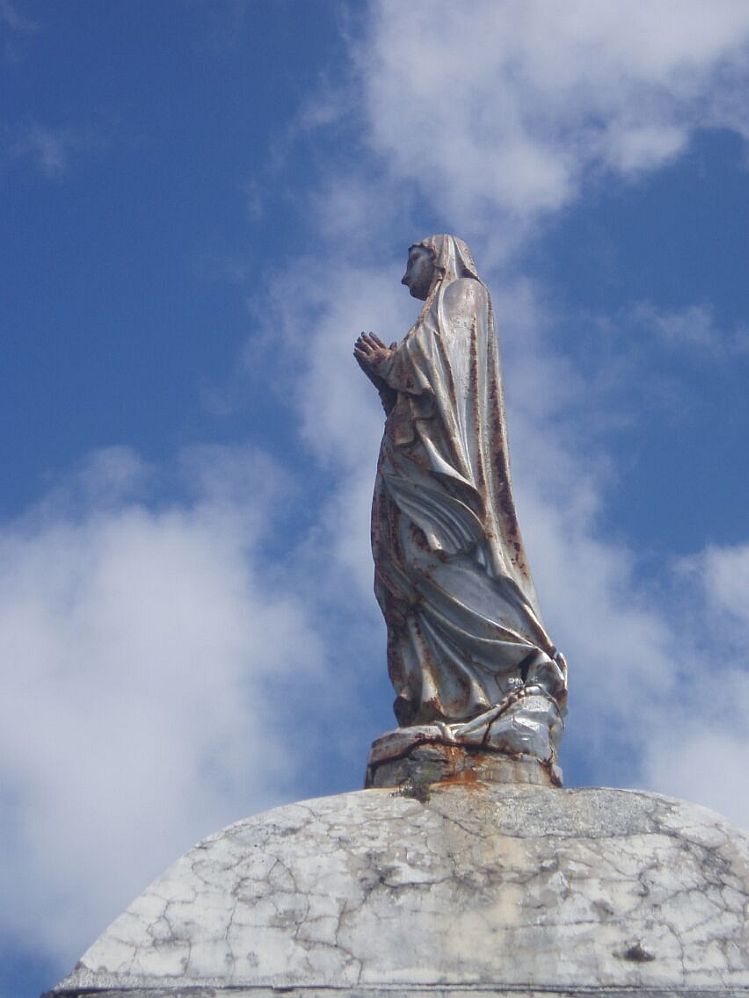
The chapel is fronted by spectacular sea cliffs that plunge to the sea and the nearby reefs. As we gazed upon the view, admiring the clarity and hues of the water, we noticed two large sea turtles swimming together and doing whatever it is that turtles do. We watched them cavort for some time and also noticed a shadowy presence nearby, that may have been a sizeable shark.
The next stop was a tour of a Vanilla plantation. We pulled into their parking lot and were met by a young woman. She spoke only French and as we walked through the plantation, I scurried to keep up with her and at the same time, to translate her comments for the others. This plantation was different from the ones we had seen before on Huahine. There the vanilla vines were grown on trellises and shaded with a tarpaulin. Here the vines were growing on live Frangipani trees. They were both shaded by coconut palms. After a short circuit through the plantation, we arrived at the house near the car park. Here was a small quantity of vanilla beans, spread out on a table and drying in the sun. We asked the young woman if they had beans for sale (this is the main reason that vanilla plantations offer tours -everywhere else in the world!) but she told us they were completely out of beans to sell. "Merci, Au Revoir".


The next stop was at Jokin where we stopped at a small resort. The resort was located on the top of sea cliffs that plunged vertically to the sea, 130feet below. From the cliff top we could see a few snorkellers, spear fishing or just exploring the reefs. There were three mooring buoys in the bay below and we considered moving onto these to spend a few days. Two French families arrived and we recognized them as fellow sailors from our visit to Ambryn in Vanuatu. We were told that the mooring buoys were too small for our vessels and had dragged in the past. The man we spoke to was from Noumea and was knowledgeable about several aspects of marine activity. We quizzed him on sharks and he explained that sharks were really no problem. Yes, New Caledonia has tiger sharks, bulls sharks, great whites, hammerheads and even the smaller blacktip reef sharks are dangerous. Just keep an eye on them. If the blacktips begin to circle, get out of the water immediately. Don't take your eyes off them or turn your back on them. Hit them in the face if they attack you. If you are diving at night, just make sure that you are out of the water before the moon rises, because then the sharks can see you and finally, don't swim where the small rivers empty into the sea. The bull sharks there will attack you every time....... Thoughts of a refreshing swim had by now entirely evaporated as we pondered the problem of getting out of the water when surrounded by circling requiem sharks without taking our eyes off them or turning our back........
We had decided that the two French families had way too many small children to sit anywhere near them for lunch, so we moved on to look for more restaurants. We drove through several small villages that the guide maintained had multiple eating establishments without spotting a commercial enterprise of any kind. Finally we stopped and asked a lady for directions. She waved at a nearby road that paralleled the beach and muttered about a nearby "Snack de la plage" (Beach snack). We drove along the road without seeing anything looking like a restaurant and stopped at a house that had several cars parked outside to ask for further directions. This establishment turned out to be the restaurant and "Loulou", the harbor master from the marina, together with the customs official, were having lunch there.
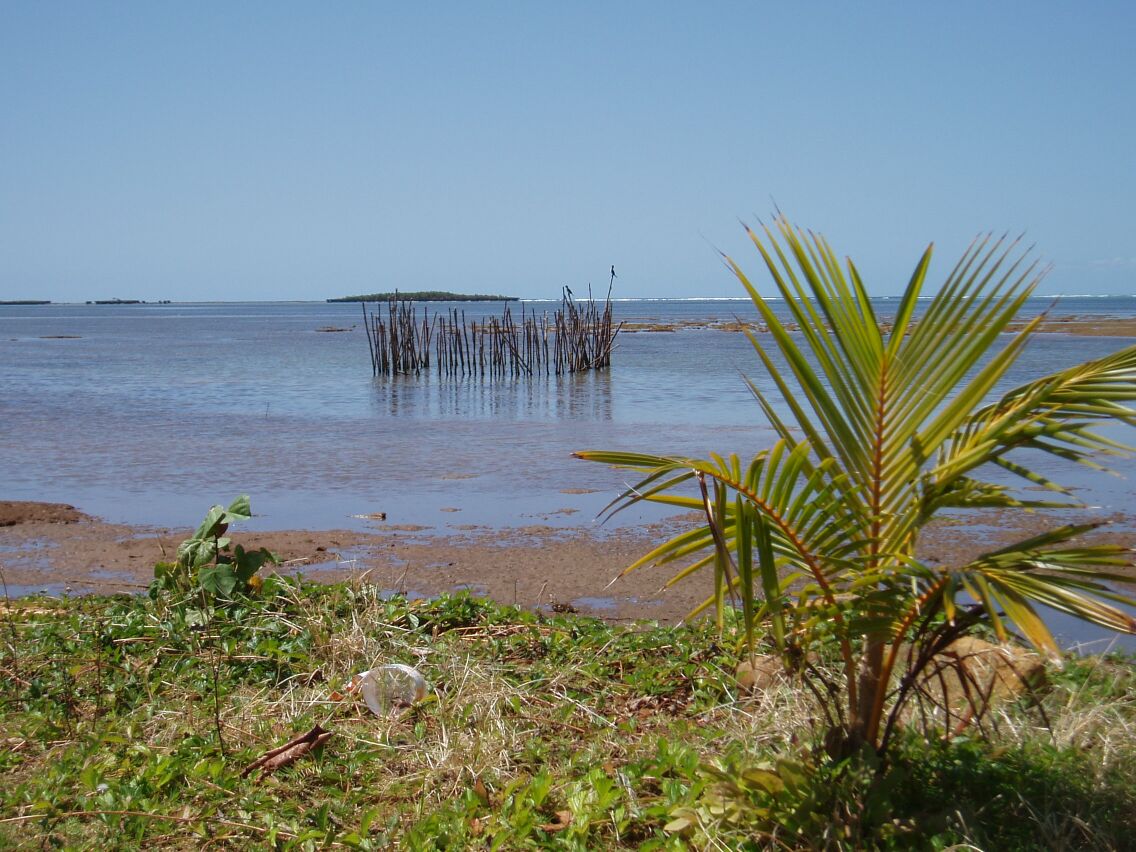

Lunch was excellent and we continued our tour of Lifou by heading south. Our destination was Lougoni with a white sand beach. The roads in general were in excellent condition with almost no traffic. We saw bus stops but no buses. There were virtually no people walking along the road or working in the fields, as we had seen on all of the other islands. No livestock except for a few chickens or pigs at the infrequent homes we passed. These homes all had power lines attached and often parked automobiles outside but no inhabitants visible. We arrived at the end of the island road and realized we had missed Lougoni. Careful backtracking took us to a tree fringed white sand beach several miles in length with crystal clear waters. The beach was empty and without footprints. Lifou might be described as "underdeveloped".
September 21, 2005
Position: 22 23.1 S 166 53.7 E
The grib files (weather forecast) indicated a possible "weather window" today, to sail for Havannah Pass. This is the entry pass through the protective reef surrounding the main island of New Caledonia, "Grand Terre". We have to match our expected sailing speed, with the need to arrive at slack water at the pass, plus have enough light to see the reefs. The mathematics involved, required us to leave the marina at "We" at 1300 hours, motor east along the northern coast of Lifou for two hours into a forecast 10 knot headwind and then turn south for a 14 hours sail, close reaching. Theoretically we would arrive at around 0500 hours the following morning - slack water at the barrier sandbanks off Havannah Pass and then be at the pass entrance 40 minutes later as the sun rose. The first part of the plan worked like clockwork but as we made the turn south, the wind changed direction and increased to 18 knots. We were now motoring into a headwind, with seas breaking over the bow and the boat crashing through the waves. Very uncomfortable. To try to tack would mean missing the slack water arrival at Havannah and conditions there are dangerous with an ebbing tide.
The radar showed a sea pattern of huge swells and we crashed on, whilst we considered the options of arriving 12 hours later or heading for an intermediate harbor on Grand Terre. After a couple of hours the wind seemed to die slightly and the waves appeared to be slightly smaller, so we pressed onwards. By 2230 hours the wind dropped away to the forecast 10 knots but remained resolutely on the nose. We motored all night and arrived off the pass with hardly any wind and the seas like glass. The pass entrance was still exciting as dawn revealed the several large ship wrecks that adorn the entrance reefs. The sea cliffs showed reddish brown rocks between the greenery and I tried to imagine the Scottish Highlands, that inspired Cook to name the islands "New Caledonia" when he landed here in 1774. Of course he landed further north up the coast from DoodleBug's historic entry. We entered the pass and after an hour or so, turned into a secluded beach in Prony Bay, anchoring at 0730 hours. Our position was 22 23.1 S 166 53.7 E. The beach was absolutely delightful with an empty bay as the background and we were entertained by the songs of exotic birds flitting amongst the trees.
September 23, 2005
We raised anchor and motor sailed the 30 miles from Baie de Prony to the marina at Noumea. Noumea is the capital of New Caledonia and is quite a contrast to the other South Pacific Islands we have visited. The population of all of the New Caledonian islands is around 200,000 with more than half living in this city. Overall the native New Caledonians (Kanaks) amount to just less than half of the population but these are scattered in the north and the outer islands. Noumea appeared very European with hardly a "Kanak" in sight. We might have been suddenly transported to a seaport on the south of France. There are banks, supermarkets, movie theatres (US movies all dubbed in French - no English subtitles - Annette asked), marine chandleries, gift shops, clothing stores, restaurants, hotels, high rise apartments and office buildings etc.


For some reason or other, the snack bars here serve liquor and nuclear coffee in the afternoon but no food. The problem was solved when we spotted the "Golden Arches" in the distance and visited the McDonalds near the marina for cheeseburgers and fries that tasted remarkably like eating at .....McDonalds, USA.
We had met Cathleen and Pierre Phillipe of S/V "Olla" earlier and arranged to meet them for drinks in the evening. We last saw Pierre and Cathleen in Opua, New Zealand. They sailed here several months ago and have both found work in their profession as medical X-Ray technicians. They had a little difficulty with work visas at first, as they are Swiss citizens and not E.U. citizens but they speak French as their native tongue and there is a shortage of trained medical technicians here. Pierre began working two weeks ago and was complaining about how tired he is on a Monday to Friday, nine to five schedule, after a schedule dictated by several years of sailing around the world.


DoodleBug hereby expresses deep sympathy for all readers of this log who are not currently out sailing.
The crew of "Olla" plan to work here for maybe six months and then sail to Australia. There they hope to sell "Olla" and buy a motor home with the proceeds, before continuing their cruising by land.
September 24, 2005 - September 29, 2005
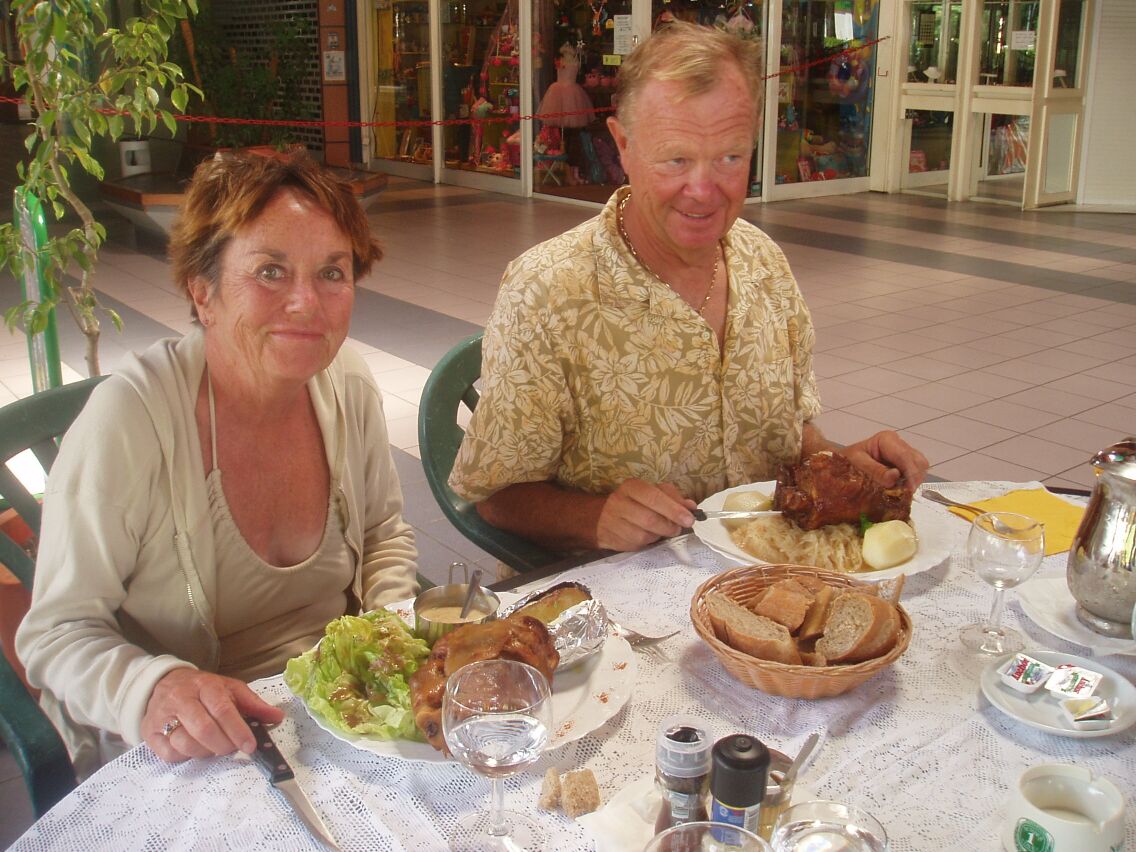
We have enjoyed hanging in Noumea for the past few days, eating well and visiting the museums, cultural centers and gift shops. As I said before, Noumea is rather like a small French coastal town but it is cleaner than I remember the South of France and the streets are certainly wider. Two areas of town are still named "Motor Pool" and "Receiving", a reminder of Noumea's importance in WWII as an American troop staging area. We particularly enjoyed our trip to the aquarium. The most spectacular exhibit that I recall were the Nautilus shells. These creatures are Cephalopod mollusks and belong to the same family as squid and octopus. The Noumea aquarium is one of two in the world that have ever managed to breed the Nautilus in captivity. I had expected Nautilus were some kind of marine snails that slimed their way around and was fascinated to watch the Nautilus creatures, bobbing up and down and swimming through the water. The aquarium is located at the far end of Baie de Citron. This is a favorite haunt of the locals, who thickly cloak the beach on the week-ends. It is also of interest to tourists from the more puritanical cultures, since some ten percent of the females (and 100 % of the males of course) prefer the topless style of beach attire. My wife says I can look but not touch and "Don't drool - it is embarrassing in public". We have continued with a few odd boat chores, checking zincs, inventorying the spare parts, checking emergency gear etc. The weather forecasts show little wind between New Caledonia and Australia, even though boats arrive from the east with tales of near gales and big seas.
September 30, 2005
This morning we rented a car and headed out to explore the country north of Noumea. The coast road is well surfaced with little traffic. By lunch time we were at the town of Tontouta, the site of the International Airport. We found an attractive looking inn, with an empty parking lot and approached the bar to see if we could get lunch there. In the bar, the sole customers were two very large gendarmes (policemen). We moved into the dining room for an excellent lunch and noticed that both officers were still in the bar and still drinking as we left. The next stop was the mining museum in the small town of Thio on the east coast. This was in the international news in 1984, when some 200 Kanak militants lead by a man called Eloi Machoro, seized the town and held off the French army for nearly two months. Supposedly the French sent in a helicopter load of special forces to kill Manchoro but they landed in the wrong place and were captured by the Kanaks. In 1985, the French sent a force of 300 to attack and kill Machoro at an isolated farmhouse near La Foa. This was readily accomplished and the Kanaks back in Thio responded by blowing up the Thio mine facilities. None of this drama was evident in the sleepy little village we pulled into.


The local people operating the mining museum asked if we wanted a guide for 1,000 francs (about US$10). We said, "Yes and does the guide speak English?". The look of horror on their faces reinforced the negative answer. I said, "OK, we need the guide anyway, we just need him to talk slowly". A few minutes later, we were told that the guide was sick and could not come.
The museum was interesting and most - but not all of the exhibits, were well labeled in French. The mine operations in New Caledonia have been strip mining, with just a meter or two of top soil removed to get at the iron, nickel and cobalt rich ores beneath. We watched a video prepared by the mining company, that showed how they restored the land after strip mining and how they separated the metal from the residue at the mill in Noumea, with virtually no emissions. The video appeared to contrast sharply with the mined landscape that had little evidence of any attempt at restoration.

We continued our trip north along the coast road to Canala. The map indicated a one way system but implied that the road was paved. The road was in fact graded dirt and we arrived at a sign that said we could travel towards Canala during odd numbered hours. The road weaved tightly along the edge of precipices, with tight, blind corners and no way of turning around or passing another vehicle. The scenery was fabulous and we did not in fact meet another vehicle during the one hour transit. We drove through the small village of Canala and were stopped by at a police checkpoint on the far side of the village. Here were asked for our "permits". We did not even have passports with us but before we were arrested or anything, the policeman asked if we were foreigners. I assure him we were and they simply waved us to continue.
Another winding crossing of the mountain range and we arrived at the town of La Foa, where Machoro had been assassinated. We stopped and got a room at the "Hotel Banu". The hotel was where the leaders of the Vichy French governors were imprisoned before their deportation in WW II. The hotel rented us a clean, air conditioned bungalow. When we first entered the room, we noticed mosquitoes and readily decamped across the road to buy bug spray at the gas station / convenience store. Annette nuked the room and we walked through the town to a small restaurant for a couple of tasty pizzas. Upon our return to the hotel, we saw that the white floor tiles facilitated a body count of over 20 mosquitoes.
October 1, 2005
We began the day with the traditional French "petit dejeunner" (light breakfast) consisting of coffee or tea, a glass of orange juice that had not been sweetened to American tastes, plus bread with butter and papaya jelly. This repast cost us US$24 versus the US$60 for the room. Next stop was a nearby sculpture park The sign announced that it was in memory of one of the late local residents, who had owned racehorses. It was quite an elaborate affair and I had assumed that it was some kind of war memorial - perhaps a memorial to a late President, a Nobel Peace Prize recipient or at least a dead rock star. Nevertheless the entrance was chained and locked. Although the sign stated it was opened daily at 0800 hours, it was now well past this time and there was little sign of activity in the town.
The guide book stated that La Foa is the home of the famous sculptor Remy Weiss. There was indeed a sign to this effect at the road's edge and we turned up the street to find his studio. At the top of the road we had found nothing and asked some folks working in their garden. They waved back down the road we had driven up and said it was, "la maison brulle". A burned house? A brown house? Must be some kind of colloquial construction term. We retraced our path and after seeking further directions, found a fenced lot with no sign of a building. Here we followed the sound of hammering and met Remy Weiss, his friend and his dog. His house had burned down a week or so earlier and there was nothing left but ashes. As I talked to Remy, Annette played with his dog. Remy said the house was gone within two minutes, as though it had been soaked with gasoline. The house and his stored sculptures had been completely destroyed, although his workshop and a few tools had been spared. As I looked down at the layer of dried wood chips beneath my feet and the collection of propane bottles stacked around, I could imagine that this place would never have survived a fire marshal inspection. We expressed our sympathies, patted the dog and moved on.
Our next stop was the fort at Teremba. The fort was built in 1871 and was intended for the dual purpose of housing prisoners and controlling the territory in the vicinity of the La Foa river. Most of the fort / prison was intact with the walls, cells and watchtowers etc. showing little damage. We parked our car in the empty parking lot and walked through the main entrance to the fort. At the far side of the open yard, we were watched by the young lady who was in the ticket booth. We greeted her and then waited, as she studiously ignored us and continued to count change at her station. The girl was of European descent (read - "French"), perhaps late twenties and reasonably pretty. I turned and smiled at Annette instead of reaching over and smacking the shit out of the ticket girl. Eventually she directed her attention to us and took our entrance fee, before enquiring our national origin and entering this information on a ledger. I noticed that the ledger was blank except for our entry. The prison cells were neat and straight out of the movie "Papillion". I walked the narrow cell and counted the paces just as Steve McQueen had done. They had costumed dummies in some of the cells, with an audio re-enactment of prison life and conversations. The watch tower could be climbed and presented a clear view of the nearby bay and surrounding countryside. Near the base of the tower we found several of the mosquitoes that the fictitious former inmates had complained about and decided to speed up our tour.


We motored out of the still empty parking lot and headed north through the towns of Bourail and Poya. At Bourail the substantial museum was solidly locked with no signs of life and we assumed it had been abandoned. The day was pleasant, the roads devoid of traffic, the scenery wonderful etc. but we thought we had by now detected a pattern to the tourist attractions and decide to reverse our course back to the south. We stopped again at La Foa and had a great lunch of cheese sandwiches and beer (much cheaper than breakfast!) at the "Hotel Banu" before passing the fume belching nickel mill at Noumea and returning to Doodlebug for the night.
October 2, 2005
Today we invited Frank and Jan of Freewind to accompany us on a sweep of the southern part of New Caledonia. We drove over to the southeastern tip of Grand Terre, near where we had originally entered through Havannah Pass. At Goro we found abandoned and rusting mine workings, where they had transported the ore to waiting ships. The construction was massive and the concrete supporting the conveyors climbed the nearby peaks and indicated the source of the ore. The steel rails, scaffolding, rollers, cables, cantilever loaders etc. were all rapidly returning to the oxide from which they were derived. I don't know when this was abandoned but assume it was around the 1920's or 1930's. The scenery on the drive was superb, with the narrow, winding road alternating between pavement and graded dirt.


The road climbed through steep passes, down heavily vegetated gullies and across barren stripped areas. We declined the US$60 lunch buffet at a resort near Fort Boise and instead bought mediocre sandwiches, that at half the price of the La Foa version, unsurprisingly had half the filling. A pretty day and a pleasant drive returned us to Noumea in late afternoon.
October 4, 2005
This morning we received an e-mail from the commercial weather service (Commander's Weather) we had used on the last two "big" passages. Their e-mail indicated that we had a weather window for Bundaberg that was not "ideal" but was "doable". The recommendation was that we leave sooner rather than later and suggested a Tuesday departure. This triggered a flurry of activity with the usual trip to Customs, Immigration and Port Captain for document clearances, last minute grocery purchases and topping up with diesel etc. Like many French businesses, the fuel dock conveniently closes at 1200 hours for a two hour lunch break but we managed to complete our fueling before the noon deadline. We then left DoodleBug moored at the fuel dock, whilst we had our last restaurant meal for the next five days. We set sail at 1330 hours with 22 knots of wind from just behind the beam and at 1500 hours we cleared the reef pass out of Grand Terre and pointed west across the Pacific Ocean.
