East Islands of Fiji
May 24, 2005
Position: 33 19.1 S 174 47.0 E
Last night was our first night at sea on this leg of the trip. We left Opua marina just after noon yesterday and motored with light winds on
 the nose and a confused and rolly sea. The sun seems to set early here but it plunged beneath the waves, leaving smatterings of fire in it's wake and leaving also a full
moon. We enjoyed the moon light all night, since it was almost bright enough to read by. Around 0300 hours the wind switched to the stern and brought
cold horizontal rain. We kept watch from below using radar and "doing a groundhog" - which is popping your head out of the hatch above the closed
companionway door to scan the horizon for lights. Right now we are under full sail in light winds but an uncomfortable sloppy sea. This reminds us we
don't have our sea legs yet, so I will close here. We are 122 miles from Opua marina and have about another 1,130 to go.
the nose and a confused and rolly sea. The sun seems to set early here but it plunged beneath the waves, leaving smatterings of fire in it's wake and leaving also a full
moon. We enjoyed the moon light all night, since it was almost bright enough to read by. Around 0300 hours the wind switched to the stern and brought
cold horizontal rain. We kept watch from below using radar and "doing a groundhog" - which is popping your head out of the hatch above the closed
companionway door to scan the horizon for lights. Right now we are under full sail in light winds but an uncomfortable sloppy sea. This reminds us we
don't have our sea legs yet, so I will close here. We are 122 miles from Opua marina and have about another 1,130 to go.
May 25, 2005
Position: 29 42.0 S 176 17.0 E
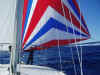

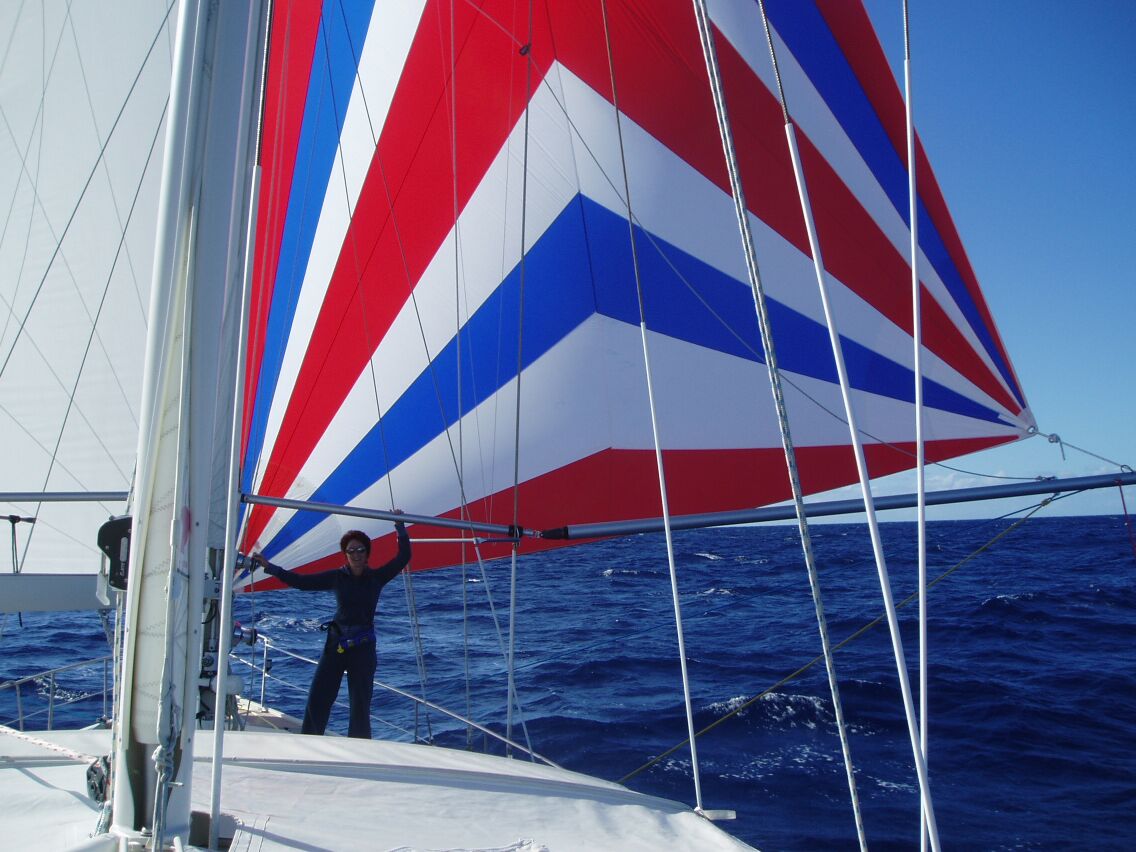
0600 hours UTM. We are sailing with the wind almost directly astern, with our big Genoa poled out to port and our "ballooner" (Amel's version of a spinnaker)
poled out to starboard. This combo gives us 1500 square feet of sail and propels us at around 7 knots with 12 or 13 knots of true wind speed. I know
we'd look great in a photograph, because the ballooner has large red, blue and white panels but there is no one to take a picture. Yesterday we heard
the New Zealand air force calling various nearby yachts on their VHF radios, to check their identification particulars. We patiently sat with our camera
posed, as they usually fly by very low and close with a big military 4 engined turboprop - but nothing....... We even straightened out our flag and
that didn't work.
Yesterday was a very pleasant sail. A little cool for bikinis, so we were pretty well wrapped up before hiding below in the cabin when it rained. We motored
/ sailed 155 miles over the first 24 hour period from Opua and added another 162 mile run today. The wind looks OK-ish for the next 24 hours and after
that we shall have to see. Friday's forecast has a cold front with an associated low catching us. We should be far enough to the north, that it
will have weakened considerably and after that we get into the trade wind systems. This weather system has prevented other boats from leaving Opua
behind us. The day we left, I understand a total of 27 boats set out for all different destinations. Almost a record. A few hours after we left, I had 7
other vessels on our radar. By nightfall we were alone and have seen no other craft of any kind, nor heard anyone on the VHF - which has a range of
30 miles or so. As we head into our third night at sea, the cloud cover has hidden the beautiful full moon. Annette says she will have sufficient seas
legs to deploy her fishing rig tomorrow. Her fry pan is ready!
May 26, 2005
Position: 26 08.0 S 177 11.0 E
0740 hours local time: Yesterday morning (Thursday) was the first dawn that we had experienced in quite a while, that felt tropical. The sea was blue and the
sun was shining as we motored in light winds over the top of a high pressure zone. At daylight we struck the big ballooner and successfully
stuffed it in it's locker. It should be noted that this is the first time we have ever done this, where it was actually dry when it went in its
locker i.e. it hadn't been fished out of the sea first. The recovery technique is always exciting. First I stand on the bow and run a
"dehooking mouse" as Amel calls it, up to the top of the forestay. This is almost 60 feet above the deck and it looks a long way when you are looking up.
Next Annette turns the boat and releases some of the sheet of the ballooner, so it is now blowing and flapping across the foredeck. I tug on
the dehooking mouse and the whole 750 square feet of sail dumps on me, as there is now nothing holding the head up. It is a frantic grab and stuff
into locker job before it goes over the side. This did happen to us last year and we had the ballooner wrapped under the hull - what a mess. By the
time we had cleared away all of the poles etc. (these poles stick out from the sides of the boat and hold the sails in position when sailing down
wind as we did yesterday) we were decidedly warmed up and changed into shorts for the first time this year!! To celebrate further Annette
deployed a fishing lure on a line over the stern.
Although there has been plenty of ugly weather systems roaming around the Pacific at the moment, we have managed to find a route that has produced
some very light wind conditions, forcing us to motor - sail. In late afternoon we took the opportunity of relative calm conditions to transship
6 jerry jugs of extra diesel into our tanks. We have found that if you don't do this when you have the chance, you usually find yourself having
to do the job in the worst possible conditions. That evening we checked in with High Frequency radio with S/V Amazing Grace, a yacht that is sailing
on the same course as we are but about 60 miles further south. They reported that S/V Nero had caught 2 mahi-mahi that day and released one as
they didn't have sufficient refrigeration space. The comment was made that mahi-mahi are often caught in pairs, as the male and female mate for life
and swim together thereafter. Now how does anyone really know that? Has anyone ever seen personal ads reading "SYFMM (single yellow female
mahi-mahi) seeking lifetime companion. If you are interested in pina coladas and tartar sauce - stay away from me". We have slowed down somewhat as we now have a
component of headwind and there is a counter current of nearly 1 knot where we are, according to the pilot chart. The temperature stayed above 73° F all night
which made for more comfortable night watches.
May 27, 2005
Position: 24 03.0 S 177 57.0 E
0600 hours local time; Yesterday morning at 0130 hours the predicted frontal system arrived. It was just a shower line with gusty winds of up to 25
knots and was welcomed at the time, since we had spent several hours playing with the wind angles, tacks and various sail combinations to avoid
motoring directly into the rapidly swinging and strengthening headwinds. Throughout the rest of the night we managed to either sail or motor-sail
with the wind off the stern quarter. By noon we realized that we have passed the half way point and are now closer to Fiji than New Zealand. The
first vessel we have seen since Opua was a freighter, spotted by our radar and passing 8 miles away along the horizon. This always looks a little odd
from the deck of a yacht. The other ship is "hull down" and all you can see are some posts (the foredeck) and what looks like a square building
(the poop deck). Sort of like a grain silo floating in the ocean. Our satellite server went on the blink today and refused to allow us to send
and receive our e-mail. I attempted to repeat the operation with our back-up system and received the same results. Their problem! Maybe the
server website will get things working again tomorrow. When I fired up the HF radio to send our e-mails over the airwaves, I
immediately noticed interference on the radar display. Not wishing the fry the unit we had just had repaired, I shut down the navigation system and
sailing instruments leaving just the auto-pilot running to steer the boat. The e-mails were sent and of course the nav system would not come back on
line. This produced over an hour of grumbling and rebooting systems before we up and navigating again. At least I think we are. Do they have ice
floes and white bears in Fiji?



Around 1500 hours the now working radar showed a squall line rapidly approaching. We reefed down and were hit with a wall of rain and strong winds that had
us blazing along at 9 knots plus until it died about half an hour later. We had by now deployed our second trolling line and I was encouraged by
the sight of flying fish, exploding from the depths as they are pursued by unseen predators. It was these predators that we were anxious to meet.
Sure enough, in late afternoon we "almost" caught our first fish. I say "almost" because it was a nice sized tuna. I hauled it in to the stern of
the boat and Annette waited for me to lift it out of the water and while she waited - I waited for her to slide the landing net under the fish -
while it was still in the water. I failed to realize that she couldn't reach that far and the fish decided it had already enjoyed entirely too
much fun anyway, flipped off the hook and was gone. Tomorrow!
May 28, 2005
Position: 21 34.6 S 178 37.7 E
0510 hours local time. We are in the tropics! The log shows the lowest temperature last
night was 75° F. Today was definitely bikini weather. Last night in the wee hours had us running around the deck under the deck flood lights, poling out the Genoa to try to control it in
the increasingly light winds. It is a big sail and when it starts flapping, it is not only noisy but there is the fear it will damage something or rip
itself. A couple of hours later the wind dropped even further and we gave up and went to engine. The light winds stayed with us all day but in the late
afternoon, we began to get about 9 or ten knots from the east - probably the trade winds. We set up everything - Genoa, main, mizzen staysail and mizzen
and were soon sailing along at 6 knots or so. Hopefully this we will keep this wind all night. As the sun goes down it gets really dark here. There
has been a fair amount of cloud cover to hide the stars and the moon won't rise until 2230 hours tonight. About an hour before sunset we were
visited by a large pod (maybe 40) of dolphins, who played around DoodleBug for 20 or 30 minutes, before disappearing as mysteriously as they had
arrived. We were under full sail as I described and to stand right at the bow and watch their antics in the clear water is one of those
unforgettable moments. This aquatic display was followed by fireworks in the sky with a breathtaking sunset. As of this posting, we are 300 miles from
Savusavu in Fiji and expect to arrive on Tuesday morning.
May 29, 2005
Position: 20 02.6 S 179 05.4 E
1820 hours local time: The winds have held all day long and our navigation chart system showed a 164 mile run yesterday, in spite of the slow start to the day. We
had our second strike on our fishing / trolling line in mid-afternoon. As you might remember, last year we lost a series of fishing rigs that were
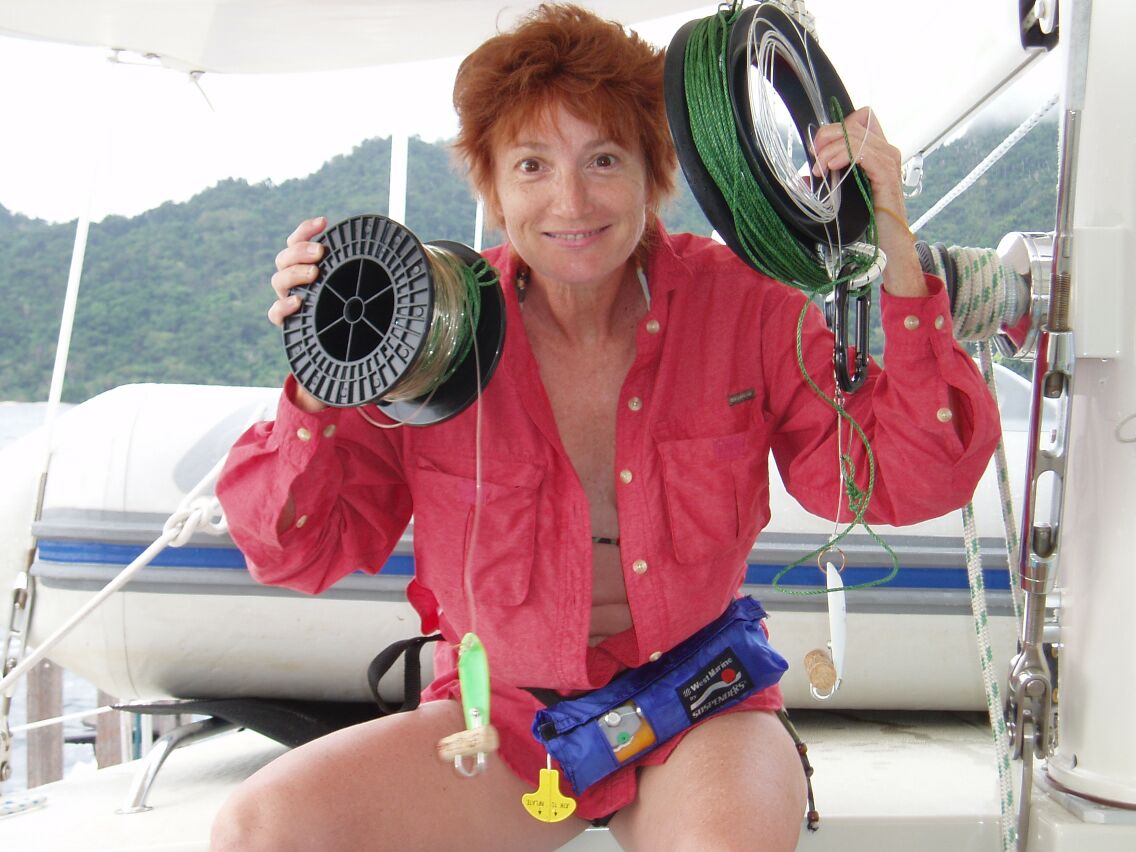
literally torn off the boat. This season's rig consists of a 1200 pound Kevlar line attached to 200 pound monofilament and then the hook. We were
using a bicycle inner tube from an ATB as a shock absorber on the Kevlar line. When the strike came, the inner tube was ripped in half but the Kevlar
line naturally held. Annette pulled in the line to see if the hook was damaged and all that was on it was piece of fish jaw (??) about 5 inch long
and black / blue colored We never saw the rest of the fish. Tomorrow we dig into the emergency running rigging supplies and come up with a new and
improved shock absorber. We have been sailing along all day, close reaching at an average speed of 7.5 knots in 13 knots of wind. We should arrive at
our waypoint in the middle of the Fijian Islands by tomorrow afternoon. We then turn slightly back to the west for our 73 mile run into the Savusavu anchorage. We will
almost certainly be doing this approach at night for an early morning Tuesday (we are across the date line) arrival. Fijian waters have a
reputation for being poorly surveyed with lots of uncharted reefs. The guide books suggest only sailing during the morning and early noon hours so that
you can post someone on the bow to lookout for reefs. This isn't going to work for us in the dark but our chosen route should swing us wide of the
major obstacles.
May 30, 2005
Position: 17 48.3 S 179 36.0 E

1750 hours local time: We have had two good sailing days with cooperative trade winds. Yesterday's 24 hour (noon to noon) run was 153 miles, close reaching at 7
plus knots most of the time in 11-13 knot winds. There is a 6 foot swell that provides plenty of boat motion but the weather has been warm and sunny
and the seas blue. Last night we passed the first Fijian island "Matuku". We couldn't pick it out in the gloom but the radar found it some 24 miles off to our
starboard. The next island Moala was highlighted by the rising sun. We have definitely arrived in the Fiji Group!
At 1000 hours Annette spotted a fish at the end of our trolling line. We hauled it aboard with some difficulty. It was a beautiful mahi-mahi and this one
didn't escape! We used a tape measure to confirm it's length of 56 inches. That's right! Over four feet long. By 1200 hours, Annette had it cleaned,
filleted, skinned, chopped up and freezer wrapped into 20 large servings. We had fish for supper.


As I write this we are sailing slowly at around 4 knots in order to arrive at Savusavu reef pass entrance at dawn tomorrow.
May 31, 2005
Position: 16 46.6 S 179 20.1 E
 0810 hours local time: We sailed smoothly into Savusavu harbor after an uneventful night passage through the islands. The anchorage is totally charming and
even though we see the palm trees, blue waters and coral sands of the Polynesian islands, Fiji is part of Melanesia and seems both different and
exotic somehow. We have been visited by the Health inspector - the usual "how many rats died of plague during your last passage" - received clearance
or "Practique" from him and have lowered the yellow quarantine flag. The Immigration gentlemen were very friendly and polite and allowed that we
could go now legally go ashore in Fiji but must return to the boat for the visit from the customs officials around 1400 hours. Annette is busy checking
out the local fauna and reports blue needle fish swimming below DoodleBug. Of course she is wondering what they taste like, even though she has a
freezer full of mahi mahi.
0810 hours local time: We sailed smoothly into Savusavu harbor after an uneventful night passage through the islands. The anchorage is totally charming and
even though we see the palm trees, blue waters and coral sands of the Polynesian islands, Fiji is part of Melanesia and seems both different and
exotic somehow. We have been visited by the Health inspector - the usual "how many rats died of plague during your last passage" - received clearance
or "Practique" from him and have lowered the yellow quarantine flag. The Immigration gentlemen were very friendly and polite and allowed that we
could go now legally go ashore in Fiji but must return to the boat for the visit from the customs officials around 1400 hours. Annette is busy checking
out the local fauna and reports blue needle fish swimming below DoodleBug. Of course she is wondering what they taste like, even though she has a
freezer full of mahi mahi.
May 31, 2005
Savusavu, Fiji; Although we arrived yesterday morning, our major accomplishment was filing
documents with Health, Immigration, Customs and Agriculture. This took up a significant part of the day but interspersed with the hurried scribbling of
indecipherable, dyslexic notes onto "official" forms, of the same computer generated and printed information I had already provided, we did manage to
sneak in several naps and some liquid refreshment. It was hot! No bare feet on the deck kind of hot. "Where is the sunscreen?", kind of hot. We
lay around in the cockpit of DoodleBug and admired the coconut palms and sleepy little village. By late afternoon we were finally through with
officialdom and officially here. We dinghied across to a nearby restaurant to use their dock and walked into town to find an ATM machine. This can be
exciting as your bank balance is shown on the ATM receipt to be twice what you thought. it is - only later you realize those are Fijian dollars not the
other ("real money") kind.
June 1, 2005
We arose today after a sound night's sleep at mooring and with energy and purpose. The watermaker had developed problems after it's maiden run of the
season, between Whangarei and Opua. The pump motor start capacitors had melted down and we had bought replacements in New Zealand. It had taken ten
days to get the replacements and they lasted about 10 minutes, before dissolving in a cloud of blue smoke with an acrid ammonia smell. My search
for parts this morning took me to "Pile's" - pronounced Peelays - and described as "a blue shed some way down the second dirt alley on the right
as you go down the main street". We found "Pile's and a diminutive Indian lady took us to a storage shed which was fastened with a padlock and then
rummaged around to find a cardboard box stuffed with obviously used components. I selected a mismatched pair of capacitors based upon their size
and shape, rather than their rating in Microfarads and then waited while the Indian lady made several phone calls to determine their price. While this
was going on, Annette was in the store across the street buying plastic funnels - the kind you use when pouring liquids into a container. The
funnels where in response to a report of uninvited furry guests on S/V Billabong. The land on the island across the harbor is being cleared by
slash / burn for a resort hotel. The burning of the undergrowth has caused the mass exodus of rodents swimming across the bay for the relative safety
of town. If they find a handy mooring line on the way, they promptly make them selves right at home. The plastic funnels are installed in an inverted
position on our mooring lines to discourage unwanted guests. The Indian lady finally came back with a price, which I had already estimated to the dollar,
based upon the cost of the new and now melted New Zealand versions. I made my purchase and met with Annette now clutching a bag stuffed with
"mega" plastic funnels. We stopped at the Copra Shed restaurant, where we had previously abandoned our dinghy and had a very pleasant lunch sitting on
the waterfront and watching the boats bob up and down at anchor.

 Back on DoodleBug, I installed the run capacitors and Annette experimented with her sewing project of making mosquito net covers for the small side
windows. Annette has always maintained that sewing is a blood sport and after one of the scuba tanks blew it's overpressure valve in the forward
locker and she stuck the needle through her finger, I could see the analogy. This is second time this has happened to us. Not the finger stabbing - the
scuba tank blow. The noise of 3,000 psi air venting to exhaustion through the blown out safety valve is an enlivening experience. Not as exciting as
the first time, when we both asleep but certainly enough to raise the ol' heart rate.
Back on DoodleBug, I installed the run capacitors and Annette experimented with her sewing project of making mosquito net covers for the small side
windows. Annette has always maintained that sewing is a blood sport and after one of the scuba tanks blew it's overpressure valve in the forward
locker and she stuck the needle through her finger, I could see the analogy. This is second time this has happened to us. Not the finger stabbing - the
scuba tank blow. The noise of 3,000 psi air venting to exhaustion through the blown out safety valve is an enlivening experience. Not as exciting as
the first time, when we both asleep but certainly enough to raise the ol' heart rate.
Annette completed her blood stained sewing prototype and I fired up the watermaker, since it was now high tide, bringing uncontaminated seawater
into the harbor. The water maker hissed along happily with it's mismatched capacitors and I tested it as "normal" for pressures and output of fresh
water. Our chart plotter / radar cockpit repeater had died on passage and after beginning surgery on the various electronic bus systems while
underway, I decided that this was a particularly stupid thing to do on a moving vessel, since the fragile connectors are usually well buried under
and behind stuff. I thought that a master reset on the device might cure it's ills but was not tired enough to overlook the fact that this operation
would have also wiped out all of the navigation waypoints that I was using. I am delighted to report that the master reset while at mooring was indeed
effective and I don't have to e-mail around the world for copies of receipts and try to figure out how we ship the device and then arrange for it's
recovery.
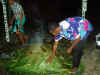

Flushed with success we cleaned up and went to a restaurant called "Bula Re" for their Wednesday special of "Lovo". This is a traditional Fijian meal
cooked in a ground oven. The food was fabulous. This was "cuisine" not "cooking" as we had experienced elsewhere in the Pacific. While at the Bula
Re we met a couple from Oklahoma who are on a diving holiday. A very pleasant evening swapping Oklahoma (Helen and Marian were both born in
Oklahoma) and shark encounter stories.
June 2, 2005
Thank goodness our pace of endeavors has slowed down since yesterday. We managed a little shopping and went to a seminar on cruising
permits and Fijian customs in the afternoon. I believe that the permit procedure is unique to Fiji. You have to apply to the government for a
permit on the places you wish to visit and even then, certain islands are "off limits". I read somewhere that following the military coup here in
1987, the old time chiefs who supported the coup and formed the "new" government (along with the military of course) were from the Eastern
islands. They didn't want to be hassled with tourists in their neck of the woods, so they made their home islands off limits. Today you can visit the
Lau group but it still needs another special permit and is fabulously expensive. We applied for and received our cruising permit yesterday. The
company we are renting a mooring buoy from ("KURLIZ") had an example application letter and we duly received a permit written entirely in Fijian.
The cruising seminar was to explain to us what the permit said and also the procedure we had to adopt when arriving at a new anchorage. Briefly, Fiji
retains the old and rigid village system. You arrive at a new anchorage and it is necessary to ask permission from the local chief to anchor in "their"
bay, swim, fish, visit the village etc. When you go ashore, you are almost always immediately met by someone from the village - 'cos they don't have a
tremendously full social calendar and they watched you arrive. You ask to see the local "herald". You tell him why you have arrived, ask to meet the
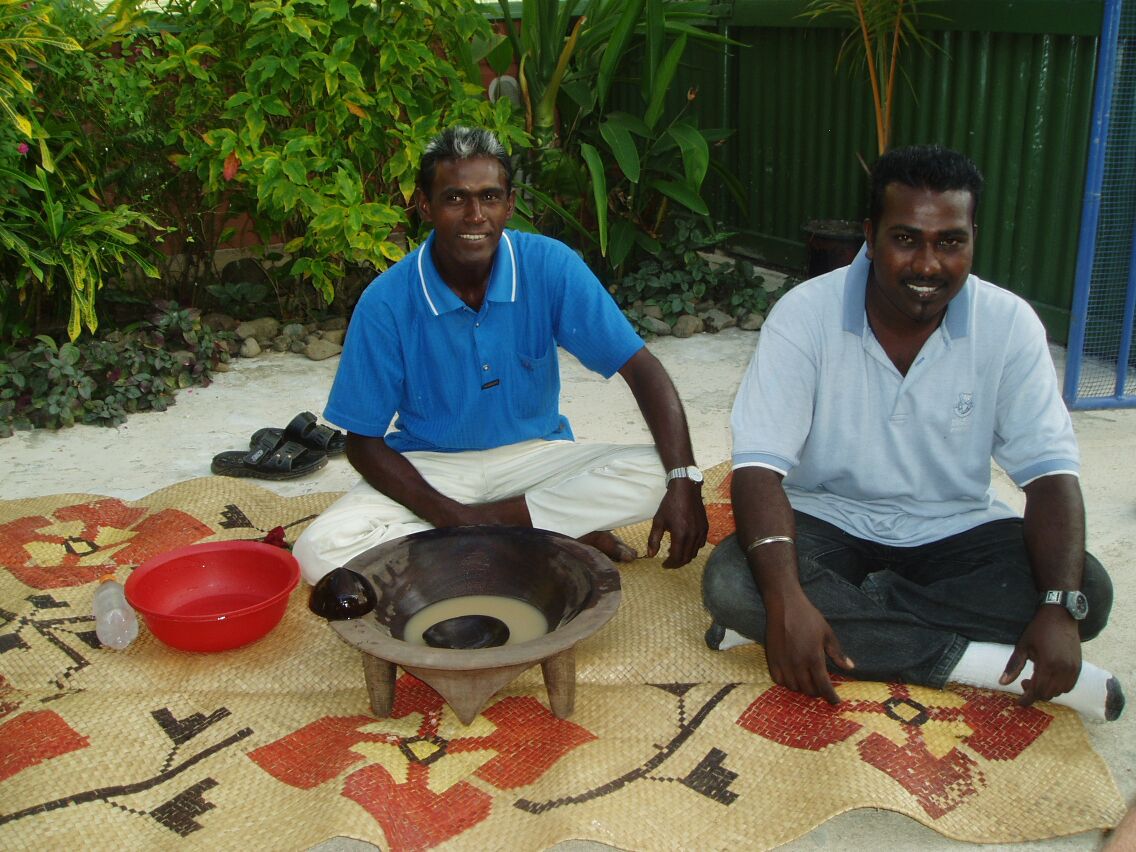
village chief and ask him if he would negotiate on your behalf. He takes you to the chief and you place on the floor in front of him, a bundle of kava
roots (previously purchased at the local market). If he picks up your offering - your in! You then sit down for a formal kava drinking ceremony.
If not, you clear off out immediately before they eat you.


June 3, 2005
We attended a cooking class this morning on Fijian cooking. Annette and I were the only attendees and the lady showed us how to cook a basic curry.
She was very skilled and it was interesting to see how she combined the local ingredients of fresh herbs etc to produce a mild curry base. Most of
these herbs we have in the USA of course but we would see them dried rather than looking like dandelion leaves. As part of the class, we then visited
the local produce market. Annette loves this kind of thing and it really is exciting to stand in the bustle of stalls and people, with all of the
unfamiliarly strange looking vegetables. The fish market is just as good, with huge coolers stuffed with the nights catch of fresh fish,
lobsters, crabs etc.
We had been warned that the week-end was wild and noisy in Savusavu, as the locals come into town from the surrounding area, to visit the market and
party. The resident waterborne crowd moves about 5 miles or so down to the tip of the headland, to a protected anchorage off the "Cousteau" resort. We
decided to do the same and left a fender with our boat name inscribed - to define ownership of our mooring buoy and anchored next to the palm
trees and elegantly sculptured grounds of the Cousteau Resort. This was purchased and is owned by the world renowned oceanographer Jean - Michel
Cousteau. We motored over to their dock, ignored the very large sign telling us to "keep off" and walked over to the restaurant to make dinner
reservations for Sunday night. Back at the anchorage we visited with Chris and KT from S/V Billabong and invited them for "sundowners". Billabong is
the boat that hit the whale on a night passage to Vavau from Nuiatoputapu, in Tonga last year.
June 4, 2005
In the cool of the morning I dismantled the access panels to the generator to see if I could diagnose it's mysteries. Yesterday in an act of
carelessness, I had overloaded the generator output and it quit making electricity. I had done this once before and it had popped a breaker but
this time, it's feeling were hurt and it sulkily refused to cooperate. I metered and tested but it was not making sense and I was reluctant to dig
too deeply into something of which I had no documentation, was also adorned with huge yellow warning stickers and is bolted onto a large hammering
diesel engine. I had asked Mike from Shangri-La, who operates a marine electrical repair service, to stop by and take a look and in the meantime
decided to go snorkeling.
This was our first snorkel of the season and we swam and explored the small reef we were anchored next to. As we were swimming from DoodleBug
towards shallower water, we saw below us four large silvery fish (over six feet long) in what appeared to be a feeding frenzy. It is truly astonishing to
see how fast those suckers can move underwater! Seeing sharks just placidly hanging in the water is one thing but the way these fish were acting was
plain scary. We convinced ourselves these were not sharks and continued our swim, although looking about warily. We later decided that these were a
variety of tuna. The reef swim was delightful and we were grateful to KT, who had warned us about tiny stinging jelly fish and we had taken the
precaution of wearing full body lycra "dive skins".
Later that afternoon, Mike showed up to look at the generator. We powered it up and discovered it was working! Despite the fact that he hadn't
actually done anything to make it work, other than supply the proximity of his healing aura, we nevertheless were extremely grateful for his efforts.
June 5, 2005
This morning we picked up Chris and KT in our dinghy and anchored it next to a coral outcropping called "hole in the rock". The clarity of water,
color of the soft corals and the colors and varieties of fish were amazing. It was a truly excellent snorkeling experience. This was a very pleasant day
and capped off by a gourmet supper at the Cousteau resort, where we belatedly celebrated our 34th wedding anniversary. We had decided that our
passage meal of sardines and crackers had not really met the standard of a celebration meal and had mutually agreed to postpone the event. The grounds
of the Cousteau resort was lit by artfully located kerosene lanterns and we tied our dinghy to their dock and walked the long and dark dock to the bar /
restaurant, where a group of Fijian musicians were softly playing. Very nice.
June 6, 2005 - June 10, 2005
Monday morning we moved back to our mooring off the little town of Savusavu. We had tried to use the washing machine yesterday and it made little sick sounds.
Fortunately I was standing nearby and got it shut down before it smoked itself. A brief investigation showed that the drum that holds the clothes and the soapy
water, was frozen solid and would not rotate. We found an appliance repair place and a young man came to the boat and worked on the recalcitrant device for nearly
three hours. He found that the water intake port for the recirculation of the soapy water, was jammed completely solid with some kind of material that looked more
like ground up rock. The washer has only been used for 11 months with liquid soap and watermaker water, so the origin of the clogging material remains a mystery.
By chipping out the clog with a screwdriver, the washer came back to life. This operation had now occupied the biggest part of the day and we rounded it off by
playing snooker in the "Planters Club" with Chris and KT from S/V Billabong. We were collectively so expert at snooker, it took us nearly two hours to
clear the table and even the locals were too disgusted to watch our efforts.
On Thursday we caught the 0930 bus from Savusavu to Lambasa. Lambasa is Fiji's third largest city, with a population of around 20,000
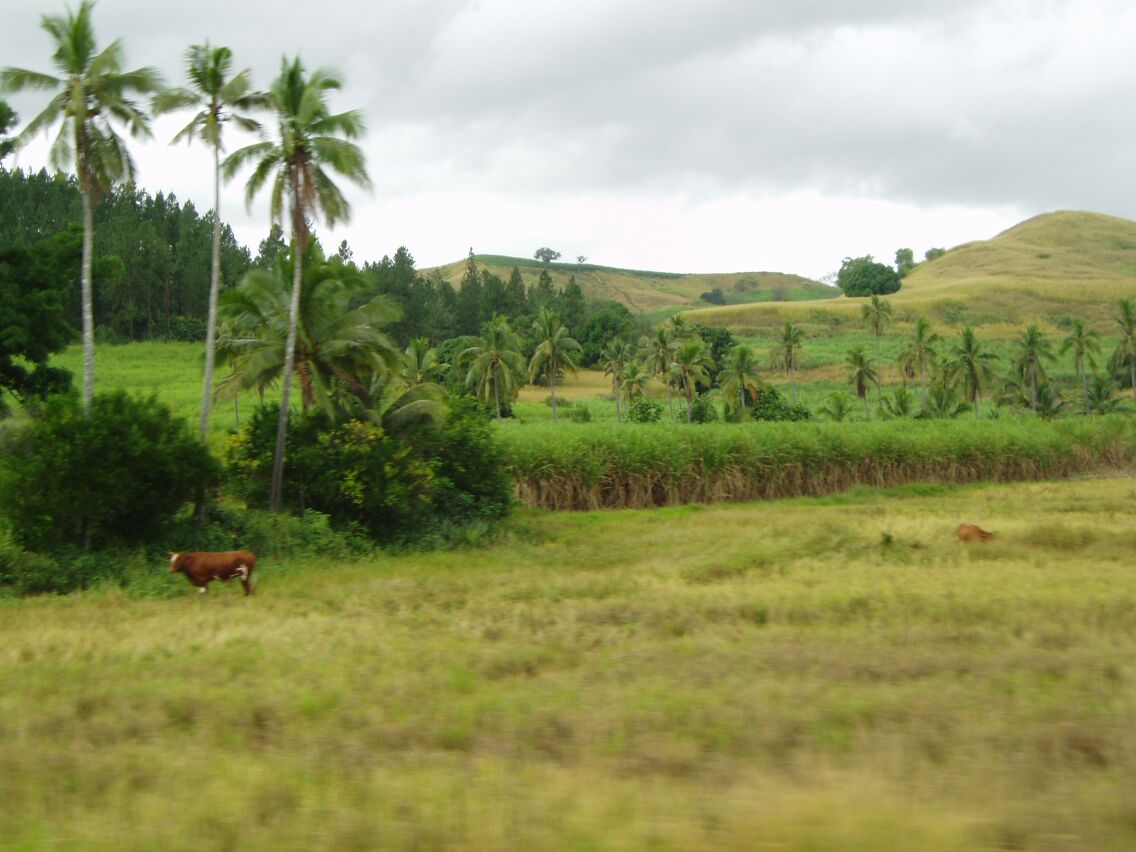
inhabitants and is on the north coast of Vanua Levu. The town has no deep water harbor but is at the center of a major sugar cane growing area. From 1880 to 1916,
Britain brought in numbers of Indian indentured laborers to work the sugar cane fields. Many of these people stayed on as settlers when their term of service was
completed. They are now approximately half of the total population of Fiji and naturally they were the group that was disenfranchised by the military coups of 1987
and 2000. Since Lambasa has a cane crushing mill and is one of the centers of the cane growing areas, it has a large Indian population.
The bus ride to Labasa was the main attraction, as few tourists go there. The ride took just over 3 hours and cost around three US dollars
each. The bus was reasonably full at all times, with laughing gaily dressed people, who greeted one another and also various friends they could see on the
roadsides as we passed. The route took us through small villages around the perimeter of Savusavu Bay and then climbed over the mountain range dividing north from
south. The temperature did drop as we climbed and the bus ground uphill at what seemed little more than walking pace. The bus stopped often and frequently the
would be passengers, had quantities of goods in crates and sacks at the roadside. The driver would wait patiently for perhaps ten minutes or so, as all of this
stuff was loaded into the luggage compartment of the bus. An elderly gentleman would rise and walk in stately fashion to the front and descend the steps. He would
reappear a few minutes later and we presumed he had gone for a pee. Once a couple of young lads boarded the bus and polled the passengers selling peanuts and
roasted, peppered peas. In all of this, the driver would sit patiently with the bus just occasionally rolling slowly backwards or forwards according to the slope
of the road and adding to the challenge of whoever was trying to load goods into the bus at that time. About ten minutes after we were in motion again, the bus
would grind to a halt and the unloading process would begin.

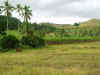
As we descended the mountain on the north side of Vanua Levu, the vegetation changed from heavily creepered trees with dense undergrowth, to
the more agrarian northern plains. This side of the mountain had small rivers running through deltas to the sea. The land at the river crossings was usually not
planted with cane and contained thickets of huge ancient bamboo, soaring into the canopy or criss-crossing like a giant game of "pick up sticks".
Eventually we sputtered into the bus station of Lambasa and gratefully moved our cramped muscles to a nearby restaurant for lunch. Two lunches of half a roasted
chicken each, fries, salad and two huge beers each came to about US$10.


We had booked ourselves into a hotel and so we dumped our backpacks here before heading off for a couple of hours of serious shopping.
Annette was fascinated by stacks of cooking pots for sale, that were probably six feet in diameter and 4 feet deep. The storekeeper told her they were for cooking
the "whole beast".
Later that afternoon we watched the single channel of Fiji television in the hotel room. There was a senior government official being
interviewed about the forthcoming "National Day of Reconciliation" and associated legislation. The TV interviewer asked him if the main content of the
"bill" was simply to grant amnesty to the military for crimes committed during the 2000 coup. He spluttered and began to say he didn't know what was in
the bill and realized how ludicrous that sounded. He then mumbled for several minutes about how he couldn't answer the question and anyone concerned could provide
their suggestions for modifications to the relevant committee. When the next set of officials were asked if it was true that the five senior members of the
present government had received personal threats from the military the prior day, we were told that nothing could be determined until the written evidence had been
thoroughly examined. It was hilarious to watch and reminded us how much more skilled our western government spokesmen are at dissembling.
In the morning we set off after breakfast to see if we could get a tour of the cane crushing plant. Our taxi dropped us in the rain at the
human resources center. There we were told that the plant was closed to visitors as they were still making repairs from "the cyclone". We were
disappointed but not completely surprised, as the TV news had mentioned labor difficulties with the drivers of the trucks delivering the cane. They are almost all
Indian and the government transport agency had come up with a new vehicle inspection regime including fines for all sorts of things like a broken taillight. The
Indian drivers union had responded by going on strike and the evening news had carried the story that the government had backed down and agreed that the road
inspections would stop and that the trucks would be examined at the government facilities after the present harvest is completed.
We wandered around the stores a little more and had coffee and chatted with an Indian jeweler who had moved here from India 15 years ago.
He made some comment about the present government, so I asked him what the "National Reconciliation Bill" was all about. He said it didn't mean anything,
just amnesty for the military, as in the previous coups.
Three more bone shaking hours on a bus was not on our "frequently repeated experiences" list and we caught a cab back to Savusavu,
which accomplished the trip in about 90 minutes. The highlight of the return trip was seeing a couple of mongooses (mongeese?) crossing the highway. These animals
were introduced in the 1880's to combat the rats which were damaging the plantations. Of course no one realized that the mongoose is a day hunter, while the rats
were mainly nocturnal. The poor ol' mongoose has had to survive on a diet of chickens and spotted owls etc. Well.... maybe not spotted owls but certainly iguanas
and native ground birds. We arrived back in Savusavu to find DoodleBug intact at our mooring and we began the preparation for leaving on the morrow for a cruise
around the eastern islands and bays.
June 11, 2005
Yesterday evening was the long awaited rugby match between Fiji and the New Zealand "All Blacks". The Fiji television had been advertising the game almost
non-stop and we headed over to the Savusavu yacht club at 1900 hours to imbibe and watch the game. The bar had a pool for the winning score at $2
Fiji per selection. I chose NZ 53 points, Fiji 22. Annette chose NZ 45, Fiji 12. Annette got to watch the New Zealand "All Blacks" perform the
"Haka" for the second time in her life. This is a Maori war chant and to see 15 very large men chanting with the crouch, limb motions and facial expressions
of the ancient Maori chant (which means something like, "I will eat your liver"), is quite an experience. By half time, New Zealand was leading 50
points to nil. When the score got to around 80 to nil, the power went out all over the island. I think the President of Fiji must have ordered the
power to be cut, to save his people from further humiliation. We stumbled back to DoodleBug in the darkness, since we hadn't bothered to take a
flashlight and were relying on the lighting from the nearby yacht club - still plunged in blackness.
Today was the day we were to leave for our cruise of the eastern islands. The morning began with a squall that hit the anchorage around 0700 hours
with bucketing, driving rain and a sudden wind shift at 35 plus knots. DoodleBug heaved at her mooring and I had to put on swim trunks to venture into the
deluge, in order to lash down a sunscreen we had failed to stow and which was trying to go to Mexico.


Our first anchorage was to be the point here the Cousteau resort lies but the weather forecast showed westerly
winds by evening. Since this particular anchorage gets very ugly in westerlies, we settled down to spend another night at our mooring.
We were a little low on beer so I dinghied over to the Copra Shed marina and went into the liquor store to buy two cases. The clerk was a young and
petite Asian girl with her baby in a play pen made from stacked cases of beer. I paid for the beer and she consulted a slip of paper next to the
register before asking me, "Would you like a girl?" "A girl?", I stuttered. "Yes", she said, "We don't have a boy to help you, so would you like a
girl?". I assured her that I could manage and told her that girls are troublesome and cost way too much money.
June 12, 2005
Position: 16 43.5 S 179 43.8 E


We slipped the mooring at 0725 hours and sailed east along the coast to Fawn Harbor. The entrance to the bay is through a dog-leg in the reef. Supposed to be
easy to see, if you arrive near noon. We arrived around noon but the sky was overcast and we could see zip of the reef, until we had felt our way
anxiously to an anchorage with Annette standing on the bow pulpit, watching for "bombies". The sun then came out so we could see how easy it might have
been.
June 13, 2005
Yesterday we were anchored in Fawn Harbor, a mangrove fringed lake, completely surrounded by reefs. There was no beach, just the dense mangroves with
reported knee deep mud for those venturing ashore. We spent a quiet night listening to the fish jumping and seeing only a few dim lights scattered on
the nearby hillside from the homes of the residents. An Australian cruiser we had met last year, had told us not to swim when it is dark - dawn or dusk
and never to swim over mud. He said sharks prefer not to swim over a bright sand bottom and they generally feed at dawn and dusk. Who would know more
about sharks than an Australian? We decided not to go swimming over the mud bottom of Fawn Harbor and set sail at 0900 for Viani Bay, further east
around the coast.
We had a pleasant sail with light winds and arrived off the reef entrance to Viani around noon. The entrance was less well defined than Fawn Harbor and
we used waypoints scaled from a chart published by the Fiji government and then corrected this to satellite coordinates. It seemed to have worked, as
we saw nothing but deep water through the pass. S/V Moonshadow (Steve and Jackie) called us on the radio to say they had watched us arriving and
suggested we pick up a mooring from Jack Fisher, a knowledgeable local Fijian, who offers tours and services to visiting yachtsmen. Steve and
Jackie had planned a hike for the afternoon led by Jack (Fisher) and invited us to join them.
We followed Moonshadow's dinghy in what appeared at first to be a tortuous route in the wrong direction. As we completed the semi-circle, we were able to observe
that Jack had directed us around an extensive reef system, previously unobservable because of the sun direction. We landed on a sandy beach and
began the hike by walking through Jack's village. The Fishers are an Anglo-Fijian family and the land was originally acquired somehow by Ned
Fisher, born in England. Jack said that his grandmother liked cigarettes and whisky, so she sold some of the land to raise cash for her habits. The rest
of the land was divided amongst the Fisher clan, who have managed to hold onto it since then. The scenery is spectacular with the crystal clear water
of the bay, the light blue of the reefs, all surrounded by a circle of green hills populated with a mixture of pines, some stands of native trees and the
rest covered with a tall, coarse grass. Jack told us that the native forests had been burnt to enable sugar cane planting. The plan was to use a cable
hoist to transport the cane from the hillsides to the beach and then by barge to the next bay. The labor difficulties turned out to be
insurmountable and the operation folded. The shoulder high native grasses now cover the denuded hillsides.


Jack's village was interesting and contained a handful of homes plus a church and a school. The school teaches four grades, has around 64 pupils
and four full time teachers. Before the school was built, Jack had to go to (elementary) school in the next bay. He said it was a four hour hike home on
a Friday and then a return four hour hike on Sunday - or really "fast" hike early Monday morning. The area that had been Jack's father's rice field is
now the village rugby pitch - the girls play volleyball nearby. I asked Jack what position he played and he said "wing". I bet he weighed a sight less
than he does now if he was a rugby winger. Jack skillfully led us up the hillside through the tall grass, at a pace designed to keep aging,
out-of-shape sailors alive. The hillsides were very steep and would be impossible if heavy rain turned the clay like soil to mud. Near the summit
of one hill was a place where there were several wooden posts

 and cross structures in the ground and someone had carved benches in the steep hillside to make a small amphitheatre. Jack said some of the villagers came
up here to drink kava and watch games or movies on television. It was then I noticed that one of the poles had pieces of wire nailed to it and a co-axial
cable attached. They had built their own directional Yagi TV antenna and the location of the amphitheatre was high enough to get reception from the main
transmitters of Fiji television. Jack said that it had begun to rain heavily during one game and it was
impossible to get some of the older viewers down the hillside in the dark and the mud - they had to spend the night up there. In the morning some were
in very bad shape with exposure to the wind and rain without any form of shelter. From the summit of the hill we could see right across the bay and
see DoodleBug and Moonshadow quietly at mooring and looking very close to the reef! Jack said the mooring that we are on, used to be in the middle of
the bay but had dragged to it's present location. He doesn't think it will drag any more and the rope has been changed out twice since it was first
deployed. I tried to remember what the Grib files predicted for the next few days wind and decided we might make it out of here intact.
and cross structures in the ground and someone had carved benches in the steep hillside to make a small amphitheatre. Jack said some of the villagers came
up here to drink kava and watch games or movies on television. It was then I noticed that one of the poles had pieces of wire nailed to it and a co-axial
cable attached. They had built their own directional Yagi TV antenna and the location of the amphitheatre was high enough to get reception from the main
transmitters of Fiji television. Jack said that it had begun to rain heavily during one game and it was
impossible to get some of the older viewers down the hillside in the dark and the mud - they had to spend the night up there. In the morning some were
in very bad shape with exposure to the wind and rain without any form of shelter. From the summit of the hill we could see right across the bay and
see DoodleBug and Moonshadow quietly at mooring and looking very close to the reef! Jack said the mooring that we are on, used to be in the middle of
the bay but had dragged to it's present location. He doesn't think it will drag any more and the rope has been changed out twice since it was first
deployed. I tried to remember what the Grib files predicted for the next few days wind and decided we might make it out of here intact.
Near Jack's place was a stand of Pine trees. Jack said his family had spent $20,000 planting the trees but they had been burned three times by malicious
neighbors. He said his horse had been stolen and when recovered, it had been tied so that it could not reach food and would starve to death. His horse
recovered from the experience and Jack described to us a careful revenge murder he had planned, if the police did not punish the responsible party.
He had similar plans if he caught the local arsonist. Jack had spent a decade managing the operation of the abattoir on Taveuni island before
quitting to become a tattoo artist. I told Jack that the real money is to be made in removing tattoos, not putting them on. He explained to me that you
can remove tattoos by going over the original needle insertion points but using fresh goat's milk instead of ink. He insisted that you must use fresh
goat's milk - not reconstituted milk. Later that evening we chatted with Steve and Jackie over sundowner's on board DoodleBug. Steve worked in the
Oil patch and sold waterproof connectors to companies like Fairfield Industries and Schlumberger for use on their seismic crews. Small world!
As the dark of the evening settled, we heard drums beating over at the Fisher village and then again from across the bay. The faithful were being
called to church as they don't have a bell.
June 14, 2005 - June 15, 2005
Position: 16 45.0 S 179 53.0 E
S/V Moonshadow left yesterday morning and as they exited the reef pass, they called us on the VHF radio. They reported that the wind and wave
action would probably produce poor visibility if we were to go snorkeling today. We resigned ourselves to a lazy day of reading, catching up on
e-mails and visiting with Jack - the local man we had met upon our arrival. We made arrangements with him to snorkel the offshore reef in the morning.
Wednesday dawned clear and sunny and we picked Jack up from the beach in front of his house, dropped the mooring and motored almost 3 miles to an
offshore reef. We edged DoodleBug close to the lee of the reef and dropped the anchor on a submarine sandy "beach" between two coral "bombies".


The anchor was in perhaps 30 feet of water and as we dropped back on the chain, the depth sounder showed hundreds of feet of water below us. Jack followed
us in the dinghy as Annette and I snorkeled along the reef face. Occasionally the current would sweep us into deep water and it was a relief
to see the dinghy nearby with DoodleBug in the distance and apparently moored in the middle of the ocean. It was interesting to see the profusion
of colors and types of reef fish and also to see the more pelagic fish lurking in the nearby deeps. At one point in swim, the current became too
strong for comfort and Jack towed us with the dinghy for the length of the reef. I have always felt that by holding onto a slow moving dinghy with one
hand, gives me a sensation of flying over canyons. I just remind myself that the way we "fish" is to tow bait behind a boat and so I am careful to look
behind occasionally.
Tomorrow we sail to Rabi Island. The electronic charts we have been using have usually agreed fairly closely with the printed Fiji government charts.
The trip to Rabi requires some tight passages between reefs and rocks and I have noticed a huge discrepancy between the two chart series. The electronic
charts clearly show our transcribed route crossing islands and reefs. We will need "eyeball navigation" and will thus attempt to time our trip
tomorrow for good visibility at the tight spots.
June 16, 2005
Position: 16 26.8 S 179 56.3 W
We dropped our mooring this morning and headed across the bay and between the reefs, relying upon the magic of satellite positioning. We could
see nothing of the reefs until 1000 hours and then, only in the opposite direction to the sun. All we could see before this time was a rippled
reflection of the sky and we motored in very light winds northwards towards the island of Rabi. As we passed between the east coast of Kioa and its
barrier reef, we took bearings of headlands and small islands, plus monitored the water depth. It was immediately obvious that the electronic
charts were off by almost three quarters of a mile to the east. The latitude (north - south position) was reasonably close to correct. These electronic
charts are based upon surveys conducted by Lieutenant W. U. Moore, R. N. in the period 1878 - 81. Their positions were by sextant, so although their
latitude was very accurate, getting the longitude by less than a mile was considered pretty good. Unfortunately, the gaps in the reef we need to
navigate are less than 0.2 miles across. The printed Fiji government charts seemed to be very close to correct and by relying upon waypoints scaled from
these charts, we arrived safely off the village of Nuka, Rabi just before noon. We anchored just off the decaying pier and I (Ed) rowed ashore while
Annette remained on board DoodleBug to monitor the holding of the anchor.
Nuka is a sleepy little village but is the administrative centre of Rabi. I asked a teenage girl for the location of the Police station and she waved at
the building I had already selected. Throughout the Pacific, it is usually the building with the radio tower. I "checked in" with the local police and
asked permission to visit our intended anchorage of Albert Cove. A few minutes later I was headed back to DoodleBug and we raised anchor and set
out again for Albert Cove. We were anxious to arrive here in good light, since this bay is not on the nice large scale chart we have been using until
now. We have crossed the date-line again (just before we got to Nuka) and the next chart has far less detail. Nevertheless the scaled off waypoints
worked well and we passed through a reef pass to enter a pristine little bay, with a white sand beach and a single trickle of smoke to indicate human
habitation. This has to be just about the prettiest little bay we have been in to date. We crept in towards the beach and anchored in a sand patch
before dropping back on the chain into deep water.


After our lunch, we dinghied ashore and walked over to the location of the smoke. There we found
a hut with two men and a sleeping child. They told us that they are the only inhabitants. The one man was visiting from the island of Kioa and the other
was a native of Rabi and the only permanent inhabitant of the bay. The latter invited us into his hut where we sat cross-legged on a mat they had
placed for us and chatted.
June 17, 2005
We had originally planned on staying here an additional day and then heading off to
Budd Reef on the morrow. After spending hours inputting various route options into the navigation system, it became apparent that there was no
viable option that would have us sail at a decent wind angle and arrive with suitable light to see the various reefs blocking the passage. If one assumes
maybe five hours of usable light, assuming of course it isn't overcast, then this would limit day passages to no more than 25 miles. Budd Reef is nearer
forty miles from our current anchorage. We decided to spend an additional day in this anchorage - no hardship! - and then sail to the northern tip of
the island of Taveuni. If the weather cooperates and we and take off from there, we will arrive on
a Monday afternoon within the Budd Reef group of islets. We spent the day in additional intense beachcombing, reading, napping etc. The sole inhabitant
of the beach is engaged in copra production. He has an oven in operation and is drying the halved coconuts to form copra over a fire. Everywhere else in the Pacific that we
have seen copra production, the cracked shells were laid out in the sun to dry. Tending an oven seems to require much more work and I presume is
perhaps due to Fiji being more overcast and wetter than the other islands.
June 18, 2005
We did a few boat chores this morning and then took off in the dinghy to explore the
surrounding reef. Annette had bought a viewing device somewhat like a child's floatie, with the middle being a sandwich of optical grade
Plexiglas. The middle of the sandwich is filled with freshwater and the loaded device floats on the surface of the sea and allows the user to
clearly see the submarine world. This wondrous device allowed us to anchor the dinghy on the reef over some really neat snorkeling territory. We
were visited by one of the fisherman from the nearest village, who was paddling an outrigger canoe. He fished nearby using some kind of net. The
only other vessels we have seen in the past week are a scattering of these outrigger canoes. The fishermen often use a gaff rigged sail and look like the
"Sunfish" dinghies at a distance.
After lunch Annette rigged hand fishing lines off the side of DoodleBug (we are finally getting low on mahi-mahi!) while I wrote the first
 software program that I have touched in nearly two years. When we were in Savusavu, I was given a file containing nearly 400 waypoints from one of the resident
cruisers. The file was exported from a Garmin system and I wrote a program to convert it to Raymarine format so we can read the file into our system.
After two hours I was pleased to see my program work - proving to myself at least, that my brain has not gone entirely to porridge yet. Annette checked
her fishing lines but no bites. She consoled herself by cooking defrosted mahi mahi fillets in lime juice, soy sauce and chili powder - pan seared in
sesame oil, with boc choy sautéed in the lime / soy marinade and deep fried taro root cubes. Supper at sea.
software program that I have touched in nearly two years. When we were in Savusavu, I was given a file containing nearly 400 waypoints from one of the resident
cruisers. The file was exported from a Garmin system and I wrote a program to convert it to Raymarine format so we can read the file into our system.
After two hours I was pleased to see my program work - proving to myself at least, that my brain has not gone entirely to porridge yet. Annette checked
her fishing lines but no bites. She consoled herself by cooking defrosted mahi mahi fillets in lime juice, soy sauce and chili powder - pan seared in
sesame oil, with boc choy sautéed in the lime / soy marinade and deep fried taro root cubes. Supper at sea.
June 19, 2005
Position: 16 40.9 S 179 52.4 W
This morning we were all fired up to take off from our quiet little anchorage and set sail for Taveuni. It was raining. Everything I have
written in the past about optimum sun angles, having the sun behind you etc. for spotting coral reefs, isn't worth didley when there is no sun and it is
overcast. We convinced ourselves that the weather would probably clear up in an hour or so and that we could see patches of blue sky to the south. Our
previous satellite "track" allowed us maneuver ourselves past the reefs guarding Albert Cove with some confidence and we set our course to the
south. An hour or so later it was still raining and overcast but we cautiously left our previous "known" route and headed east below the island
of Rabi, crossing between numerous unseen reefs. We were navigating based upon the
 Fiji government issued paper chart and fixing our position by taking bearings to any markers we might identify, plus monitoring our depth
reading and correlating this back to the chart. This worked quite well, until we arrived at the southeast reef passage below Rabi. The coordinates
and track we were following indicated a rise in depth from 160 feet to about 35 feet, as we passed between the unseen coral mounts and then
plunging to 800 feet or more as we passed into clear water. Our depth remained stubbornly fixed at near 150 feet and our coordinates showed us
clear and in deep water. We turned towards Taveuni and immediately the depth began to rise sharply, indicating a rapidly shallowing sea bottom. I
reversed the throttle to bring DoodleBug to a dead stop and slowly returned to our original course. Gradually the depth began to increase again and
perhaps a half mile or so later, we had found the deep water we were expecting. Whew!
Fiji government issued paper chart and fixing our position by taking bearings to any markers we might identify, plus monitoring our depth
reading and correlating this back to the chart. This worked quite well, until we arrived at the southeast reef passage below Rabi. The coordinates
and track we were following indicated a rise in depth from 160 feet to about 35 feet, as we passed between the unseen coral mounts and then
plunging to 800 feet or more as we passed into clear water. Our depth remained stubbornly fixed at near 150 feet and our coordinates showed us
clear and in deep water. We turned towards Taveuni and immediately the depth began to rise sharply, indicating a rapidly shallowing sea bottom. I
reversed the throttle to bring DoodleBug to a dead stop and slowly returned to our original course. Gradually the depth began to increase again and
perhaps a half mile or so later, we had found the deep water we were expecting. Whew!


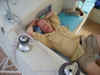

The approach off Taveuni was cautious again and we anchored perhaps half a mile from the beach fronting a busy little airport. As a humorous gesture,
the sun came out and we could now see the obstacles we had missed on the way in. There was little sign of life from the few scattered homes on the
shoreline but a half dozen or so small aircraft, took off and landed as we watched. They usually turned and climbed directly over DoodleBug as we took
their pictures.
Annette noticed a shoal of squid hovering near our anchor chain and called me to observe. I did not realize that they moved so fast and also in
formation like a school of fish. The water was crystal clear and you could see every detail of the sea bed. Annette was considering going swimming
until I casually mentioned that Taveuni has the highest record of shark attacks in the Fiji group. She contented herself with observing from the
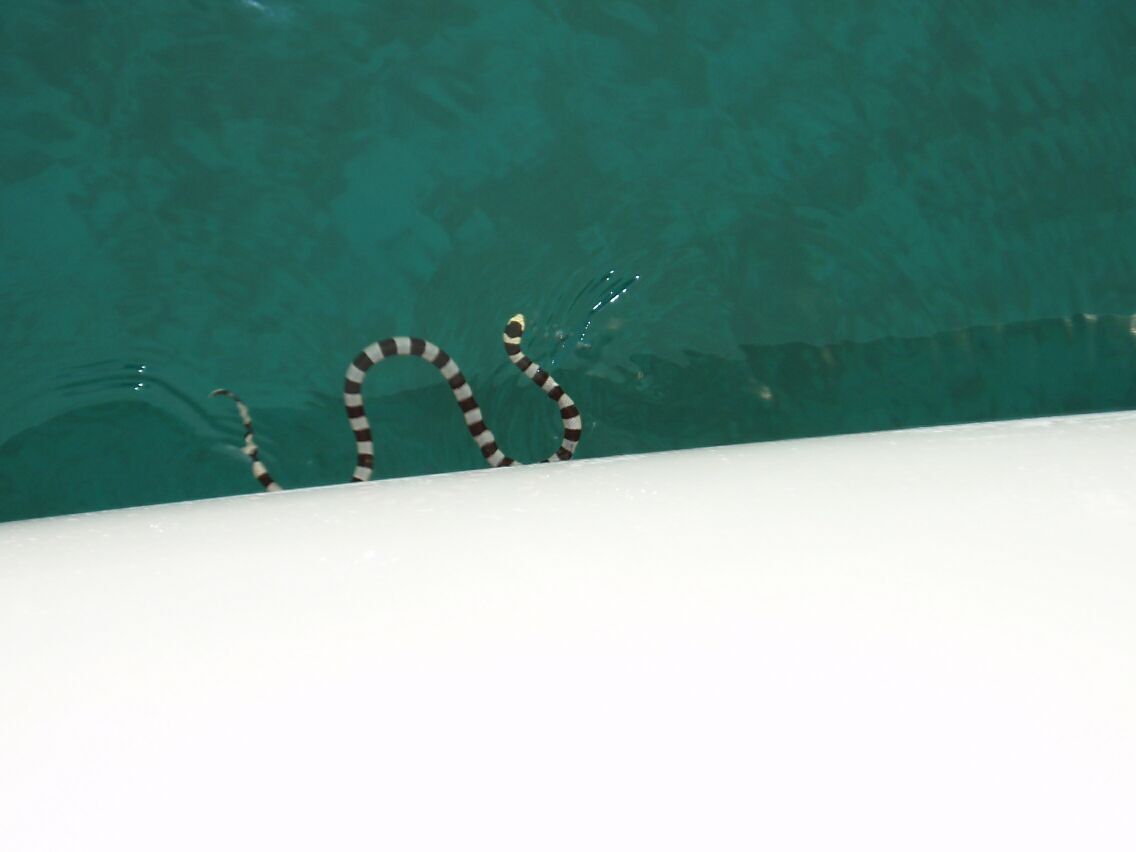
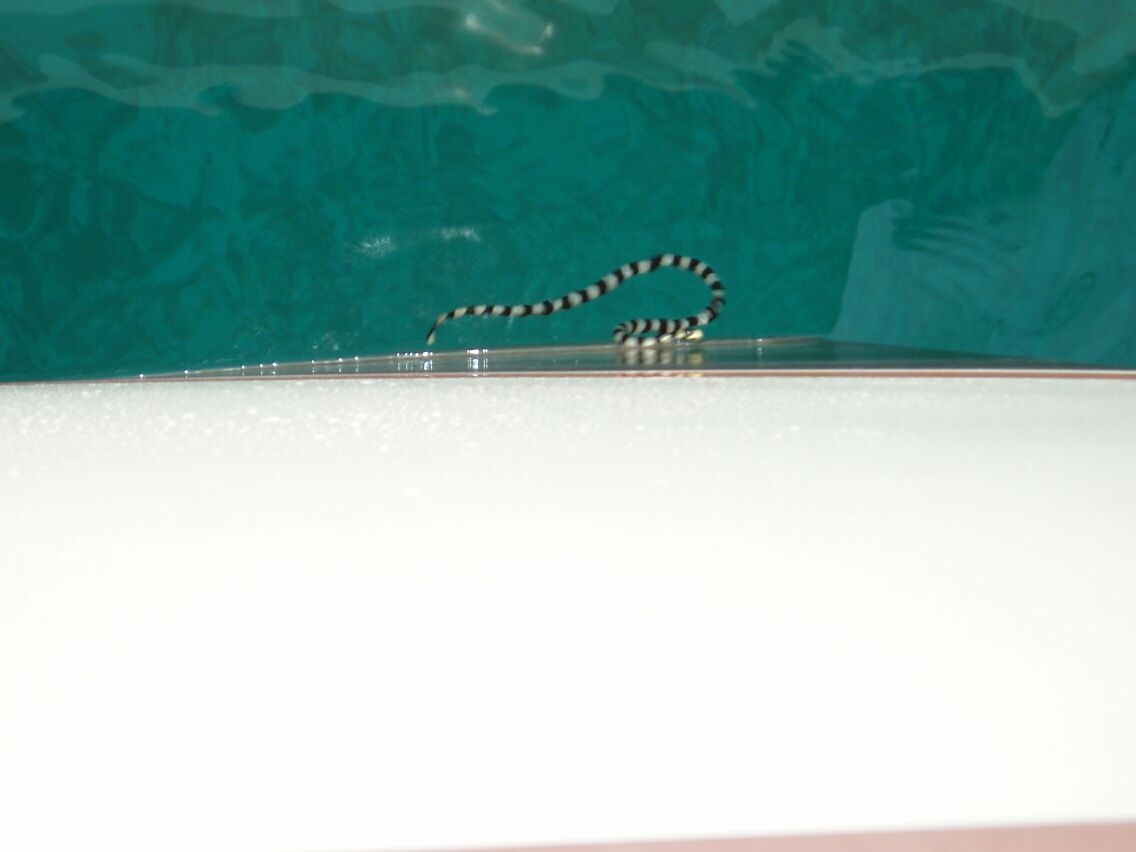
deck. A small banded snake swam up and attempted to board DoodleBug. It is hard to imagine how any two foot snake was going to climb a six foot smooth
fiberglass wall but his attempts have made him the most photographed snake in Fiji.
June 20, 2005
Position: 16 29.8 S 179 41.8 W
The first grey of dawn showed more clouds and rain. The next time I looked, there was
blue skies and sunshine! These islands make their own weather. While we suffered yesterday in the rain, Savusavu enjoyed sunshine all day. The
island of Rabi lies in the rain shadow cast by Taveuni. Taveuni has a ridge of mountains along its spine with peaks of over 4000 feet in
elevation. The warm trade winds blowing across the wide Pacific, gather lots of moisture and when thrust violently upwards by the mountains of Taveuni,
they dump their liquid contents onto the poor sailors who happen to be downwind. According to Lieutenant W. U. Moore of the 1878 surveying
expedition, the island of Taveuni is always swathed in clouds under trade wind conditions.
We crept out of our anchorage off the northwest tip of the island, before the rain
gods realized we weren't being soaked and set sail for Budd Reef. Budd Reef lies about fifteen miles northeast of Taveuni and consists of a large atoll
like reef structure containing six islands - the most northerly of which is "Cobia", an extinct volcanic crater. Only one of the six islands is
inhabited - "Yanuca" and at 1200 hours we anchored off the single village and dinghied ashore to ask for a "Sevusevu" ceremony. Essentially this
is asking permission to anchor off their village, visit the village, swim, fish, or whatever. We "dressed up" in acceptable clothes, which for Annette
was a shoulder covering blouse and a brightly colored wrap-around sarong. I (Ed) was wearing a shirt, plus a men's sarong or "sulu". We carried some
kava root wrapped up in newspaper and tied with ribbon.


We beached the dinghy and walked along the beach towards the homes, until we were met by a
young woman. We asked her for directions to the "Toranga ni koro" (the village herald) and she told us that he had left that morning and that the
chief had also left the island on business two weeks earlier. Most of the men were out fishing, so she would take us to the home of the most senior
male - to accept the sevesevu. We met two men - both named Matthew and they agreed between them, that one would act as chief and the other would act as
Toranga ni koro. The wife of the younger of the two Matthews had just had a baby and
 Annette got to hold the baby, which was probably more fun for her than catching a fish. I placed the kava bundle on the floor and the two
Matthews, plus the woman who met us on the beach, began a ceremony - in Fijian of course - accompanied by hand clapping. I felt like we were
supposed to clap too but there were no cue cards and no clue on our side as to what was appropriate. The young woman had an elaborate geometric tattooed
band on her arm but was wearing a western looking sheath dress and both Mathews were wearing shorts. We had been told not to wear clothes like this
as Yanuca is a traditional village. The men were really impressed with my "sulu" though and enquired where I had obtained it. After several minutes it was
announced that we were "accepted" and we thanked them and asked all of our questions about, "is it OK to fish? Is it safe to swim with the sharks
etc.". They said we are the third yacht to call there this year. They also maintained that since we had completed the sevesevu correctly, the sharks
would not bite us.
Annette got to hold the baby, which was probably more fun for her than catching a fish. I placed the kava bundle on the floor and the two
Matthews, plus the woman who met us on the beach, began a ceremony - in Fijian of course - accompanied by hand clapping. I felt like we were
supposed to clap too but there were no cue cards and no clue on our side as to what was appropriate. The young woman had an elaborate geometric tattooed
band on her arm but was wearing a western looking sheath dress and both Mathews were wearing shorts. We had been told not to wear clothes like this
as Yanuca is a traditional village. The men were really impressed with my "sulu" though and enquired where I had obtained it. After several minutes it was
announced that we were "accepted" and we thanked them and asked all of our questions about, "is it OK to fish? Is it safe to swim with the sharks
etc.". They said we are the third yacht to call there this year. They also maintained that since we had completed the sevesevu correctly, the sharks
would not bite us.


As we toured the village, they had an oven and drying rack where they were drying coconut for copra AND they were drying sea cucumbers for sale to "the Asian
people". I had read of this and Annette had been absolutely dying to know if you can eat the sea cucumbers. We were told that the dried cucumbers fetch
$80 Fijian per Kilo. This is about US$10 per cucumber. They derive far more money from this product than from the sale of copra. When we were in Ahe in
the Tuamotus and Penrhyn in the northern Cooks, you could hardly walk in shallow water for the sea cucumber that lay around so thickly. Don't tell
this to the Fijians if you are related to any cucumbers.
The village lies facing the southeast and although the anchorage seemed reasonable, we
decided to move to the other side of the island to avoid any wave action. By 1500 hours we had determined that the best anchorage lay off the school and
laid out a second "stern" anchor to hold us facing into the light swell. Our approach towards the school was accompanied by drumming of increasing tempo
until we dropped the anchor. We watched the children playing outside of the school building and when the classes finished for the day, the children
drifted off along the beach, before disappearing into the bush to cross to the other side of the island where the village lies. There remained three
men laying on the grass near the beach and we rightly judged these to be the teachers. We dinghied ashore and chatted to them for a while. There is also
a female teacher who is off visiting somewhere and the four of them share two small houses near the school. One of the men also lives in the village
and he offered to sell us fresh lobsters that the locals catch in quantity for sale in Savusavu. Annette is already planning the menu.
June 21, 2005
This morning I saw Matthew and Paul from the village, standing on the beach in front of the school and dinghied over to greet them. As

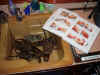 we were chatting, a man from the village showed up with the promised bag of lobsters. I delivered the lobsters to DoodleBug and returned with his cash. Matthew then
asked if he might have a copy of the picture we had taken of his baby (Gabriel) yesterday. He then announced that he had been suffering with an
earache for 3 or 4 days and asked if we carried any painkillers. I promised to meet him at noon, when he brings the school children their lunches from
the village. The tide had been receding and by mid-morning the reef between us and the beach was uncovered. We dinghied ashore to explore and met
"Willie", who was already on the reef hunting for octopus. As neither of us had participated in an octopus hunt, we decided to join this endeavor.
Willie's tools were a cane knife and two sharpened sticks. We were walking on top of a live reef covered with sharp spiny coral in places and Willie
was wearing a single flip-flop on his left foot. Within a minute or so, Willie announced, "There's one" and strode confidently up to a hole in the
coral, where he proceeded to jam in the sharpened sticks. We looked into the hole and indeed we could see tentacles wrapped around the sticks. The stick
jamming and poking continued for some time, while Willie regaled us with tales of his mother's prowess as octopus hunter but not much else seemed to
be happening. Willie then instructed us to keep an eye on his sticks, while he found some "iron". A few moments later he returned with a six foot long
iron pole with pointed ends, with which he began to pound away at the reef to enlarge the hole. The Budd Reef chapter of the Sierra club don't appear
to be too active. Even this heightened level of activity was not having much effect on the octopus and we wandered off in search of other reef treasures.
we were chatting, a man from the village showed up with the promised bag of lobsters. I delivered the lobsters to DoodleBug and returned with his cash. Matthew then
asked if he might have a copy of the picture we had taken of his baby (Gabriel) yesterday. He then announced that he had been suffering with an
earache for 3 or 4 days and asked if we carried any painkillers. I promised to meet him at noon, when he brings the school children their lunches from
the village. The tide had been receding and by mid-morning the reef between us and the beach was uncovered. We dinghied ashore to explore and met
"Willie", who was already on the reef hunting for octopus. As neither of us had participated in an octopus hunt, we decided to join this endeavor.
Willie's tools were a cane knife and two sharpened sticks. We were walking on top of a live reef covered with sharp spiny coral in places and Willie
was wearing a single flip-flop on his left foot. Within a minute or so, Willie announced, "There's one" and strode confidently up to a hole in the
coral, where he proceeded to jam in the sharpened sticks. We looked into the hole and indeed we could see tentacles wrapped around the sticks. The stick
jamming and poking continued for some time, while Willie regaled us with tales of his mother's prowess as octopus hunter but not much else seemed to
be happening. Willie then instructed us to keep an eye on his sticks, while he found some "iron". A few moments later he returned with a six foot long
iron pole with pointed ends, with which he began to pound away at the reef to enlarge the hole. The Budd Reef chapter of the Sierra club don't appear
to be too active. Even this heightened level of activity was not having much effect on the octopus and we wandered off in search of other reef treasures.


Willie finally got his octopus, very much the worse for wear, with lots of
holes poked in it and three of it's limbs missing. If you touched the tentacles they still "stuck" to your hand and took some pressure to remove.
The octopus was only about two feet long and not in the category of Captain Nemo's foe. Willie then showed us how to clean an octopus by turning its
mantle inside out so the guts were now on the outside of it's body. Any desire to participate in the forthcoming gastronomic treat, evaporated at
that moment. We printed a photo for Matthew and gave him half a jar of Tylenol before setting off in the dinghy to look for deserted beaches that
had not already been "shelled" by the school kids. A loud "whump" as we arrived on the beach, reminded us of the saying that "only fools stand under
coconut trees". Supper was fresh lobster with sautéed cashews and onions in toasted rice, plus fresh tangerine. There was also left over lobster for
tomorrow........
June 22, 2005
This morning we planned to explore the uninhabited island of Yavu and began the
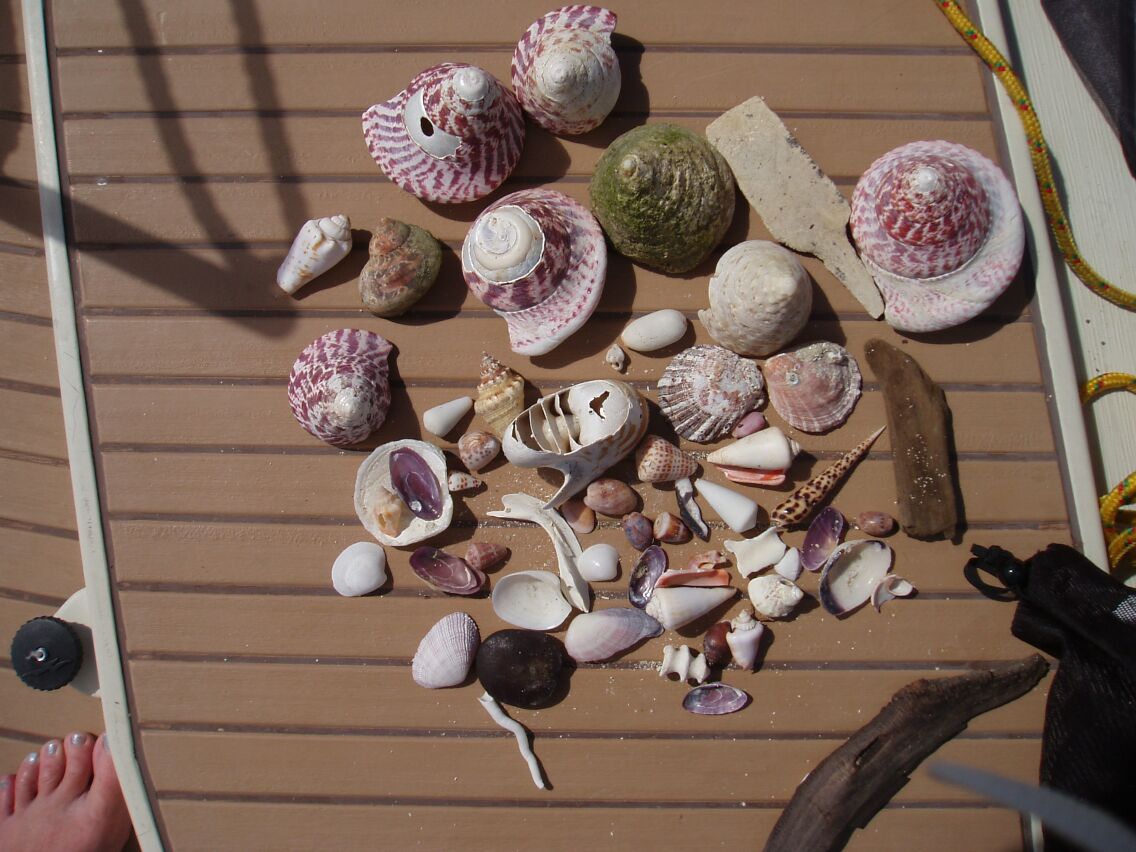
process by returning a kidnapee to the reef and recovering the stern anchor from the dinghy. I should explain that Annette's shell collecting system has
certain fail-safe measures built in. The shells are "stage one" cleaned, sorted and left to dry for some period of time. If the shells have not moved
when she returns, they go to "stage two" cleaning, involving a bucket containing Clorox. If the shells have moved, it means that they are owned by
someone else and have to be returned to their approximate habitat. The hermit crab involved in this instance, does not live in deep water and spent
the night in a habitat made from a plastic bucket with some sea water and a really small sand "beach". We prepared to raise the main anchor and a power
boat swung into the bay and headed directly for us. The power boat contained a Swiss man who is staying in the village and he asked if we had bought any
lobster. We acknowledged that we had. He said the village chief was upset because someone had raided the communal lobster holding tank and ripped off
some lobsters. He said the lads do this occasionally when they need to raise cash to buy booze. Ooops!!! No evidence left.


We motored around to the lee of Yavu Island and found a pretty beach in a sheltered cove where we re-anchored. We explored the beach and reef before heading
back to DoodleBug for a lunch of lobster left-overs. It began to rain, the clouds looked they were setting in, so we raised the anchor again and set
sail towards Taveuni in the south. We had estimated that we would be off the reefs guarding the Tasman Strait between Taveuni and the Island of Qamea
around 1300 hours, with good light to define the narrow pass. Instead we arrived with pouring rain and overcast skies. The chart showed reef markers
on both sides of the entrance but there was nothing to be seen, even with radar. As we edged closer using coordinates from the now discredited Fiji
government chart, we did see breakers to both starboard and port, indicating the reef positions but no water color whatsoever. The water depth indicated
we had passed into the Tasman channel and we approached the head of Naiviivi Bay, where we intended to anchor. Charting for this bay did not exist and we
were relying upon visual navigation to miss the large reef in the center of the bay approach - according to an outdated guide book. It began to rain
even harder. We finally were close enough to pick up the reef markers beyond the reef we were trying to miss and crept towards them at an oblique angle.
The guide book had said that when mid-way between the markers it was necessary to make a hard turn to starboard and line up with certain features
on the beach. It was raining so hard, we couldn't even see the beach, let alone the alleged markers. Just at the critical moment, a panga came up
behind us and Annette waved at the occupants to pass us. They did and we obligingly followed them through the reef entrance and into the narrow bay
beyond. Predictably the sun then came out and we could now clearly see the reef pass behind us.


Naiviivi is a long narrow bay with a mud bottom and surrounded by mangroves. It is a
"hurricane hole" and we anchored at the head of the bay. Later that afternoon Annette called the Qamea Resort and Spa on the VHF.
They were not monitoring the radio but had a shuttle boat out crossing the Tasman Strait who did pick up the call and the Resort
called us back about fifteen minuets later. We asked if they had a restaurant and if so, did they have room for two more and if so, did they
have a water taxi and if so, what was their dress code? They answered yes, yes, yes and casual. At six thirty we were picked up from DoodleBug by a
large, new looking power launch, which whisked us effortlessly across the bay in the dark and in the wrong direction. The problem with radio is that
you aren't always sure to whom you are talking. No problem, we had dinner reservations somewhere. The launch then made several sharp turns and headed
in the "correct" direction. This is called "local information" and reinforced our decision not to attempt this in our own dinghy. The landing
was on a steep beach but the launch was reversed into the beach and we were able to get ashore only slightly damp. The resort is exquisite and the staff
were wonderfully friendly. It became immediately obvious that the majority of the clientele are honeymooners from the USA. Since Annette and I are
still on honeymoon (after 34 years) we fit right in. I understand that these resorts do most of their advertising in bridal magazines. We met the manager
and his wife and chatted to them for some time. They said that there had only been a couple of boats in Naiviivi Bay this year and we were the first
dinner reservation they had ever received via VHF from a yacht. Dinner was wonderful and we found DoodleBug waiting for us on our return in the
moonlight.
June 23, 2005
Position: 16 45.8 S 179 46.9 W
Arrived Naiviivi Bay of Quamea yesterday afternoon. Leaving this morning for Savusavu Bay. Will write more later. Gotta get ready to leave now.....
June 23, 2005 (later that day)
16 48.6 S 179 17.2 E
The guide book for Qamea did not mention any hikes on the island and we decided to
make our run to Savusavu, to meet daughter Marian who is flying in on Monday morning. We raised anchor and left it dangling in the sea off the bow, to
wash off the black clinging mud that provides the great holding in the this bay. We navigated the reef passage relying upon the GPS track used on our
entry yesterday and headed south down the strait. The charting here is terrible. There are reefs and shallows throughout and the electronic chart
is off by nearly eight tenths of a mile. We navigated by compass bearings from the few landmarks we thought we could see and then on a compass bearing
to pass between two shallows guarding the southern entrance to the strait. There is strong current here and the wind was now directly ahead as we
motored at fairly high engine revolutions into the short choppy sea. The visibility was poor, with both spray and rain but we could see breaking
waves over the position that we had calculated as one of the shallows and the depth sounder indicated that we passed between these unseen hazards and
then into deeper and safer water. We sailed down the west coast of Taveuni, close reaching in stiffening winds but the crew had become used to the
calmer seas of the past week and had neglected to take sea-sickness medicine. A few hours later we made the turn past the south cape of Taveuni
and headed on a direct course for Savusavu Bay, "wing and wing" with the Genoa poled out on a near dead run. The waves were short and steep and
although we were running, the ride was still uncomfortable. The wind picked up to the 20 to 25 knot range as we approached the lighthouse off the tip of
the passage into Savusavu Bay and as we moved into shallower water, the waves began to stack higher and higher over the stern. We tore into the Bay
at around 9 knots and turned sharply to starboard behind the reef. The wind still howled but the waves died away to nothing behind the reef. Minutes
later we were in the lee of the peninsula and in the fading light, we anchored behind "S/V Gumbo Ya-Ya" - last seen in Tonga. Later that evening
Kurt and Nancy dinghied over to share sundowners and an impromptu dinner whipped up by the now fully recovered first mate.
June 24, 2005
When we arrived at the anchorage at dusk last night, there were six other yachts at anchor. This morning, as we stuck our sleepy heads out of
the cockpit, the sea was like glass and we were alone. Everyone else had departed for wherever they were off to. We tidied and stowed away all of the
poles and rigging we had been using on yesterday's sail and motored slowly the five miles or so to Savusavu town. The anchorage was crowded and is
squeezed between the town on one side and an island on the other. I saw two powerboats, plus someone swimming in the water directly ahead of us and
assumed that it was some kind of competition. I reversed engine and brought DoodleBug to a halt and yelled for Annette to come watch. One of the power
boats came towards us, with a man in the bow yelling and

 waving his arms at us. Just as I was thinking, "I am already stopped, bozo!", Annette shouted "It's a whale!". A large humpback whale had swum through the middle of the
boats at anchorage and now swam slowly down the side of DoodleBug, pursued by an excited entourage of Fijians in the two powerboats.
waving his arms at us. Just as I was thinking, "I am already stopped, bozo!", Annette shouted "It's a whale!". A large humpback whale had swum through the middle of the
boats at anchorage and now swam slowly down the side of DoodleBug, pursued by an excited entourage of Fijians in the two powerboats.
We picked up a mooring just off the Copra Shed Marina. When I visited their office to
"sign in", there was another cruiser there, "Neil" who was waiting for his cruising permit to be faxed to the marina office. I commented to him that
yesterday's weather had been the roughest we had experienced since last season and that we had a fast and benign sail up from New Zealand. He stated
that they had departed New Zealand at around the same time as DoodleBug but had taken nearly a month to complete the passage. They had stopped at
Minerva Reef (S 23 deg 39' W 178 deg 55') for a few days, while on the passage. I had heard what a fabulous place Minerva Reef is - isolated,
crawling with lobsters etc. etc. They had been caught by the low pressure system that had developed south of us and the wind had howled across the
reef at 45 knots for 10 days. During this time the reef passage was impossible to transit and they had been trapped inside the lagoon. The wind
had peaked at 70 knots and five other cruising boats had dragged anchor and been smashed to pieces on the reef. They has rescued two cruisers from the
reef and transported them to Fiji. A sixth boat had capsized in the seas nearby and had sunk, although the crew was fortunately rescued by a nearby
freighter. All this was on the anniversary of the June, 1994 Queen's Birthday storm although she is probably not to blame.
June 27, 2005
This morning Marian arrives in Savusavu. We caught a taxi to the airport and
asked the driver if he could stay, as we were meeting someone. He assured us that this was not necessary as there were always lots
of taxis at the airport. We arrived about 30 minutes early, because the flight time from Nadi is only 45 minutes and we did not want to be late.
There we met an Australian couple, traveling with two small children, who had been waiting for their flight since the previous day. After a five hour
wait, they had been sent to a motel for the night and assured of a 0700 hour morning flight. Marian's flight was scheduled to arrive at 0830 hours, so
their day was not looking too good - especially since their connecting international flight to Melbourne left that morning at 0900 from Nadi. I
asked them if we had the correct terminal. They looked slightly confused as the airport waiting area is more like an open bus shelter with a single
wooden shed attached for the "airport office". Marian's flight arrived right on time and there she was, grinning broadly and waving from the window
of the twin engined Brazilian made turboprop. We hugged her, grabbed her luggage and looked for a taxi. None to be seen. I went into the airport
office and asked if they could call us a taxi.


The man looked confused and then assured me that there were always lots of taxis, just wait a few
minutes. A few minutes later, the baggage handlers in their safety vests, climbed into an SUV and left. We were alone at the airport with our little
pile of baggage - even the Australian family had got on the sole aircraft and left. 45 minutes later a taxi approached and picked us up. The driver
said he could see us from his house and we looked like we needed a ride. She is here in Fiji and safe!
June 28, 2005
It has begun to rain. We have shopped the town, visited the vegetable market etc. This afternoon we took a tour of a copra "plantation" followed by a tour of
the copra processing plant. At the plantation they gathered coconuts and dried them. The gathering is done daily, as every day some coconuts fall.
They don't shake the tree, climb it, or use trained monkeys. Just heap them together at the base of the
 trees into piles. The next stage is to hitch up a pair of bullocks to pull a crude cart and the piles of coconuts are
gathered from around the plantation. The coconuts are cut in half with an axe and the meat cut from the halves with a knife. Our tour driver attempted
to show us how and was gleefully heckled by the locals, as he was neither fast nor skillful at this. The coconut is dried in an oven for two to five
days and the oven is heated of course, from a fire of coconut husks. The dried product or "copra" is then bagged for transport to the copra
processing plant - at $500 Fiji per ton. I mentioned before that this is the only island where the copra is not sun-dried and the plantation operator
confirmed this is due to Fiji's higher rainfall. We toured the "plantation", a property with absentee owners and currently for sale. If you want to sit
on your porch and watch the palm fronds wave before stirring up the bullocks to drag the coconuts over to the oven, this is the place for you! Marian was
fascinated by the untended fruit trees dropping, mangoes, papayas, kumquats, oranges etc. etc onto the ground to rot. I showed her a low ground covering
plant the local guide called a "sensitive" plant. If its leaves are tapped, it folds them up in a couple of seconds, as you watch. If however, you burn
the tip of a leaf with a lighter, the leaf immediately folds and then the next leaf on the twig quickly folds and then the next. It is amazing how
fast the process works, as the "fire alarm" message is passed along the stem. We just don't think of plants moving or communicating at those speeds.
trees into piles. The next stage is to hitch up a pair of bullocks to pull a crude cart and the piles of coconuts are
gathered from around the plantation. The coconuts are cut in half with an axe and the meat cut from the halves with a knife. Our tour driver attempted
to show us how and was gleefully heckled by the locals, as he was neither fast nor skillful at this. The coconut is dried in an oven for two to five
days and the oven is heated of course, from a fire of coconut husks. The dried product or "copra" is then bagged for transport to the copra
processing plant - at $500 Fiji per ton. I mentioned before that this is the only island where the copra is not sun-dried and the plantation operator
confirmed this is due to Fiji's higher rainfall. We toured the "plantation", a property with absentee owners and currently for sale. If you want to sit
on your porch and watch the palm fronds wave before stirring up the bullocks to drag the coconuts over to the oven, this is the place for you! Marian was
fascinated by the untended fruit trees dropping, mangoes, papayas, kumquats, oranges etc. etc onto the ground to rot. I showed her a low ground covering
plant the local guide called a "sensitive" plant. If its leaves are tapped, it folds them up in a couple of seconds, as you watch. If however, you burn
the tip of a leaf with a lighter, the leaf immediately folds and then the next leaf on the twig quickly folds and then the next. It is amazing how
fast the process works, as the "fire alarm" message is passed along the stem. We just don't think of plants moving or communicating at those speeds.
The next stop was the copra processing plant. It is the only one in Fiji and every coconut used in copra production throughout the islands, is processed
here. They also bring in copra from the outlying islands such as Kiribati, for processing. The bagged copra is tested for moisture content before being
ground and heated by steam in one of three large pots. They extract an amazing 60 percent of the weight of the copra in oil. The remaining
"byproduct" is bagged for use as animal feed. The coconut oil is stored in one of four huge tanks like a refinery tank farm. Each storage tank held 400
tons of oil and it takes a week of plant operation to fill all four tanks. At this point, the processing plant shuts down and waits for the monthly
tank ship to anchor out, connect to their pipeline and spend the next three days loading the oil. Very interesting tour.
When anchored in Savusavu, there are a couple of streams that empty into the harbor with steam rising from their surface, regardless of the current air
temperature. We walked over to the source of the stream - hot springs a couple of hundred yards from the beach. The water was clear and definitely
boiling as it emerged from the ground. The locals use these springs to cook their supper.
In the evening we had made arrangements to watch a movie at the local "mini-theatre". When we had asked the proprietor what was showing, he said,
"What do you want to watch? I will play it for you. What time would you like?" Now why don't they treat you like that in the USA? We told him we
wanted to watch an Indian move, "With plenty of skin", I added. The movie theatre was very clean and we paid our US$1.50 each and ordered beer (US$1
each). The movie was called, "Jism" "A dark evening of passion and lust". The male actor was an Indian "Tom Cruise" with "Don Johnson - Miami Vice",
dress, semi-shaven face, cigarette dangling from lips, 40's Zippo lighter, old style US Jeep. He was supposed to be a lawyer. The chick was gorgeous
and from the number of other movie posters showing her in various stages of undress, she is obviously a very popular actress in India. The sex scenes
were very suggestive but fully clothed. The hottest scene was when he blindfolded her and dripped ice water from a melting ice cube across her
lips and stomach. We got to see the ice cube stroked around her navel but no actual penetration of the navel - hot stuff! The film had sub-titles and was
a seduction / cop / murder plot and was a lot of fun. We later set off in the dark to cross the harbor in our little dinghy with blowing
rain from the bow, seeking our warm, safe haven aboard DoodleBug.
June 29, 2005
The sky is still grey and cloudy and the Fiji weather service has issued a strong wind
warning for all of Fiji waters. Probably not a good time to take a non-sailor like Marian on a offshore cruise. We had made arrangements with
Lucy at the Bosun's Locker to take a tour of her village this morning. As before, we were all formally dressed in Fijian style with sulu, sarong and
shoulder covering blouse where appropriate. We traveled to Lucy's village by taxi, since under Fijian law, the Bosun's Locker has to a apply for a permit
from the LTA (Local Transit Authority) each and every time they carry passengers in their mini-van. The LTA will also impose an on-the-spot fine of $80(Fiji) if you are riding in the front seat of a
vehicle without wearing a seat belt, or if you are riding anywhere in the car with your elbow on the window ledge. When we made the trip to Labasa, I
heard on the television news how the cane-truck drivers had gone on strike and shut down the sugar cane harvesting - because of the predation by the LTA.


We rode to Lucy's village with our elbows primly at our sides and discussed with Lucy
and her husband (the taxi driver) the LTA and the advantages of the second amendment to the US Constitution. The village was wealthy by
comparison to others we had seen around Fiji and many of the villagers worked at a nearby resort. We performed our sevusevu ceremony but again the
"toranga ni koro" (village herald) and the village chief were both absent, so the ceremony was performed by one of the senior ladies and consisted of
our asking for permission to visit the village and the acceptance of our offering of kava, plus hand clapping. The village has perhaps thirty homes
arranged around a central clearing. At each end of the clearing stands a church - Methodists at one end, Catholics at the other. The Methodist church
had two drums to call the faithful. Marian got to play with the drumsticks but our guide was insistent that she not beat the drum. The Catholics only
had one drum but it was bigger. Marian got to see a privy, a shower and a Fiji "kitchen" - tin roof, dirt floor and open fire. She said she will never
feel deprived in her Los Angeles studio apartment ever again. The villagers grew their own vegetables and fruit and the "old" village water cistern
contained a large pig. How they got it in there remains a mystery.
After the tour, Annette and Marian bought a dozen eggs from the local grocery store, to see if they could cook them in the hot springs.


The experiment attracted a small crowd and Annette, Marian and Lucy the tour guide, enjoyed a beer
while they timed the eggs at fifteen minutes in the spring. The experiment was a resounding success, although next time they intend to tie the neck of
the plastic bag containing the eggs. It was tricky to capture the escapees as they headed downstream in the boiling water. We had boiled eggs for lunch.
In the evening we ate at the Bula Rey cafe for their weekly Fijian "lovo". This is
where they cook everything in a fire pit covered with huge taro leaves. You get to choose three of the five "meat" courses from the pit, that go with
the baked taro and spinach like greens
 containing coconut cream. The food has a smoky barbeque flavor from the pit and the five meat courses are fish, "home made" corned beef, lamb, chicken or shrimp baked in
pumpkin. It was all fabulous.
containing coconut cream. The food has a smoky barbeque flavor from the pit and the five meat courses are fish, "home made" corned beef, lamb, chicken or shrimp baked in
pumpkin. It was all fabulous.
July 2, 2005
On Thursday afternoon we left our mooring and headed down the coast to the tip of the headland protecting Savusavu bay. There were three sailing vessels already
anchored there but Curly of Curliz Cruising, had given us permission to use his mooring ball and we tied up to this. Marian decided she just had to swim
in the ocean. We promised not to make "daahh dum, daaahhh dum..." noises and to watch her from the safety of the deck. She was swimming in 70
feet depth of sea water and could see actual real fish below her! She felt decidedly uncomfortable with this concept and we shortly let her back on
board. A fourth sailing vessel arrived and anchored directly behind us. It was a Dutch built 103 foot "Super Yacht" S/V Windstorm, that has been sailed
by a husband and wife team for the past nine years. I chatted with the owner "Walter" and he talked about sailing along at 13 and 14 knots, which I can
assure you non-sailors, is very fast!


Friday morning dawned with blue skies, sunshine and much less wind. We were hanging
laundry to dry on the lines at the bow (I hung out two towels myself!!) when Annette remarked, "Look at the mooring line!". It was laying
flat in the water alongside, with the shackle that was supposed to be attached to a huge block of concrete or whatever, leaving a pretty line of
bubbles as it traced through the water. This was not good. A quick glance showed we were also drifting rapidly downwind on top of Windstorm. I started
the engine and encouraged Annette and Marian in a calm, modulated voice, to rapidly get the remains of the mooring line on board, so I could put the
engine in gear without fear of wrapping the mooring line around the prop. Walter had appeared on deck and was watching the activity with some concern.
We were now beam on to Windstorm and I was able to drive forwards to pass their bow. Walter suggested we raise our swim ladder, that had been ignored
in the excitement and was carving its own wake along the side of DoodleBug. We retrieved this and motored back to anchor off the reef in about 20 meters
of water. Inspection showed that the anchor shackle at the base of the mooring had failed. Never a dull moment!
By now the sun was climbing in the sky and we loaded ourselves and our snorkel gear into the dinghy to motor over to "Split Rock", where we anchored the dinghy
and snorkeled this unusual coral formation. The split rock is about 100 feet in diameter and rises to within 3 feet or so of the surface, from a depth of
around 40 feet. The reef is covered in a profusion of live corals and an amazing quantity and variety of colored reef fishes. Marian was fascinated
and all fears of large woman-eating predators were forgotten, as she swam over and through the wonders of the reef. This really is a neat spot and I
was told last week, that the nearby Cousteau Resort feed the fish here to make an exceptional attraction for their guests - although I don't know if
this is really true.


After lunch we motored over to the Resort to make dinner reservations for this evening,
get a scuba tank filled and have a drink at the bar. Annette and Marian also hit the gift shop for some serious shopping. Just after sunset a squall hit
the anchorage and the wind began gusting at 25 knots, with rain and some swell forming. This did not make an attractive scenario for dinghying a
distance in the dark, all dressed up in our best, for our dinner date at the resort. A conference aboard DoodleBug confirmed that since we had already
hit the resort bar and the gift shop, the important chores had already been accomplished. We called on the VHF to cancel the reservation and spent the
evening watching movies aboard DoodleBug.
Today we moved back to our mooring off the Copra Shed Marina in Savusavu and the ladies visited the vegetable market on "Market Day"
as well as the balance of the Savusavu gift shops.


The wind is still gusting to 25 knots or so occasionally. There is a large high pressure over New Zealand producing
these high winds and it is producing very rough seas with winds of 30 knots plus, through the island passes. The high will probably persist for several
more days and our plans to sail with Marian to the western part of Fiji have now been cancelled. Fortunately, we never cancelled her return domestic air
ticket to Nadi, as we had intended. Flights out of here are almost impossible to obtain under these weather conditions, if you don't already
have a reservation and the ferry boat was described as "feet deep in puke".
July 3, 2005 - July 4, 2005
Sunday in Fiji means church, church and church. We were moored just off the center of town as the high winds continued, making sailing an option only for the
thrill challenged, with forecast winds to 35 knots. We lazed around on DoodleBug, while we were hammered with competing high volume, amplified
sermons in Fijian, from each end of town.
Monday we caught the 0930 bus to Labasa on the north coast. The bus made far fewer stops than our previous trip and covered the distance in two and a half
hours. The cane drivers strike was obviously over and we had the thrill of passing cane trucks with their towering loads of cut cane. Our bus driver
drove pretty much down the center of the road. As he approached an oncoming vehicle, he would do a half hearted swerve back to his own side of the road
but gradually veer back across the road as the two vehicles passed, forcing the other driver into the dirt. The day was quite warm, with the temperature
in the low eighties and this was accentuated by the steady blast of hot air emanating from the engine compartment. The driver wore a black ski-jacket,
zippered tight and seemed to be slumped across his steering wheel and half asleep. How anyone could have dozed through the screaming hammer of the
Leyland engine at maximum RPM is beyond imagination. We gratefully descended from the bus near the Labasa market and joined the throngs shopping. As I
waited for the ladies to try on clothes (they were shopping for Indian saris), I chatted to a man I had met on the sidewalk. He asked me what my
wages were in the United States and I explained that I was retired. He grumbled that he made $1.88 / hour (less than one US dollar per hour)
working in Labasa in construction. Last year he had worked cutting cane and maintained that construction was much easier.


Annette and Marian had a great time shopping and as before, we caught a taxi back to Savusavu. It was quite dark when we arrived and during the dinghy
trip back to DoodleBug, Annette felt something large crawling up her leg. A flashlight showed a small and surprised looking crab. They screamed at each
other and parted company. The crab went back in the dinghy and Marian was very amused by this until I reminded her that she has been using the dinghy
as a sort of smoking lounge. The Surgeon General never mentioned crustaceans.
July 8, 2005
Position: 16 43.5 S 179 43.7 E
The wind finally dropped as the high pressure moved east of Fiji and on Wednesday we moved to the entrance to Savusavu Bay, anchoring off the Cousteau Resort.
Thursday morning, Marian was picked up in a small launch by a local dive instructor "Lino", for her first scuba experience. They spent an hour or so
going over basic safety procedures, such as clearing a mask under water, retrieving a
 lost air hose, "out of air" procedures etc. and then moved on to a dive site off the reef guarding the entrance to the bay. Marian got to
see all kinds of fish, starfish, reef corals, manta rays and a SHARK! This was a black tip reef shark and she is still amazed that she was in the same
water as the creature. Of course when you are clutching a dive instructor at 60 feet down, there aren't too many other places to go. She had a really
great time and is now talking about getting qualified as a scuba diver.
lost air hose, "out of air" procedures etc. and then moved on to a dive site off the reef guarding the entrance to the bay. Marian got to
see all kinds of fish, starfish, reef corals, manta rays and a SHARK! This was a black tip reef shark and she is still amazed that she was in the same
water as the creature. Of course when you are clutching a dive instructor at 60 feet down, there aren't too many other places to go. She had a really
great time and is now talking about getting qualified as a scuba diver.
This morning we raised anchor and set sail for Fawn Harbor to the east. The winds
were light and we motor-sailed on a close reach for the morning. About an hour or so before we reached the reef pass to the harbor, we caught a nice,
chubby 19 inch tuna on our trolling line. We anchored in Fawn Harbor at 1200 hours and Annette immediately began lunch preparations. The tuna was
fabulous. This evening at sunset we witnessed the flight of huge fruit bats (flying foxes as they are known here) as they set off on their nocturnal
hunt of ....fruit?
July 9, 2005
Position: 16 48.5 S 179 17.3 E
Marian returns to Los Angeles tomorrow and after debating the various options we had for transporting her to the airport in Savusavu, we
decided to sail back to Savusavu Bay today. We had a beautiful sunrise with pale blue at the horizon, fading to pale pink through pale gold and as we
gazed higher in the sky, we could watch the giant fruit bats flapping clumsily on their way back to their roosts. The day had begun and with blue
skies and sunshine, we were able to clearly see the reef pass out to the open sea and we close reached towards Savusavu under full sail. This was the
best sailing day that we have enjoyed during Marian's visit. We sat out on the bow in the shade of the Genoa, watching the flying fish explode in
showers from the sea and scatter to the horizon. About mid-morning we caught a small tuna (perhaps 3 pounds) and stuffed him in the beer cooler for later
processing. Annette redeployed her fishing gear as she is a real predator when it comes to fish. The morning wore on until we were within a mile of
our waypoint off the Savusavu lighthouse and I was beginning to reef the sails in anticipation of jibing through the reef pass at the bay entrance. I
glanced up and saw a large fish on the end of the trolling line.

 We had just minutes to haul a 50 inch mahi-mahi on board. I left Marian and Annette to subdue the beast, while I made the turn through the pass. We
anchored just off the bay entrance and Annette spent the best part of the next hour filleting the two fish. Mahi mahi for supper and the freezer is
now stuffed. This is the second day that Marian has sailed and our catch of three fish she now assumes to be the norm. We have enjoyed her visit and
will miss her.
We had just minutes to haul a 50 inch mahi-mahi on board. I left Marian and Annette to subdue the beast, while I made the turn through the pass. We
anchored just off the bay entrance and Annette spent the best part of the next hour filleting the two fish. Mahi mahi for supper and the freezer is
now stuffed. This is the second day that Marian has sailed and our catch of three fish she now assumes to be the norm. We have enjoyed her visit and
will miss her.
July 12, 2005
Position: 17 26.5 S 178 57.2 E
Dalice Bay, Makogai: Marian flew home on Sunday from the tiny airport in Savusavu. The
previous flight was Sun Air and it took off, circled the airport and landed again. Two of the passengers had deplaned thinking they were in Taveuni and
had just discovered their mistake. Air travel is sorta casual in Fiji. Marian's flight was on time and without such drama and she headed out into


Back on DoodleBug we prepared to sail for Lautoka on the west coast of Viti Levu. We
spent Monday morning getting clearance documents from Fiji Customs and loading diesel, groceries and beverages. We anchored overnight off the
Cousteau Resort and woke this morning to pouring rain and overcast skies. The weather forecast was for "occasional showers" and light northeast winds.
No problem. Our course lay south so we would have a tail wind. What we got instead was driving rain and a 25 knot close haul. So much for weather
forecasts. As usual the reef entrance was unmarked and the chart quality unknown. We eased in to the reputed gap, past large breakers on our
starboard side from another nearby reef. On our final 10 minutes approach, the rain quit and the sun tried to shine but never made it. Nevertheless we
were able to see enough of the reef to correct our course and pass into the lagoon beyond. We are currently anchored off the former leper colony in
Dalice Bay. It was operated by Catholic nuns from 1911 to 1969 and sheltered 4,500 patients at one time. Today the island is owned by the Fiji Department
of Agriculture and is reputed to be used for raising experimental sheep (all meat - no wool??) although we haven't seen any yet.
Today marks the mid-point of our 2005 cruise and we have now begun the move west, which should put us in Australia around November.

 the nose and a confused and rolly sea. The sun seems to set early here but it plunged beneath the waves, leaving smatterings of fire in it's wake and leaving also a full
moon. We enjoyed the moon light all night, since it was almost bright enough to read by. Around 0300 hours the wind switched to the stern and brought
cold horizontal rain. We kept watch from below using radar and "doing a groundhog" - which is popping your head out of the hatch above the closed
companionway door to scan the horizon for lights. Right now we are under full sail in light winds but an uncomfortable sloppy sea. This reminds us we
don't have our sea legs yet, so I will close here. We are 122 miles from Opua marina and have about another 1,130 to go.
the nose and a confused and rolly sea. The sun seems to set early here but it plunged beneath the waves, leaving smatterings of fire in it's wake and leaving also a full
moon. We enjoyed the moon light all night, since it was almost bright enough to read by. Around 0300 hours the wind switched to the stern and brought
cold horizontal rain. We kept watch from below using radar and "doing a groundhog" - which is popping your head out of the hatch above the closed
companionway door to scan the horizon for lights. Right now we are under full sail in light winds but an uncomfortable sloppy sea. This reminds us we
don't have our sea legs yet, so I will close here. We are 122 miles from Opua marina and have about another 1,130 to go.